Agency or in-house marketing? After leading marketing on both sides, here is why the answer depends less on who you hire than on the game you set up.

Daniel Zaitz
By Daniel Zaitz
Two months ago I moved from leading marketing in-house to working at an agency. For years before that, I kept coming back to the same question: what actually leads to better marketing results, building the team inside the company or bringing in a partner from outside? Having now sat on both sides of the table, I have a clearer answer. It has less to do with who you hire than with the game you set up for them.
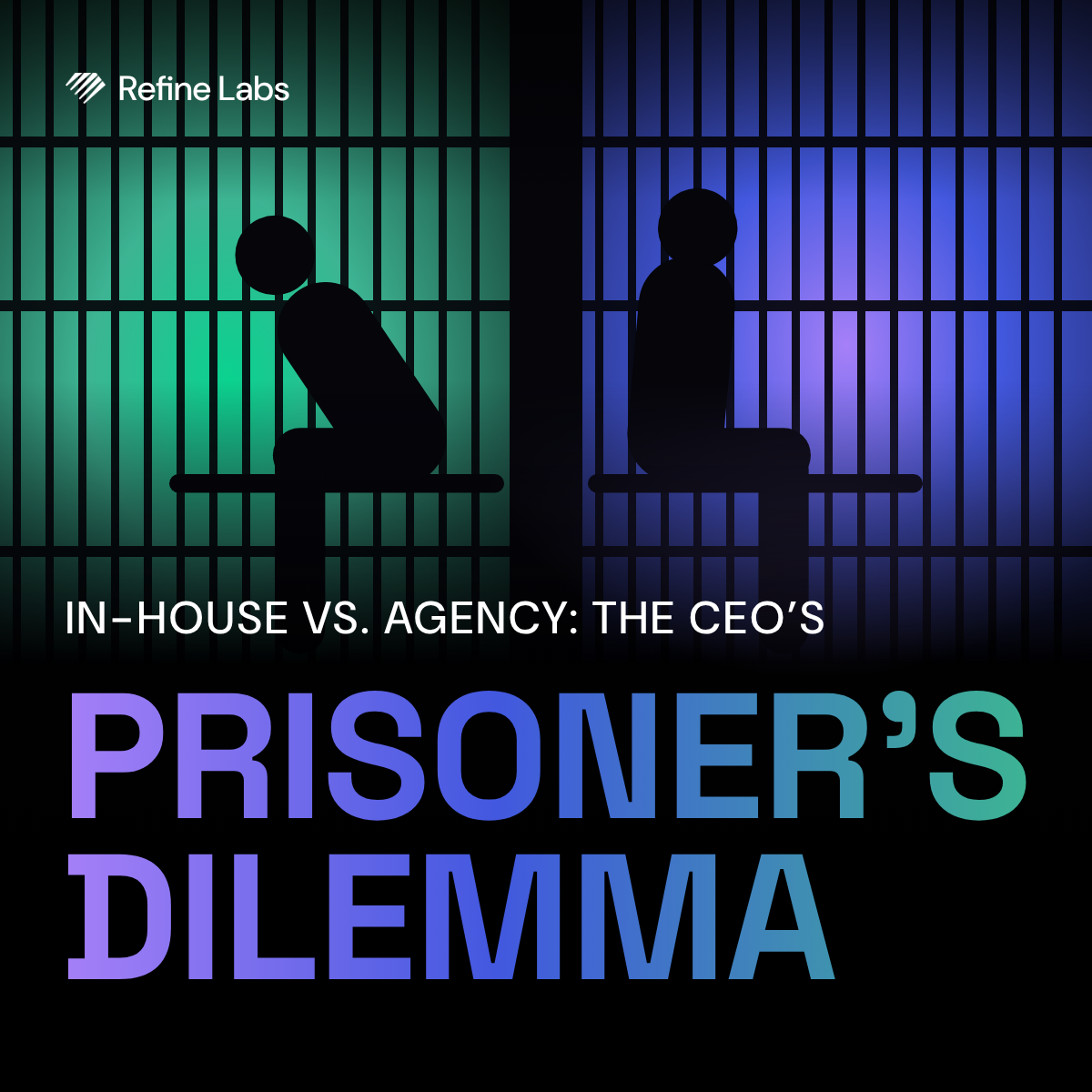
My background is in economics, and one idea from game theory has stayed with me through all of this: the Prisoner's Dilemma.
Two suspects are arrested and held in separate rooms. If both stay silent, each gets a light sentence. If one talks and the other doesn't, the one who talks walks free and the other takes the heavy sentence. If both talk, both get a middle sentence. Each prisoner, protecting himself, talks. Both end up worse off than if they had trusted each other.
What I like about the model is its lesson. Two players can want the same thing and still get a bad result. The outcome depends less on who is playing than on whether they trust each other enough to play for the long term.
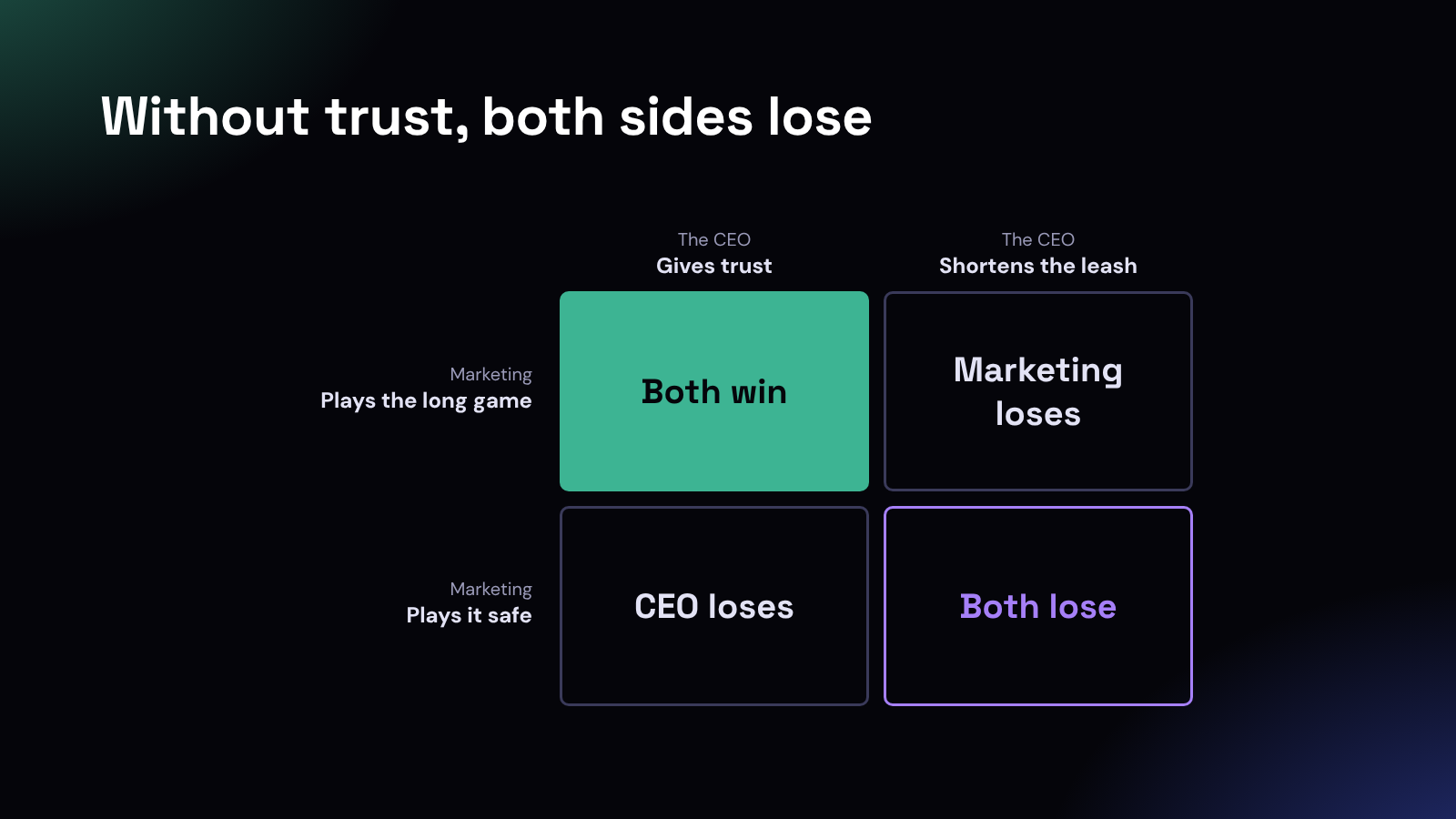
I see the same thing between CEOs and marketing, whether marketing sits inside the company or at an agency. The CEO isn't sure the money is well spent, so they shorten the leash: quick wins, limited access, scrutiny every quarter. The people doing the marketing, inside or out, read that and protect themselves by delivering what is easy to show rather than what builds the business. Both sides acted rationally, and both lose. Without trust from the CEO, neither model works.
When I ran marketing in-house, I expected outside partners to challenge my strategy. Even if a partner managed only one piece, say LinkedIn or Google Ads, I expected them to understand the strategy well enough to make sure what they offered fit into it.
Most of the time that didn't happen. They saw their channel in isolation. However much context I shared, they rarely seemed to absorb the business behind it, and what came back felt like a one-size-fits-all solution rather than the one I needed.
This matters because companies that outsource are rarely buying only hands. Sometimes they are. More often, they are trying to solve a bigger problem behind the one they describe. A partner who brings pattern recognition from other clients, and takes the time to understand the business, can see that bigger problem. One who only knows their channel can't.
The partners I would hire again tomorrow think in systems. They raise the level of my thinking, and they care about the overall result even when the right move doesn't make them any money. The ones I wouldn't hire again lean toward the upsell, whatever the business needs.
The in-house version of the problem looks different. Many CEOs expect their marketing leader to succeed without giving them a real hand in business strategy.
Marketing only works as part of a machine that includes sales, product and the company's internal processes. If marketing controls one part of that machine but is held responsible for what the whole machine produces, something will break, and it's usually the marketing leader who pays for it. It's no surprise that marketing leaders turn over faster than most executives: Spencer Stuart's 2025 study puts average CMO tenure at Fortune 500 companies at 4.3 years, below the C-suite average.
Part of this comes from a narrow idea of what marketing is. A CEO can be excellent at finance or product and still not have a deep feel for how a business grows. There's no shame in that, but it calls for humility. Without it, the CEO judges marketing by the wrong measures, and the person running it carries the blame for problems that live elsewhere.
Two months in, a few things stand out.
The first is access. A client working with a good agency gets a level of talent that is very hard to build internally: many people with very different experiences, plus data and pattern recognition gathered across other clients. That makes possible strategic conversations that would be very hard, if not impossible, with an in-house team alone.
The second is who you report to. Inside a company, the marketing team reports to someone, and that shapes what people are willing to say. At an agency, the relationship is closer to a partnership than a reporting line, and people explore and share ideas more freely.
There is a real downside, and it's worth naming. People a tan agency are not always on the same ship as the client. If the business struggles, the worst outcome for them is losing an account, not losing their job. That's why an agency's governance matters so much: how its leadership ties its people to client success, whether it develops and promotes its talent, and what it does with the people on your account. Everyone needs skin in the game, and a CEO choosing an agency should look at this as closely as at anything in the pitch.
Two more things I didn't fully appreciate before. Understanding a business well enough to find its edge takes exposure, and the client controls how much exposure the agency gets. The more a client onboards the people working on its account, the better the work becomes. And the person who hires the agency is often not the person who manages it day to day. When those two people have different ideas of what the agency is for, the brief drifts away from the company's real objectives, and long-term growth pays for it.
Sometimes the choice is simple.
If your marketing plan has identified work that needs a specialist, such as SEO, design or paid media management, and you aren't going to hold that partner accountable for overall business growth, only for running those channels well, hire an agency. There is nothing to debate.
If you're looking for a CMO who treats marketing as strategy and growth, someone who owns all four Ps (product, price, place and promotion),that should be an internal hire, with an agency helping where it adds something.
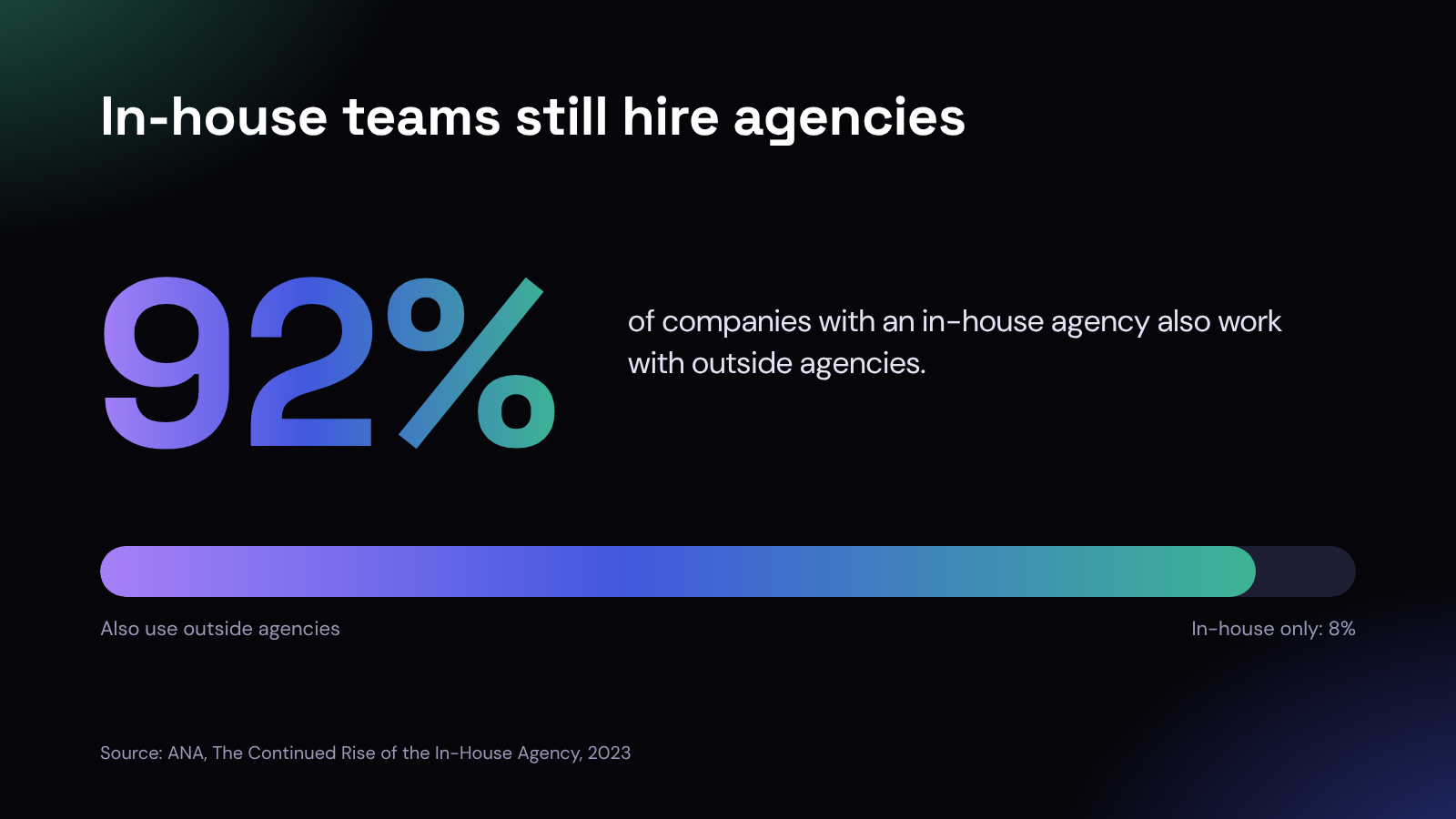
Most companies sit somewhere in between, which is also where most large marketers have landed: an ANA study found that 92% of companies with in-house agencies still work with outside agencies. That middle ground is where the decision needs real thought. When a founder asks me which way to go, I start with three questions:
1. What has driven your growth so far?
2. How well does your CEO understand marketing and business strategy?
3. Do you want a partner who operates, or one who sets strategy with you? And if you hire a leader, will they have real executive authority, or will they be a senior operator reporting to the CEO?
Then I map the capabilities the business needs against theones it already has, area by area, and use the gaps to weigh the trade-offs ofeach option. That tells you far more than comparing a retainer to a salary.
You don't need 90 days to know whether a partnership is on track. What you need is clear expectations, written into a well-designed agreement that spells out what happens month by month: the process for creative, demand generation and audits, the milestones, the performance routine, who on the agency team does what, what each person is expected to contribute and what each meeting should accomplish. Once that's agreed, your job is to make sure it's being executed.
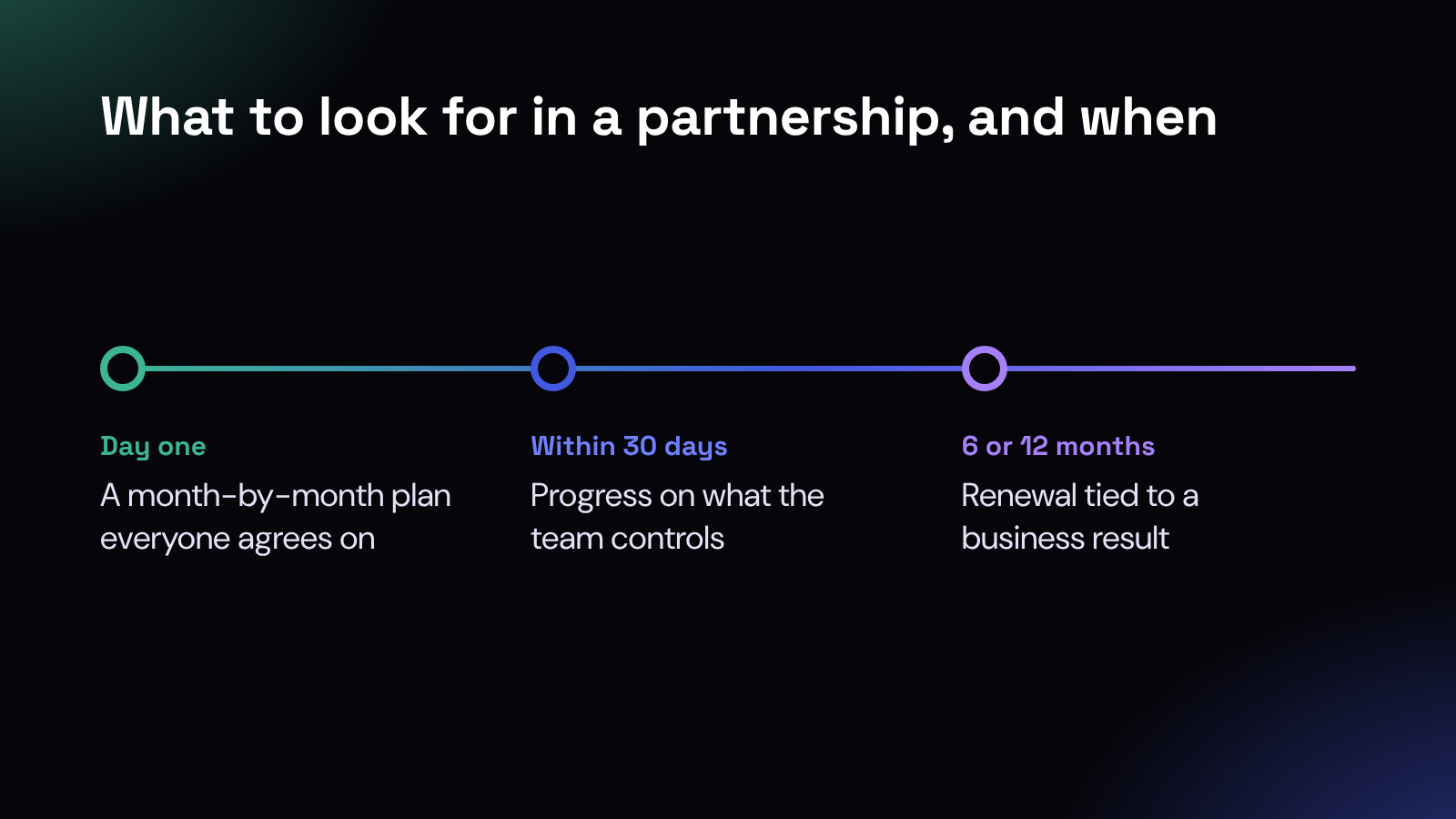
Set up properly, you will see progress within 30 days on the things the agency or marketing team controls. That isn't always business performance. B2B sales cycles are long, and most buyers aren't in the market a any given moment; research by John Dawes at the Ehrenberg-Bass Institute estimates that around 95% ofB2B buyers are out of the market in any given quarter. A marketer or an agency can do all the right things for a long time and the business may still not grow, for reasons outside their reach.
That's why the relationships that compound look the way they do. There is a high level of trust, and things are built together. Even when the agency is doing the building, both sides accept that Rome isn't built in a day. You go step by step, stay agile, give access, stay available, and accept that there is a lot you don't know yet and many hypotheses to test. Marketing is not an exact science. A client should measure an agency against what is actually achievable, not against an ideal that doesn't exist anywhere and will make anyone fail.
If I could add one clause to every agency agreement, it would tie renewal at six or twelve months to a real business result. Not every result is in the agency's control, as I said above. But a shared stake in the outcome pushes an agency to act as a strategic partner and to step beyond the scope it was paid to manage. It's the skin in the game I mentioned earlier, written into the contract.
Many founders will push back on this, but I believe you should be comfortable not measuring everything. The right metrics matter. Fundamentally, though, you have to trust the process and focus on people and processes more than on results. Results are a consequence.
Peter Drucker wrote that there is only one valid definition of business purpose: to create a customer. Marketing exists to help a business grow by doing that. It doesn't exist to prove that a number is working.
In the Prisoner's Dilemma, both prisoners lose becauseneither trusts the other enough to play the long game. Marketing works the same way. Choose the model that fills your gaps, then give it what it needs to play the long game: access, clear expectations, a shared stake in the outcome, and time.
Daniel Zaitz is a Demand Generation Manager at Refine Labs.Before moving to the agency side, he led marketing in-house at a B2B technologycompany.
Sources
• Spencer Stuart, CMO Tenure Study 2025
• ANA, The Continued Rise of theIn-House Agency: 2023 Edition
• John Dawes, Ehrenberg-Bass Institutefor the LinkedIn B2B Institute, "The 95:5 Rule"
• PeterDrucker, The Practice of Management (1954)
Keep reading