Why did we rebuild our B2B website just one year after relaunching it? Here’s what we learned about positioning, buyer behavior, content, and website strategy.

Evan Hughes
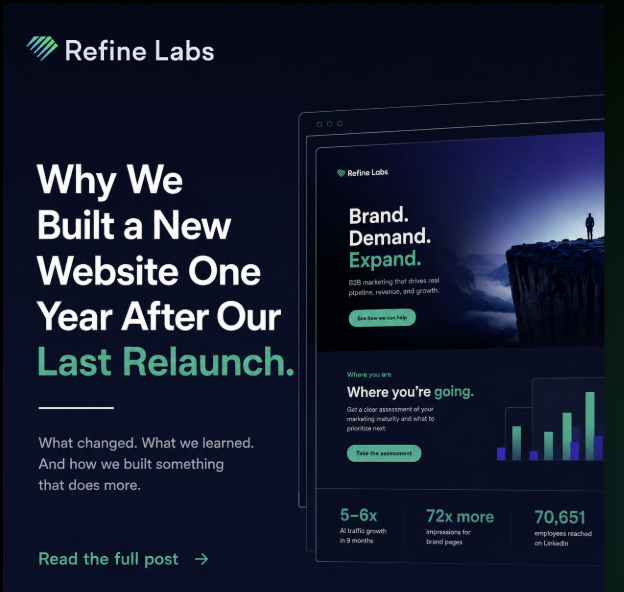
We relaunched the Refine Labs website last year. And then, roughly a year later, we decided to do it again.
I realize that’s probably not the strongest endorsement for our website planning process.
But the more we got into it, the more I started questioning why websites are treated like these three-to-five-year investments in the first place.
Nobody would say, “We set our marketing strategy two years ago, so we’re not allowed to change it yet.” We change campaigns constantly. We adjust budgets. We change positioning. We launch new services. We enter new markets. Our buyers change. The channels they use change. The way they research companies changes.
Yet somehow the website gets a pass because we spent a bunch of money building it.
That was really the reason we decided to go again.
The website we launched a year earlier wasn’t bad. The business had just moved.
I think this is where website conversations tend to go wrong.
We usually wait for something obvious to trigger a redesign. The brand looks dated. The CMS sucks. Conversion rates are bad. The navigation has become a mess. Someone on the executive team hates the homepage.
Those are all legitimate reasons to rebuild.
But I think there’s another one that matters more: the website no longer represents how the company thinks, sells, or creates value.
That was increasingly true for us.
Over the previous year, our thinking around Brand, Demand and Expand became much more developed. We were building new IP and tools. Our services were evolving. We had a clearer understanding of the companies we could help most. We were also getting much clearer about the role we wanted our own marketing to play.
The website wasn’t necessarily saying anything wrong. It just wasn’t saying enough of what had become important.
There’s a difference.
And I suspect a lot of B2B companies are sitting in that exact spot. Their website is technically fine. It loads. It looks modern. The messaging passed several rounds of executive review.
But it represents the company from 18 months ago.
That matters because your website is often where all the changes happening inside the business eventually collide. Your positioning, ICP, product, services, brand, content, sales motion and customer proof all have to make sense together there.
If those things have materially changed but the website hasn’t, eventually you’re asking marketing and sales to work around it.
There was obviously a part of me that thought: we just did this.
That’s probably the hardest part of rebuilding anything relatively new.
You remember the hours. You remember the budget. You remember everyone debating the homepage copy. You remember finally getting it across the finish line.
Starting again can feel like admitting the first investment was a mistake.
I don’t think it is.
The first website was built using the information we had at the time. Then we got another year of information.
We had another year of sales conversations. Another year of customer conversations. Another year of website behavior. Another year of watching what people cared about and what they didn’t. Another year of seeing where the market was going.
That information has value too.
The mistake would have been ignoring it because the previous website hadn't reached some arbitrary age where rebuilding it became financially or politically acceptable.
This is something I think marketing teams could generally get better at. We protect past investments instead of evaluating future usefulness.
“We just launched it” is not really an argument for keeping something.
Ask a harder question:
If we were building this today, knowing everything we know now, would we build the same thing?
If the answer is no, figure out how far away you are.
You might not need a new website. You might need a new homepage, different navigation, a clearer product story, better proof or a completely different conversion experience.
But the age of the website shouldn't make that decision for you.
The redesign also forced us to answer a question I think more marketing teams should spend time on:
What is the website actually for?
The obvious B2B answer has historically been pipeline.
Get traffic to the website. Turn traffic into leads. Turn leads into pipeline.
That thinking shaped an entire generation of B2B websites.
Read a blog? Download the full guide.
Want the benchmark data? Fill out this form.
Interested in learning more? Book a demo.
Not ready? Here's another button to book a demo.
We’ve optimized websites around extracting the next action from the visitor instead of asking whether the visitor got anything useful from us.
I think that trade has gotten worse.
Buyers have more information available to them than ever. AI has made producing generic educational content essentially free. Search behavior is changing. Buyers can research companies through LinkedIn, communities, podcasts, YouTube, Reddit, AI tools and dozens of other places before they ever land on your homepage.
So when someone does choose to spend time on your website, “here’s our company and here’s our demo form” feels like a pretty weak experience.
We wanted ours to do more.
Someone should be able to come to Refine Labs, learn something useful and leave without becoming a lead.
That became an important principle behind the new site.
We started creating more ways for someone to engage with our thinking, methodology and tools without immediately talking to sales. Our marketing assessment is one example. Instead of publishing another article telling marketers they should “align brand and demand,” we can help someone evaluate where their organization is today and identify areas they might need to work on.
Maybe that eventually creates pipeline. Maybe it doesn't.
If someone spends 15 minutes with something we built, gets an idea, takes it back to their team and improves their marketing, that interaction still did something for our brand.
I think B2B marketing has lost sight of that a little bit.
This became another consideration during the rebuild.
There is about to be an unbelievable amount of average content on the internet.
We're probably already there.
The cost of creating a decent-looking article, landing page, ebook or comparison page has collapsed. A marketing team can produce more content in a week than it could have produced in a quarter a few years ago.
That creates an interesting problem.
If everybody can publish more, publishing more stops being much of an advantage.
The advantage shifts toward having something worth consuming.
Original research. Actual customer insights. Useful tools. Strong opinions. Data another marketer can benchmark against. Frameworks developed from doing the work. Examples that show what happened instead of explaining what theoretically should happen.
That's a much higher bar than “we have a resource center.”
And it changed how we thought about our website.
We didn't want to rebuild it simply to have a nicer container for more content. We wanted to make the things inside the container more useful.
That distinction is going to matter a lot over the next few years.
You probably don't need to rebuild your website one year after launching it.
That's not the lesson here.
But I do think marketing teams should stop using time since the last redesign as the primary signal for when something needs to change.
Instead, I’d look at four areas.
1. Business change
List the meaningful changes to the company since the website was built. New products, new services, different ICP, new positioning, acquisitions, different pricing, a move upmarket or a change in the sales motion.
Then ask how many of those changes are accurately reflected on the website.
If you have to explain the gap with “well, sales knows how to position it,” you probably found something worth fixing.
2. Buyer change
Look at how your buyers research and evaluate companies today versus when you built the site.
Where are they coming from? What do they already know before arriving? What questions are showing up repeatedly in sales conversations? What information do prospects ask sales for that should probably already exist on the website?
Your website shouldn't be designed around the buyer journey you had three years ago.
3. Value change
Open your website and pretend you have absolutely no intention of buying from your company today.
What can you get?
Not what can you download in exchange for an email address.
What can you actually use?
If the answer is mostly blog posts, company information and sales CTAs, there may be a much bigger opportunity than another homepage redesign.
Build something worth coming back for.
4. Evidence
Finally, stop arguing about the website entirely from opinions.
Look at what people are doing.
What are your highest-traffic pages? Where do people spend time? What gets shared? What does sales use? Which pages assist opportunities? What content brings people back? Where are people dropping off? Which pages get almost no engagement despite being strategically important?
Then combine the quantitative behavior with qualitative information from customers, prospects and sales.
That's usually where the useful answers are.
I don't know when we'll rebuild the Refine Labs website again.
Hopefully not next year.
But I'm also not particularly interested in setting a rule that says we won't.
The new website represents what we believe today based on everything we've learned up to this point.
We'll keep learning.
Some things will work. Some won't. We'll probably build things nobody uses. We'll probably discover that something we thought would be small becomes incredibly valuable. Our services will evolve. The market will move again.
The website should be allowed to move with it.
So if you launched a website six months ago and already know something is wrong, change it.
If you launched three years ago and it still accurately represents the business and helps your buyers, don't redesign it just because someone thinks it's time for a refresh.
The calendar isn't the KPI.
The better question is whether your website still represents the company you're trying to become and whether it's genuinely useful to the people you're trying to reach.
If it doesn't, you don't need permission from the launch date to start fixing it.
Keep reading