Organic social plays a different role at every stage of the funnel. Here's how to match format, voice, and production style to Brand, Demand, and Expand.
Stephanie Crugnola
We’ve been talking about Brand, Demand, and Expand as the three key pillars of modern B2B marketing for a while now, but we talk a lot about budget allocation and haven’t spent much time on how to leverage your organic resources into the overall strategy. Unfortunately, a lot of times, the organic socials team is bounced around from bucket to bucket with no clear direction or roadmap on how they’re supporting the initiative.
Instead of treating Organic as an afterthought, it should be woven meaningfully into all three pillars, with a slightly different role in each.
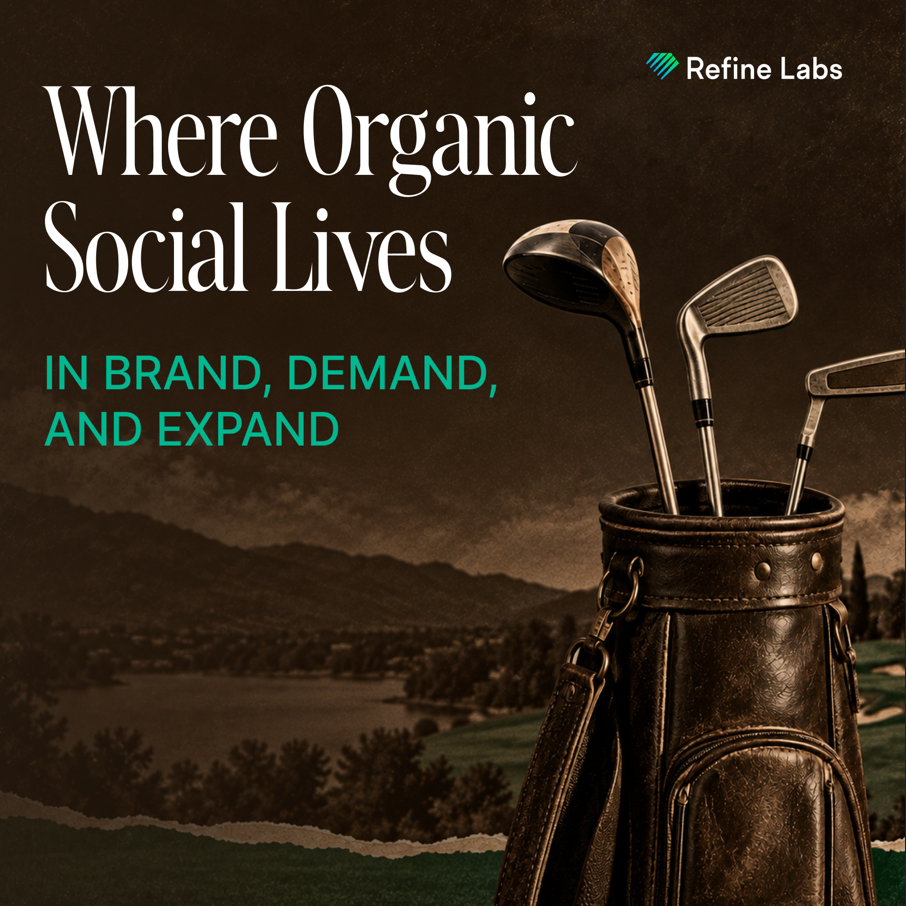
Think of it like a round of golf: Brand is the drive off the tee, the long game, the swing that sets everything off downstream. Demand is a shot from the fairway, calculated and direct. Expand is the putt, the time when you capitalize off the work you’ve done on the course so far. All three are important but need different tools to succeed. Organic Social is the club you choose at each step.

Brand can be difficult to conceptualize because it’s the stage where you’re not selling anything specific. You’re making buyers trust you before they even visit your website. That means you have to show up in places where people learn to trust recommendations, long before your CRM could catch them. Organic social is where that happens in real time, and the choices you make here will decide whether anyone remembers or trusts you in the long run.
Take long form versus short form content: a three minute short earns attention and interest. A 45 minute webinar earns belief and appreciation. Brand needs both, but a lot of teams aren’t willing to admit that long form still has a place in the strategy. The 95% of your market that isn’t buying yet still needs a reason to know you really understand what you’re talking about, not just that you’ve got clever quick packages.
Then, there’s founder-led thought leadership versus employee posting and advocacy. Founder-led content builds conviction fast. It’s a bet on one voice carrying the whole brand. Employee advocacy is slower, messier, and compounds in a way founder content can’t, because it turns your company page into a hundred company pages. Brand needs the founder to set the tone and the employees to prove it’s real.

Demand is where paid media and creative earn their keep, and where the mediums you choose start changing the math significantly. Video content versus audio versus written isn’t just a style preference, it’s a purposeful decision in distribution.
Video stops the scroll and travels the farthest, but it costs the most to make well. Audio builds trust at a pace nothing else can, because someone let your voice into their ears for 45 minutes and that commitment is big. Written content is the cheapest to produce, and the easiest to repurpose into the other two formats. Demand needs all three feeding into each other, not just one format carrying the quarter.
Production style matters just as much as medium. Polished, produced content signals budget. Raw, unscripted content signals honesty. Demand-stage buyers are already in an evaluation mindset, so they want to see real tactical answers to questions without having to strain their ears or eyes to hear or see it. Your presentation will reflect what you can provide them.
The decision to make educational versus entertaining content lives here as well. Educational content earns the save. Entertaining content earns the share. Demand needs both because saves turn into pipeline, and shares will get you back on top of the funnel for more.

Expand is about the customers you already have, and the accounts that went quiet for what seemed like no good reason. You’re playing a small, known field with people you already have a relationship with, and the wins come from precision, not volume. Organic social’s job here is subtle: stay visible enough that a stalled deal or happy customer sees you before a competitor does.
The decision to host in-person events versus webinars lives in the expand pillar. A live event in person creates content and relationships that outlast the room. A webinar creates content that scales. Expand runs on both, because re-engaging a quiet account often just takes one meaningful touchpoint at the right time.
None of these organic content decisions are either/or. They’re a set of levers, and which one you pull depends entirely on which stage you’re trying to turn. Brand, Demand, Expand, isn’t a set of three different sports, they’re one single strategy wearing three different position numbers.
Keep reading