Employee Profiles Outperform Brand Pages on LinkedIn
A normalized performance analysis across 10 months
For years, marketers have debated the role of employee advocacy on LinkedIn.
Some see it as a nice-to-have culture initiative. Others believe it’s a core distribution strategy. Most companies fall somewhere in between. They encourage leaders to post, they share company content occasionally, but they don’t measure it with the same rigor they apply to paid media or pipeline performance.
We wanted to know what was actually happening.
Not what felt true.
Not what we believed.
What the numbers showed.
So we analyzed LinkedIn performance across three employee profiles and the Refine Labs brand page from Q4 2024 through Q3 2025. Instead of stopping at raw impressions, we normalized all results per 1,000 followers to control for audience size.
That normalization step changed the conversation.
Establishing the baseline
Before comparing performance, we looked at audience size. This matters more than most people admit. If one profile has dramatically more followers, performance comparisons become meaningless.
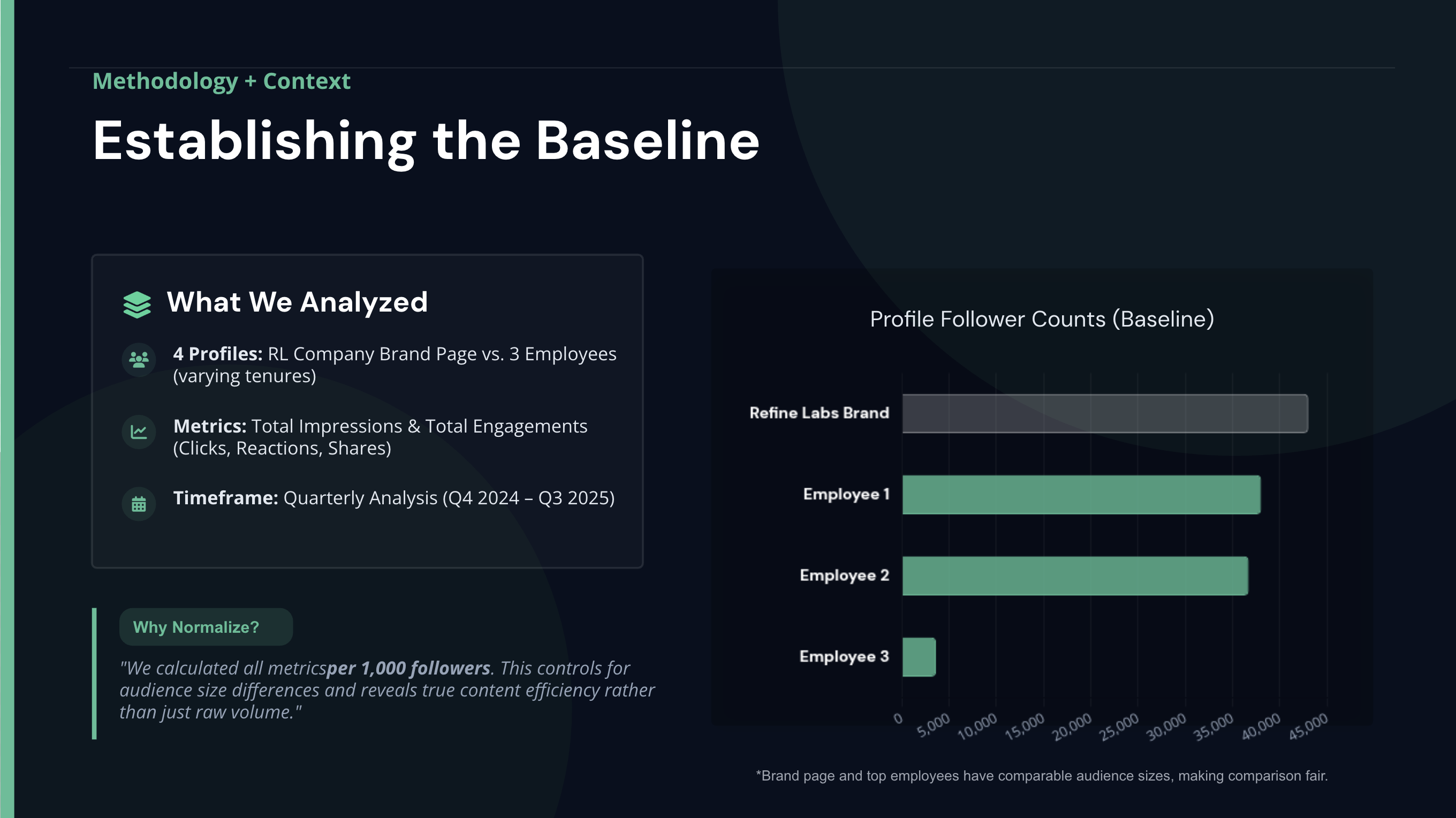
The Refine Labs brand page has approximately 43,000 followers. Two of the employee profiles analyzed sit just below that range, and one is significantly smaller. This is not a comparison between a niche account and a massive brand page. The audiences are comparable enough to make the analysis legitimate. Once that baseline was established, we moved to performance.
Why raw impressions are misleading
Most teams look at total impressions and stop there. On the surface, employee profiles often generate strong total reach.
But raw totals alone don’t answer the important question: How efficiently is each profile generating distribution relative to its audience size? Someone with 40,000 followers should produce more impressions than someone with 5,000. That’s not insight. That’s simply scale. To make this meaningful, we calculated impressions per 1,000 followers:
Total impressions ÷ follower count × 1,000.
Now we’re measuring distribution efficiency, not size.
Impressions per 1,000 followers
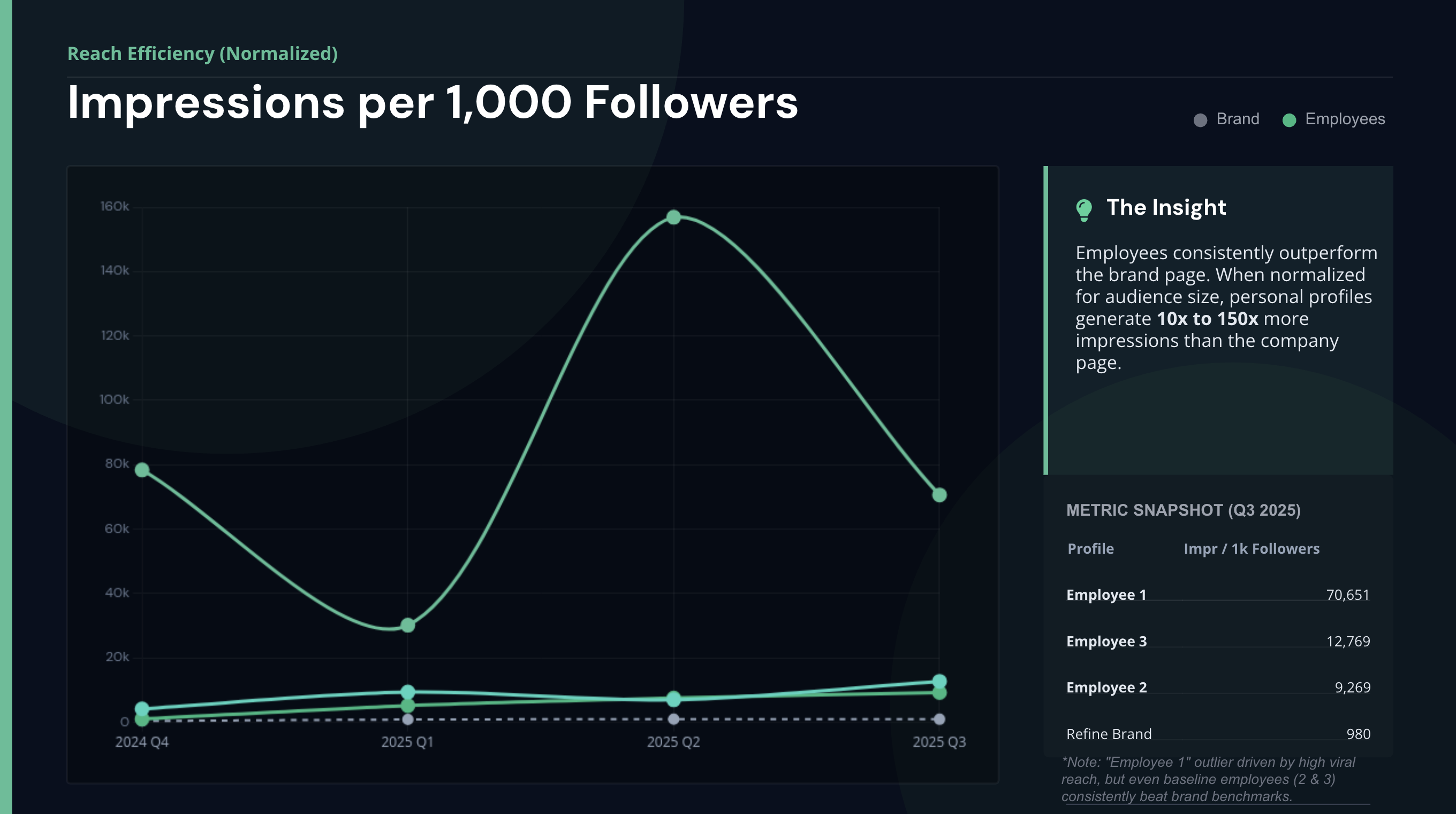
In Q3 2025:
- Employee 1 generated 70,651 impressions per 1,000 followers
- Employee 2 generated 9,269
- Employee 3 generated 12,769
- The Refine Labs brand page generated 980
Even removing the highest-performing employee from the comparison, personal profiles consistently outperformed the brand page by a wide margin. This wasn’t an isolated quarter. The relative gap appeared across multiple periods. That suggests something structural. LinkedIn distributes content from people more efficiently than content from company pages, even when audience size is similar.
But impressions aren’t the real story
Impressions show distribution. Engagement shows intent.
We applied the same normalization logic to engagements per 1,000 followers:
Total engagements ÷ follower count × 1,000.
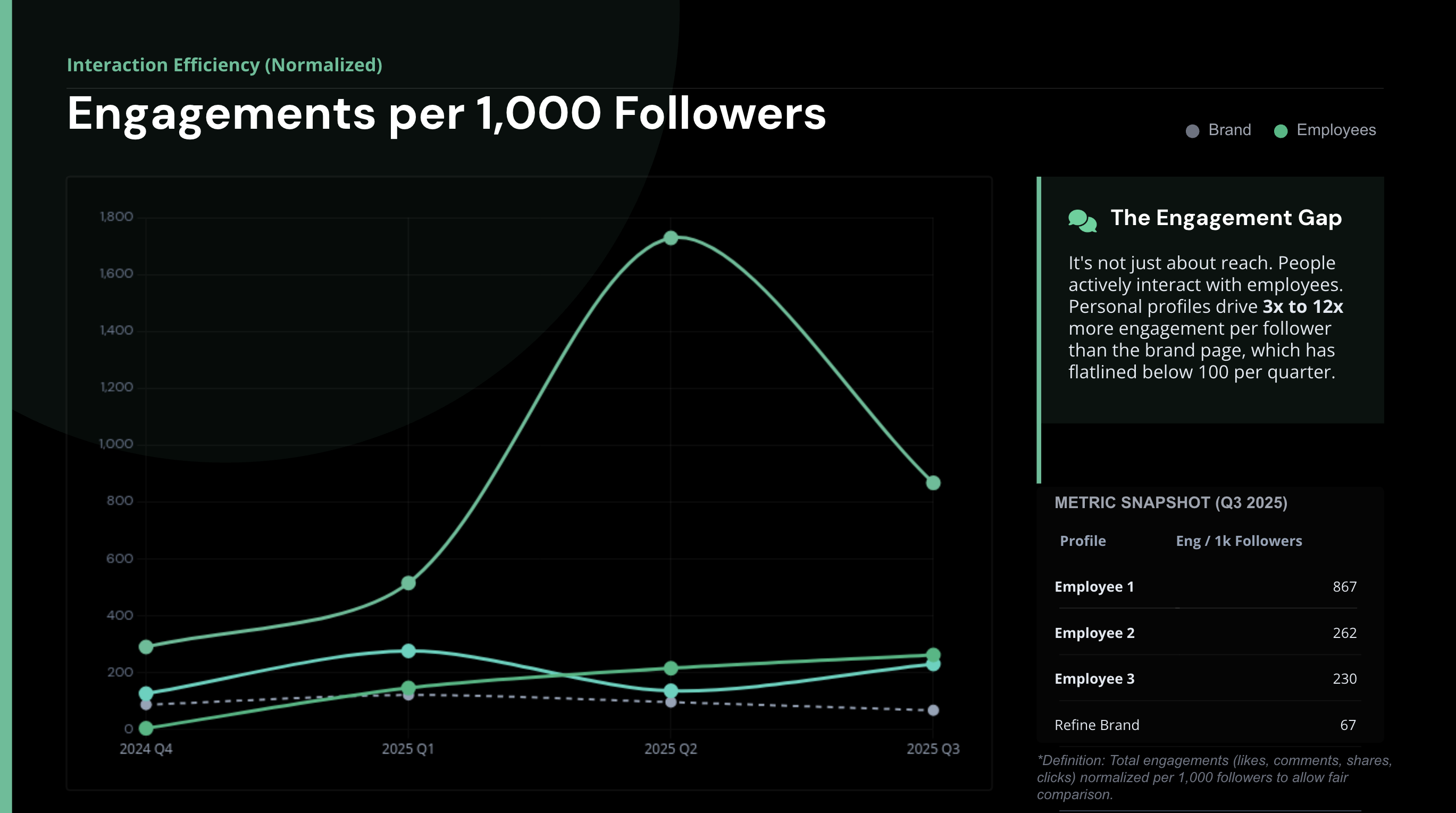
In Q3 2025:
- Employee 1: 867 engagements per 1,000 followers
- Employee 2: 262
- Employee 3: 230
- Brand page: 67
The engagement gap was even more pronounced than the impression gap. This is significant. It suggests that audiences are not only seeing employee content more frequently. They are choosing to interact with it more frequently. Engagement is a proxy for trust. And trust compounds distribution.
“Maybe that was just one spike.”
One viral post can distort quarterly data. So we analyzed performance monthly across 10 consecutive months.

Yes, there are spikes. LinkedIn performance is inherently volatile. But the relative advantage of employee profiles over the brand page persists across months. The gap narrows and widens depending on content and cadence, but the hierarchy remains consistent. This is not a one-time anomaly.
Platform mechanics, not just content strategy
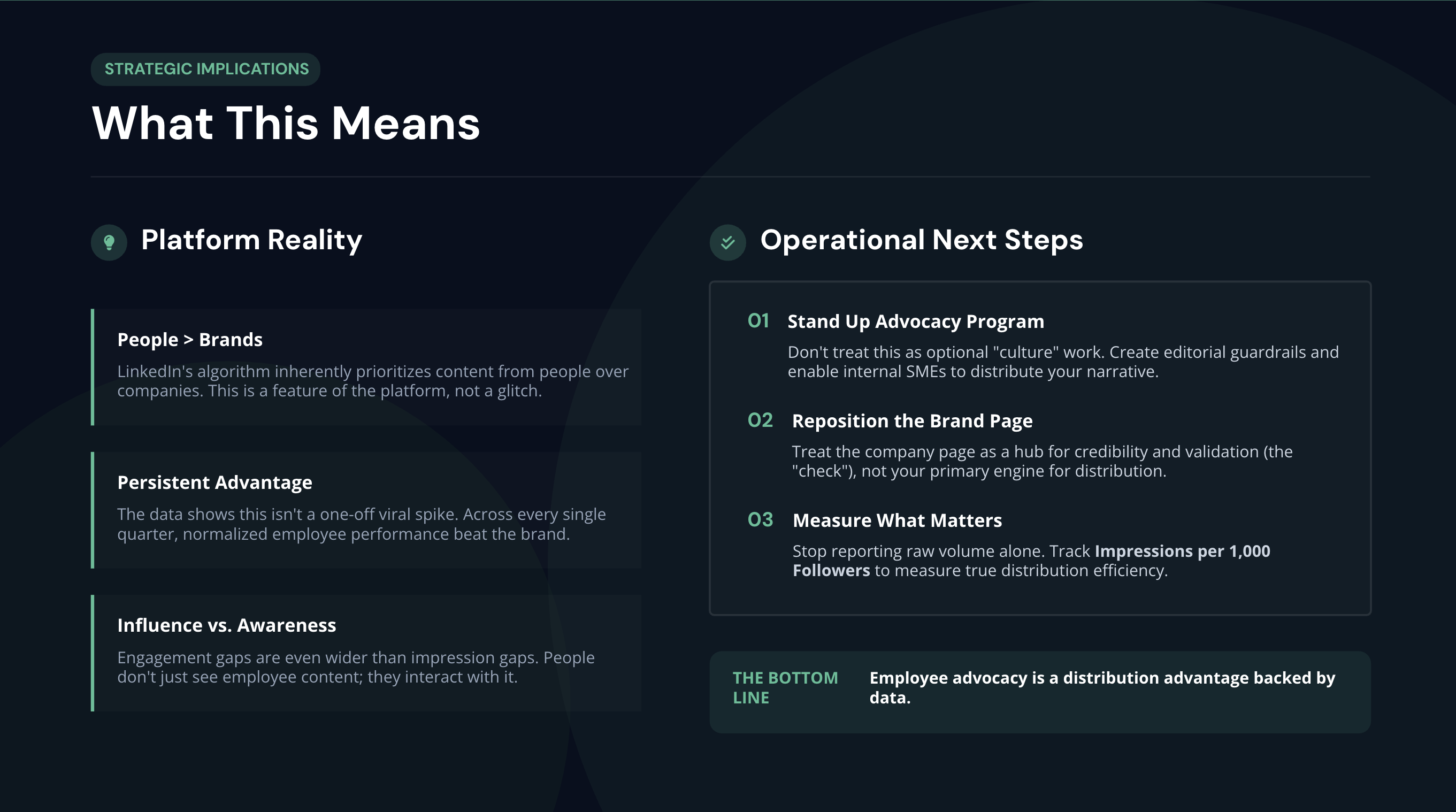
LinkedIn is architected for person-to-person interaction. That design decision influences distribution.
Company pages still play an important role:
- Employer brand
- Paid distribution
- Social proof
But organic feed dynamics favor individuals. When impressions and engagement are normalized per 1,000 followers, that platform bias becomes measurable.
Operational implications
Many companies interpret employee advocacy as a soft initiative. Encourage leaders to post. Share company updates. Hope it works. That approach underestimates the opportunity.
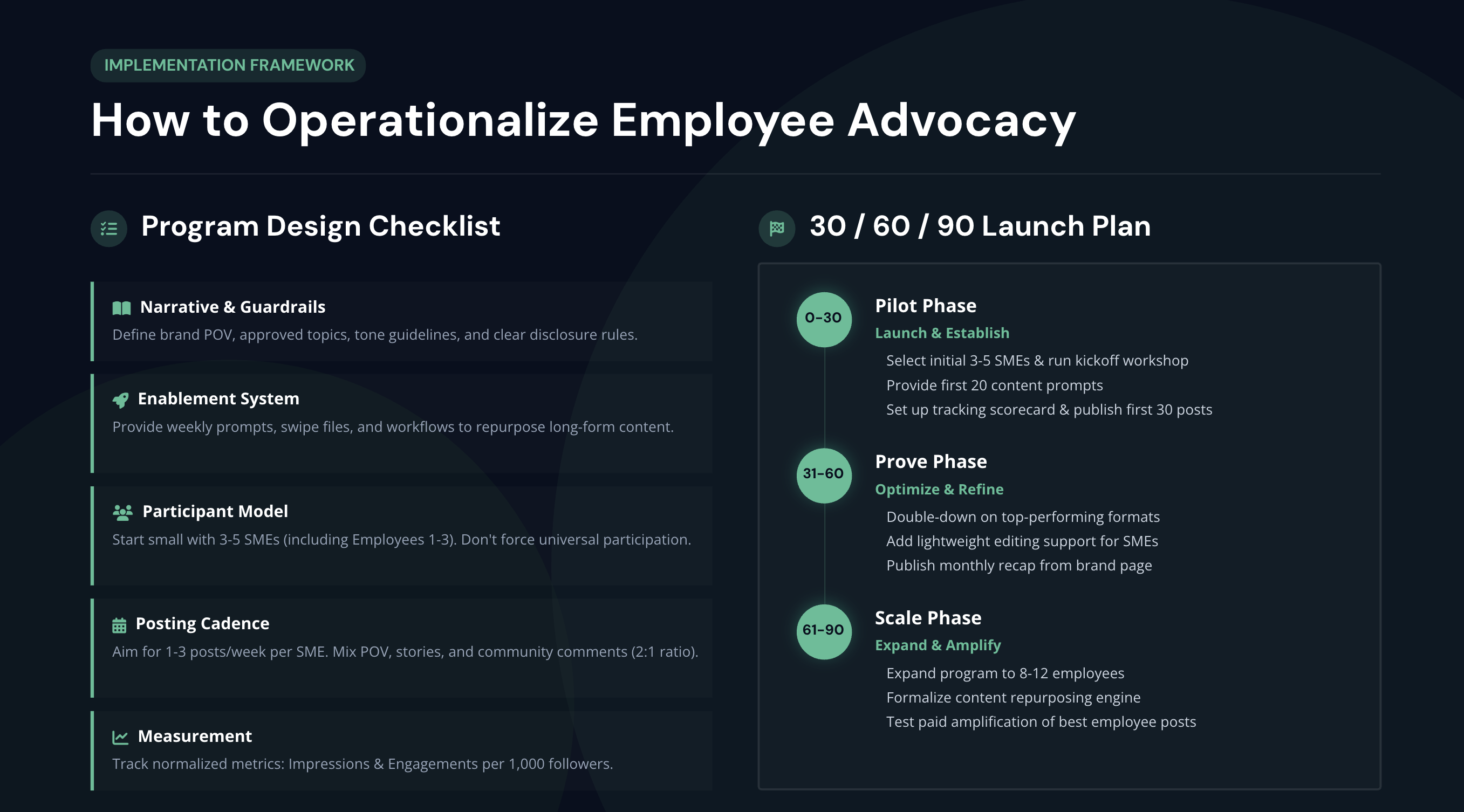
If employee profiles are structurally more efficient at generating reach and engagement, then advocacy must be treated as a distribution system.
That requires:
- Clear narrative guardrails
- Enablement for key voices
- Defined success metrics
- A phased rollout plan
And no. This is not about forcing every employee to post daily. It’s about identifying leverage points and measuring them properly.
What compounds over time
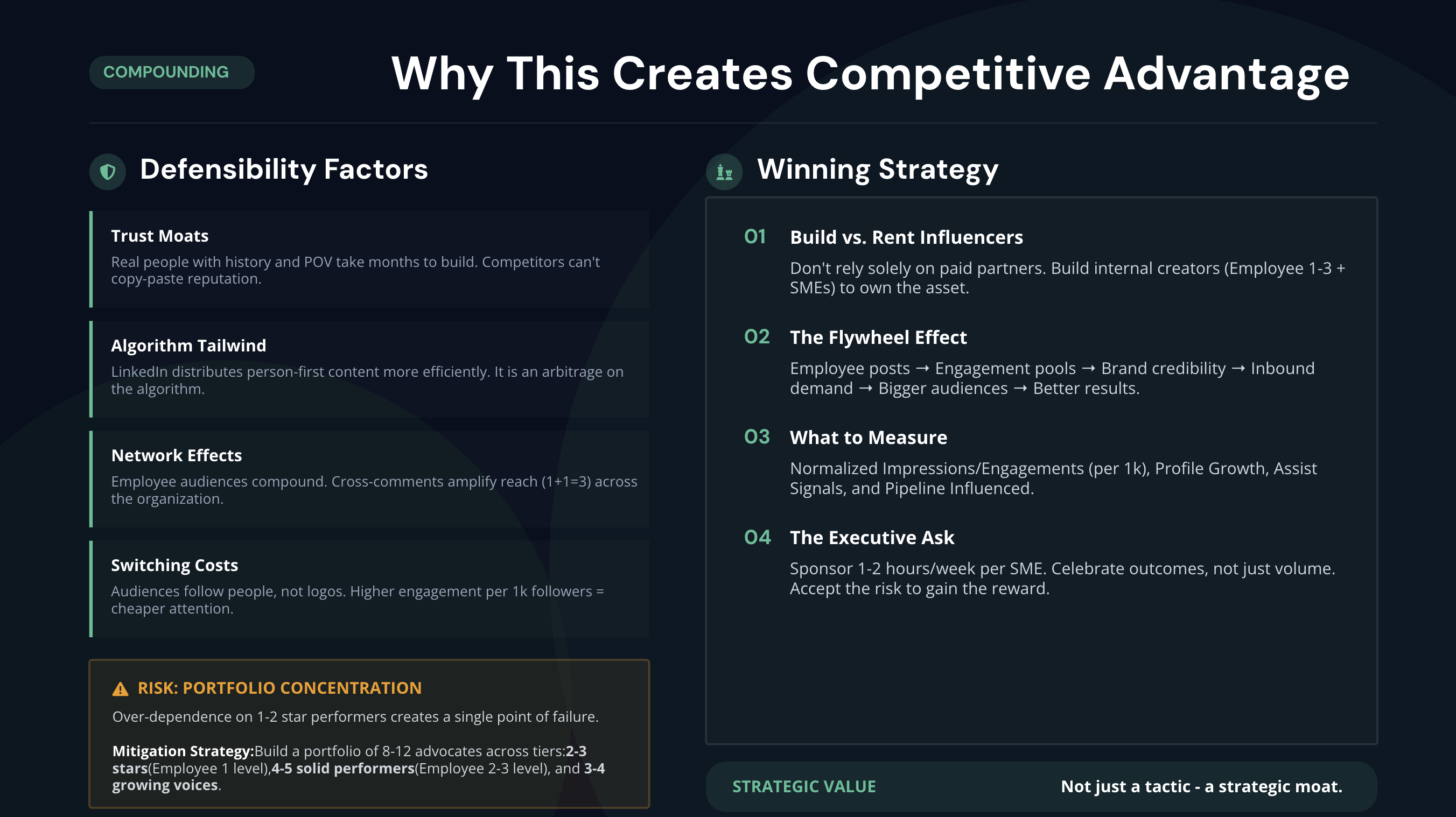
The long-term implication is not just increased impressions. It’s defensibility. An employee’s audience, voice, and engagement history compound over time. Competitors cannot easily replicate that asset. Brand pages can be built quickly. Trust in a human voice cannot. So when employee advocacy is supported intentionally, it becomes a durable distribution advantage.
Why we’re revisiting this now
A few years ago we published the original study showing that personal LinkedIn profiles outperformed the company page by a wide margin (Personal LinkedIn Profiles Outperform Company Pages with 5x More Engagement.) At the time, the headline number got attention. Five times more engagement is hard to ignore. But the pushback was predictable. Some people said the follower counts weren’t equal. Others assumed that if we normalized the data, the advantage would shrink. A few believed the algorithm would eventually level the playing field and favor brand pages more over time.
So we went back and ran it again. This time we normalized everything. Impressions per 1,000 followers. Engagement per 1,000 followers. Quarter by quarter. Month by month. The gap didn’t close. In several periods, it actually expanded. That matters because it removes the easy excuse. It is not just about scale. It is not just about raw follower count. It is about how the platform distributes content and how people choose to engage. LinkedIn consistently rewards people over logos.
That does not mean company pages are irrelevant. They serve a role. They anchor your brand presence. They house your content. They create credibility when someone checks you out. They support paid amplification. But they are not your primary growth engine.
People are.
When employees consistently publish thoughtful content, something different happens. Conversations start. Comments turn into direct messages. DMs turn into calls. And those calls rarely begin with, “I saw your company page.” They begin with, “I’ve been following your posts.” This is where the conversation becomes bigger than LinkedIn.
From a Brand → Demand → Expand perspective, employee advocacy is not a side tactic. It strengthens Brand because it builds familiarity and trust before someone is ready to buy. That stronger Brand makes Demand more efficient because prospects already recognize you. And when recognition is higher at the start of the sales cycle, Expand becomes easier because the relationship begins with context instead of skepticism.
If your LinkedIn strategy is concentrated almost entirely on your company page, you are likely underutilizing your real distribution advantage. Employee advocacy is not a branding exercise.
----------------------
Refine Labs is the leading B2B demand generation agency that has helped over 300+ B2B companies accelerate revenue growth and improve marketing ROI with innovative marketing strategies.
Learn more at www.refinelabs.com. Connect with us on LinkedIn and YouTube.
Listen to our Podcast with weekly episodes Stacking Growth.