All Rights Reserved © 2026 Refine Labs
Privacy Policy


Resources
Frameworks, breakdowns, and research for B2B tech marketing teams who want to understand the why — not just copy the playbook.
Featured
Refine Labs names Evan Hughes Chief Operating Officer, effective Oct. 1, 2026, as the agency expands its brand, demand, and expand services.
September 30, 2026
Read the post →News

Evan Hughes Named Chief Operating Officer of Refine Labs
Refine Labs names Evan Hughes Chief Operating Officer, effective Oct. 1, 2026, as the agency expands its brand, demand, and expand services.
September 23, 2026
Refine Labs is proud to announce that Evan Hughes has been appointed Chief Operating Officer, effective October 1, 2026. In this role, Evan will own day-to-day execution across the agency, allowing CEO Megan Bowen to focus on growth strategy and M&A as Refine Labs builds toward its next phase.
Evan joined Refine Labs in 2021 as Director of Demand Generation, quickly earning promotions to Senior Director and then VP of Demand as he helped scale the agency's core delivery engine. He later took on an even bigger challenge: stepping in as VP of Marketing to lead Refine Labs' own marketing function through a critical transition of moving the agency off founder-led marketing and building a full, repeatable marketing engine that no longer depended on any single person to run.
As Refine Labs has scaled, Evan has increasingly leaned into broader parts of the business beyond marketing, developing the operational range that made him the natural choice for this next step. Now, one year after Refine Labs' ownership transition, the agency is entering an exciting growth phase and appointing a COO is a key part of building the leadership infrastructure to support it.
"Evan has consistently shown that he can take on ambiguity and build something durable, first with our customers in his client-facing roles, then with our own marketing function," said Megan Bowen, CEO of Refine Labs. "As we expand our service capabilities and build a true agency platform spanning brand, demand, and expand, I need a partner who can own execution so I can focus on where we're going next. Evan is that partner."
“Refine Labs has given me the chance to grow across nearly every part of this business, and I don’t take that lightly,” said Evan Hughes, incoming COO. “We have a huge opportunity in front of us. We know where we want to go, and I genuinely believe we can build one of the best agencies in the business. My focus is making sure we execute against that vision and build the company that can get us there. I’m excited to get to work.”
Evan's appointment reflects Refine Labs' continued investment in the leadership bench needed to support its growth strategy, as the agency works to expand beyond demand generation into a full platform of brand, demand, and expand services for its clients.
Blog

Where Organic Social Lives in Brand, Demand, and Expand
Organic social plays a different role at every stage of the funnel. Here's how to match format, voice, and production style to Brand, Demand, and Expand.
September 23, 2026
We’ve been talking about Brand, Demand, and Expand as the three key pillars of modern B2B marketing for a while now, but we talk a lot about budget allocation and haven’t spent much time on how to leverage your organic resources into the overall strategy. Unfortunately, a lot of times, the organic socials team is bounced around from bucket to bucket with no clear direction or roadmap on how they’re supporting the initiative.
Instead of treating Organic as an afterthought, it should be woven meaningfully into all three pillars, with a slightly different role in each.
Think of it like a round of golf: Brand is the drive off the tee, the long game, the swing that sets everything off downstream. Demand is a shot from the fairway, calculated and direct. Expand is the putt, the time when you capitalize off the work you’ve done on the course so far. All three are important but need different tools to succeed. Organic Social is the club you choose at each step.

Brand can be difficult to conceptualize because it’s the stage where you’re not selling anything specific. You’re making buyers trust you before they even visit your website. That means you have to show up in places where people learn to trust recommendations, long before your CRM could catch them. Organic social is where that happens in real time, and the choices you make here will decide whether anyone remembers or trusts you in the long run.
Take long form versus short form content: a three minute short earns attention and interest. A 45 minute webinar earns belief and appreciation. Brand needs both, but a lot of teams aren’t willing to admit that long form still has a place in the strategy. The 95% of your market that isn’t buying yet still needs a reason to know you really understand what you’re talking about, not just that you’ve got clever quick packages.
Then, there’s founder-led thought leadership versus employee posting and advocacy. Founder-led content builds conviction fast. It’s a bet on one voice carrying the whole brand. Employee advocacy is slower, messier, and compounds in a way founder content can’t, because it turns your company page into a hundred company pages. Brand needs the founder to set the tone and the employees to prove it’s real.

Demand is where paid media and creative earn their keep, and where the mediums you choose start changing the math significantly. Video content versus audio versus written isn’t just a style preference, it’s a purposeful decision in distribution.
Video stops the scroll and travels the farthest, but it costs the most to make well. Audio builds trust at a pace nothing else can, because someone let your voice into their ears for 45 minutes and that commitment is big. Written content is the cheapest to produce, and the easiest to repurpose into the other two formats. Demand needs all three feeding into each other, not just one format carrying the quarter.
Production style matters just as much as medium. Polished, produced content signals budget. Raw, unscripted content signals honesty. Demand-stage buyers are already in an evaluation mindset, so they want to see real tactical answers to questions without having to strain their ears or eyes to hear or see it. Your presentation will reflect what you can provide them.
The decision to make educational versus entertaining content lives here as well. Educational content earns the save. Entertaining content earns the share. Demand needs both because saves turn into pipeline, and shares will get you back on top of the funnel for more.

Expand is about the customers you already have, and the accounts that went quiet for what seemed like no good reason. You’re playing a small, known field with people you already have a relationship with, and the wins come from precision, not volume. Organic social’s job here is subtle: stay visible enough that a stalled deal or happy customer sees you before a competitor does.
The decision to host in-person events versus webinars lives in the expand pillar. A live event in person creates content and relationships that outlast the room. A webinar creates content that scales. Expand runs on both, because re-engaging a quiet account often just takes one meaningful touchpoint at the right time.
None of these organic content decisions are either/or. They’re a set of levers, and which one you pull depends entirely on which stage you’re trying to turn. Brand, Demand, Expand, isn’t a set of three different sports, they’re one single strategy wearing three different position numbers.
Blog
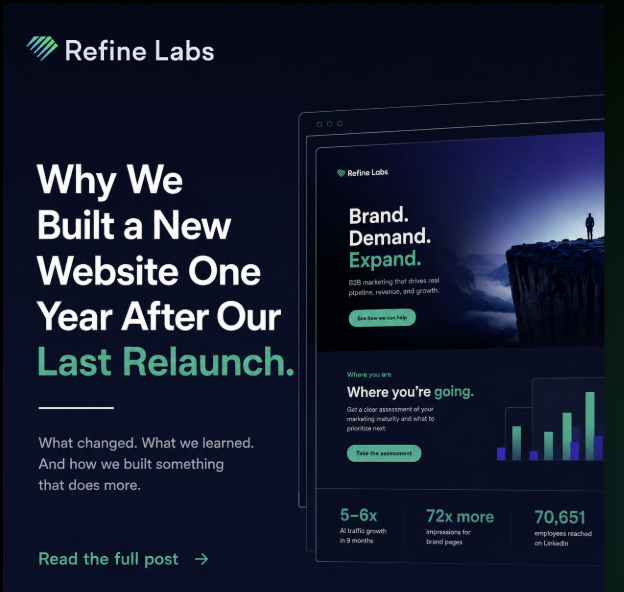
Why We Built a New Website One Year After Our Last Relaunch
Why did we rebuild our B2B website just one year after relaunching it? Here’s what we learned about positioning, buyer behavior, content, and website strategy.
September 2, 2026
We relaunched the Refine Labs website last year. And then, roughly a year later, we decided to do it again.
I realize that’s probably not the strongest endorsement for our website planning process.
But the more we got into it, the more I started questioning why websites are treated like these three-to-five-year investments in the first place.
Nobody would say, “We set our marketing strategy two years ago, so we’re not allowed to change it yet.” We change campaigns constantly. We adjust budgets. We change positioning. We launch new services. We enter new markets. Our buyers change. The channels they use change. The way they research companies changes.
Yet somehow the website gets a pass because we spent a bunch of money building it.
That was really the reason we decided to go again.
The website we launched a year earlier wasn’t bad. The business had just moved.
I think this is where website conversations tend to go wrong.
We usually wait for something obvious to trigger a redesign. The brand looks dated. The CMS sucks. Conversion rates are bad. The navigation has become a mess. Someone on the executive team hates the homepage.
Those are all legitimate reasons to rebuild.
But I think there’s another one that matters more: the website no longer represents how the company thinks, sells, or creates value.
That was increasingly true for us.
Over the previous year, our thinking around Brand, Demand and Expand became much more developed. We were building new IP and tools. Our services were evolving. We had a clearer understanding of the companies we could help most. We were also getting much clearer about the role we wanted our own marketing to play.
The website wasn’t necessarily saying anything wrong. It just wasn’t saying enough of what had become important.
There’s a difference.
And I suspect a lot of B2B companies are sitting in that exact spot. Their website is technically fine. It loads. It looks modern. The messaging passed several rounds of executive review.
But it represents the company from 18 months ago.
That matters because your website is often where all the changes happening inside the business eventually collide. Your positioning, ICP, product, services, brand, content, sales motion and customer proof all have to make sense together there.
If those things have materially changed but the website hasn’t, eventually you’re asking marketing and sales to work around it.
There was obviously a part of me that thought: we just did this.
That’s probably the hardest part of rebuilding anything relatively new.
You remember the hours. You remember the budget. You remember everyone debating the homepage copy. You remember finally getting it across the finish line.
Starting again can feel like admitting the first investment was a mistake.
I don’t think it is.
The first website was built using the information we had at the time. Then we got another year of information.
We had another year of sales conversations. Another year of customer conversations. Another year of website behavior. Another year of watching what people cared about and what they didn’t. Another year of seeing where the market was going.
That information has value too.
The mistake would have been ignoring it because the previous website hadn't reached some arbitrary age where rebuilding it became financially or politically acceptable.
This is something I think marketing teams could generally get better at. We protect past investments instead of evaluating future usefulness.
“We just launched it” is not really an argument for keeping something.
Ask a harder question:
If we were building this today, knowing everything we know now, would we build the same thing?
If the answer is no, figure out how far away you are.
You might not need a new website. You might need a new homepage, different navigation, a clearer product story, better proof or a completely different conversion experience.
But the age of the website shouldn't make that decision for you.
The redesign also forced us to answer a question I think more marketing teams should spend time on:
What is the website actually for?
The obvious B2B answer has historically been pipeline.
Get traffic to the website. Turn traffic into leads. Turn leads into pipeline.
That thinking shaped an entire generation of B2B websites.
Read a blog? Download the full guide.
Want the benchmark data? Fill out this form.
Interested in learning more? Book a demo.
Not ready? Here's another button to book a demo.
We’ve optimized websites around extracting the next action from the visitor instead of asking whether the visitor got anything useful from us.
I think that trade has gotten worse.
Buyers have more information available to them than ever. AI has made producing generic educational content essentially free. Search behavior is changing. Buyers can research companies through LinkedIn, communities, podcasts, YouTube, Reddit, AI tools and dozens of other places before they ever land on your homepage.
So when someone does choose to spend time on your website, “here’s our company and here’s our demo form” feels like a pretty weak experience.
We wanted ours to do more.
Someone should be able to come to Refine Labs, learn something useful and leave without becoming a lead.
That became an important principle behind the new site.
We started creating more ways for someone to engage with our thinking, methodology and tools without immediately talking to sales. Our marketing assessment is one example. Instead of publishing another article telling marketers they should “align brand and demand,” we can help someone evaluate where their organization is today and identify areas they might need to work on.
Maybe that eventually creates pipeline. Maybe it doesn't.
If someone spends 15 minutes with something we built, gets an idea, takes it back to their team and improves their marketing, that interaction still did something for our brand.
I think B2B marketing has lost sight of that a little bit.
This became another consideration during the rebuild.
There is about to be an unbelievable amount of average content on the internet.
We're probably already there.
The cost of creating a decent-looking article, landing page, ebook or comparison page has collapsed. A marketing team can produce more content in a week than it could have produced in a quarter a few years ago.
That creates an interesting problem.
If everybody can publish more, publishing more stops being much of an advantage.
The advantage shifts toward having something worth consuming.
Original research. Actual customer insights. Useful tools. Strong opinions. Data another marketer can benchmark against. Frameworks developed from doing the work. Examples that show what happened instead of explaining what theoretically should happen.
That's a much higher bar than “we have a resource center.”
And it changed how we thought about our website.
We didn't want to rebuild it simply to have a nicer container for more content. We wanted to make the things inside the container more useful.
That distinction is going to matter a lot over the next few years.
You probably don't need to rebuild your website one year after launching it.
That's not the lesson here.
But I do think marketing teams should stop using time since the last redesign as the primary signal for when something needs to change.
Instead, I’d look at four areas.
1. Business change
List the meaningful changes to the company since the website was built. New products, new services, different ICP, new positioning, acquisitions, different pricing, a move upmarket or a change in the sales motion.
Then ask how many of those changes are accurately reflected on the website.
If you have to explain the gap with “well, sales knows how to position it,” you probably found something worth fixing.
2. Buyer change
Look at how your buyers research and evaluate companies today versus when you built the site.
Where are they coming from? What do they already know before arriving? What questions are showing up repeatedly in sales conversations? What information do prospects ask sales for that should probably already exist on the website?
Your website shouldn't be designed around the buyer journey you had three years ago.
3. Value change
Open your website and pretend you have absolutely no intention of buying from your company today.
What can you get?
Not what can you download in exchange for an email address.
What can you actually use?
If the answer is mostly blog posts, company information and sales CTAs, there may be a much bigger opportunity than another homepage redesign.
Build something worth coming back for.
4. Evidence
Finally, stop arguing about the website entirely from opinions.
Look at what people are doing.
What are your highest-traffic pages? Where do people spend time? What gets shared? What does sales use? Which pages assist opportunities? What content brings people back? Where are people dropping off? Which pages get almost no engagement despite being strategically important?
Then combine the quantitative behavior with qualitative information from customers, prospects and sales.
That's usually where the useful answers are.
I don't know when we'll rebuild the Refine Labs website again.
Hopefully not next year.
But I'm also not particularly interested in setting a rule that says we won't.
The new website represents what we believe today based on everything we've learned up to this point.
We'll keep learning.
Some things will work. Some won't. We'll probably build things nobody uses. We'll probably discover that something we thought would be small becomes incredibly valuable. Our services will evolve. The market will move again.
The website should be allowed to move with it.
So if you launched a website six months ago and already know something is wrong, change it.
If you launched three years ago and it still accurately represents the business and helps your buyers, don't redesign it just because someone thinks it's time for a refresh.
The calendar isn't the KPI.
The better question is whether your website still represents the company you're trying to become and whether it's genuinely useful to the people you're trying to reach.
If it doesn't, you don't need permission from the launch date to start fixing it.
Blog
Is Your Company a Destination, Or Just a Layover?
Discover how intentional culture design makes your company a true talent destination—not just a layover—and improves retention and growth.
June 18, 2026
The question isn't whether talented people have options. It's whether they'd choose you.
The question is, are you one?
At Refine Labs, we spend a lot of time thinking about destinations. It's baked into how we think about growth, about brand, and about the journey our clients are on. But lately, we've been thinking about a different kind of destination. One worth booking in advance.
A talent destination.
It's a simple idea with a powerful ripple effect: when you build a company that the best people actively want to work for, everything else gets better. The work. The clients. The outcomes. The business.
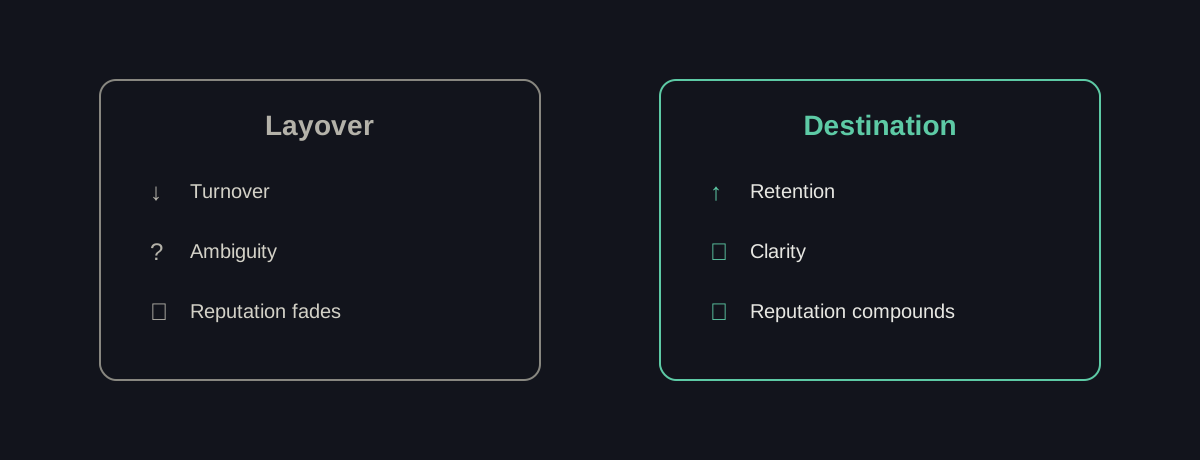
A talent destination isn't just a company with good perks or a "great culture" section on their careers page. It's a company that has created the conditions for people to do the best work of their lives, and can prove it.
People don't stumble into a talent destination. They pursue it, invest in it, and grow because of it. And when they eventually move on, they leave better than they arrived, stronger as practitioners, leaders, and humans. Many go on to build teams, run companies, or start their own. Some even come back as clients, collaborators, or advisors.
That's the cycle. And it's a powerful one
A part that often gets overlooked in the "culture" conversation: being a talent destination is just good business.
The companies that will win in the next few years, especially as AI absorbs more of the tactical work, will be the ones that have invested in judgment, creativity, and the human qualities that can't be automated. Those qualities live in people. And people choose where to bring them.
Here's some good news: you may already have many of the ingredients in place. The question isn't always how to build from scratch. It's how to make what you're already doing more visible, more intentional, and more consistent.
That's where a culture playbook comes in. Think of it as your company's vivid vision for the employee experience. What do you stand for? How do you operate? What can people expect when they show up? When you can answer those questions clearly, and put them somewhere people can actually see them, you create the conditions for trust. And trust is what everything else is built on.
.svg)
Start with the conversation. Gather your leadership team and ask the hard question: what's important to our most effective and happiest employees, and are we actually designing around that?
From there, you can begin to build the playbook. Define the culture you want to create, not just the culture you have. Document it. Socialize it. Hold your leaders accountable for designing the operating environment that brings it to life.
At Refine Labs, this kind of intentional thinking is baked into how we operate. We call it our Vivid Vision — a clear, honest picture of what we're building and who we're building it for. It keeps us accountable and moving in the same direction.
The best companies don't just build a great place to work, they become known for it. And when that reputation precedes you, the right clients, the right talent, and the right opportunities have a way of finding you.

Some destinations are worth staying for.
Blog
B2B Paid Awareness Benchmarks: CTR, CPM & CPC Data (Q1 2026) — Refine Labs
See CTR, CPM, and CPC benchmarks for B2B paid awareness campaigns on Meta, LinkedIn, and Reddit—agency data from Q1 2024 through Q1 2026.
March 6, 2026
Something interesting is happening across the paid media landscape for B2B brands running brand awareness objectives. Over the past eight quarters, we've been tracking CPM, CPC, and CTR across Meta, LinkedIn, and Reddit and the story the data tells is more nuanced than the platform reps will share with you in a QBR.
This post breaks down what we're seeing at the agency level at Refine Labs, why it matters for how you think about awareness investment, and what the Q1 2026 numbers suggest about where we're headed.
Let's start with CTR - the metric that often gets dismissed as a vanity number but actually tells you a lot about audience-creative alignment at scale. Across all three platforms, CTR for awareness campaigns has been remarkably stable over the past year, though the trajectory getting here is telling.
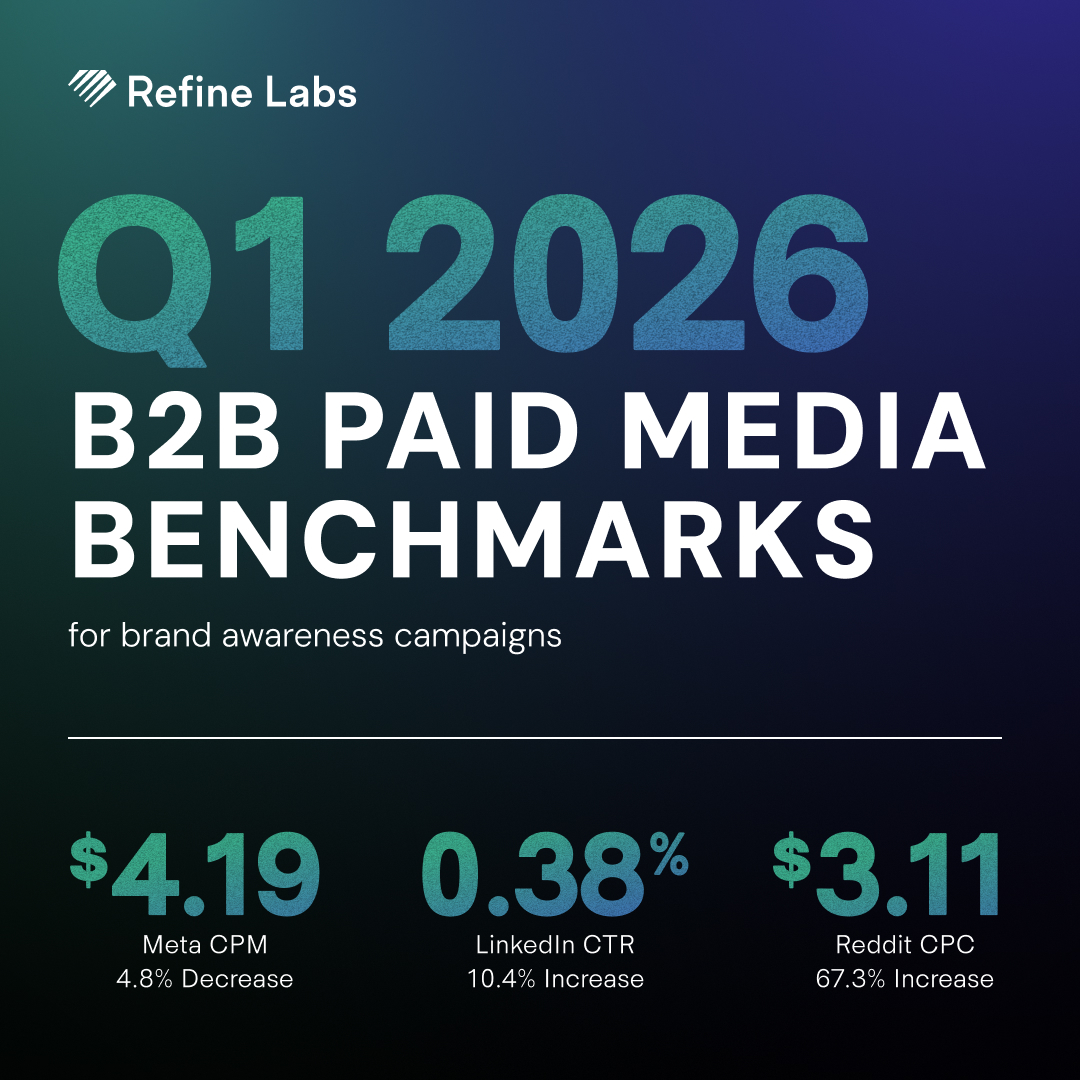
Meta's CTR sits at 0.20% in Q1 2026 - effectively flat year-over-year but down from a mid-2025 peak. LinkedIn holds at 0.38%, nearly double Meta's rate and that gap is intentional. LinkedIn's more expensive inventory self-selects for professional intent. Reddit comes in at 0.30% for awareness campaigns, despite the platform's reputation for scroll-resistant, ad-skeptical audiences.
Here's our take: if you're optimizing awareness campaigns for CTR, you're solving the wrong problem. Awareness media is about frequency with the right audience, not inducing immediate clicks. A 0.20–0.38% CTR range for brand awareness is healthy - it means you're reaching people who aren't necessarily in active buying mode but are encountering your brand message repeatedly.
The danger signal we watch is CTR collapse - when it falls below 0.10% on Meta, it typically indicates creative fatigue or audience exhaustion. The QoQ comparisons are as much about creative refresh cadence as platform dynamics.
This is where the data gets genuinely interesting — and frankly, where most B2B brands should be paying close attention. CPM trends reveal what platforms are actually charging you to reach an audience, and the divergence across these three platforms is striking.
Meta at $4.19 CPM with a −4.8% YoY decline continues to offer the most cost-efficient reach for awareness in the market. For B2B brands with broader TAMs or consumer-crossover audiences, this is hard to argue with. The Q4 seasonality spikes we've seen in prior quarters followed by price corrections confirm this is structural efficiency, not noise.
LinkedIn's CPM dropped 13.7% year-over-year to $42.29. That's a meaningful directional move. The LinkedIn premium has historically been justified by audience quality — you're reaching actual decision-makers, not demographic lookalikes. But as LinkedIn's inventory has expanded (particularly Thought Leader Ads and Document Ads), supply has increased faster than B2B ad demand, creating real price relief.
This is a window. LinkedIn at sub-$45 CPM for true professional audience targeting is not a given. Brands that lock in awareness investment now, while pricing is favorable and competition is lower, will benefit from the brand memory effects when those buyers eventually enter a purchase cycle.
Reddit's CPM jumped +36.8% YoY to $9.33. Reddit is getting more expensive, fast. This reflects growing platform investment from B2B and DTC brands as Reddit's audience verification and contextual targeting have improved significantly. For highly specific technical or niche professional audiences, Reddit can still deliver strong CPM-to-reach ratios — but the broad reach math has changed materially since 2024.
Cost-per-click on awareness campaigns is a secondary metric, but it's a useful calibration tool. It tells you the blended cost of the rare moments when your awareness ad drives enough interest that someone actually clicks through to learn more.
The CPC story mirrors and amplifies the CPM trends. Meta and LinkedIn are both showing significant CPC declines year-over-year — −22.6% and −21.8% respectively — which is a compounding tailwind for brands investing in these platforms for awareness right now. Meta drops to $2.06 CPC. LinkedIn drops to $11.24.
Reddit's CPC spike of +67.3% YoY to $3.11 is more significant than it might appear. When rising CPMs compound with declining CTRs, you get amplified CPC increases. This math matters when you're evaluating Reddit's role in an awareness mix — it's increasingly a precision instrument for specific community contexts, not a broad reach play.
One reminder worth repeating: don't optimize your awareness campaigns for CPC. When brands do this, they effectively convert awareness campaigns into consideration campaigns — attracting the 0.5% of people immediately ready to act, at the cost of the 99.5% who needed to see your brand repeatedly before they were ready. Awareness investment is about building the baseline, not harvesting it.
Here's the consolidated YoY view that matters most for planning - stripping out the noise of quarter-to-quarter seasonality and showing the directional signals across every metric and platform.
LinkedIn CPM compression creates a rare window. A −13.7% YoY drop is not noise -it's an opportunity. B2B brands with a genuine enterprise or mid-market ICP should be leaning into LinkedIn awareness now. The buyers you're reaching today at depressed CPMs are the same people who will be searching your category in 12–18 months. The brands consistently visible through awareness campaigns are the ones who show up as safe choices when those buyers are finally in-market.
Meta remains the most efficient reach engine, full stop. $4.19 CPM with stable CTR means Meta is delivering consistent awareness reach at lower cost than ever. The concern we hear - "but my buyers aren't on Meta for work" - misunderstands how brand memory works. Your buyers are humans. They use Meta personally. Frequency and message quality drive recall regardless of context.
Reddit is becoming a precision tool, not a reach strategy. With CPMs up 36.8% and CTR declining, the Reddit efficiency story has changed. If you were allocating Reddit budget based on 2024 benchmarks, that math no longer holds. Reddit still earns its place for brands with specific technical communities or niche professional segments — but it's amplification, not scale.
Don't optimize awareness campaigns for CPC. Brands running awareness but optimizing for click volume are turning them into consideration campaigns. The result: you attract the 0.5% of people immediately ready to act, at the cost of the 99.5% who needed repeated exposure. Awareness investment is about building the baseline, not harvesting it.
The headline from Q1 2026's awareness benchmarks is encouraging for brands willing to play the long game. Meta and LinkedIn are getting more efficient. CPCs are declining meaningfully. The cost to build consistent brand presence is, in two of three major channels, lower today than it was a year ago.
Refine Labs is a B2B demand generation agency that has helped over 300 B2B companies accelerate revenue growth and improve marketing ROI. Learn more at www.refinelabs.com. Connect with us on LinkedIn and YouTube. Listen to our Podcast with weekly episodes Stacking Growth.
Blog
How We Grew AI-Referred Traffic 5–6× in 9 Months - Refine Labs
How Refine Labs grew AI-referred website traffic 5–6x in 9 months with zero paid spend—the content structure and technical signals that worked.
March 2, 2026
At the start of 2025, we had what most B2B marketing teams have: a decent content library, reasonable search rankings, and essentially zero traffic from AI tools. ChatGPT, Perplexity, Gemini - they were crawling our site, but not surfacing it. We showed up in neither the citations nor the answers.
That changed in April. Not because of an algorithm update. Not because we got lucky. Because we made a deliberate decision to change how we write - specifically, to write the way language models retrieve, not the way search engines rank.
Nine months later, the chart looks completely different. This post walks through exactly what we did, quarter by quarter, and what the data says about what worked.
Here's what AI-referred sessions looked like across the full period. Every bar is one month. The green is ChatGPT. The rest are Perplexity, Gemini, Claude, Copilot, and OpenAI direct.
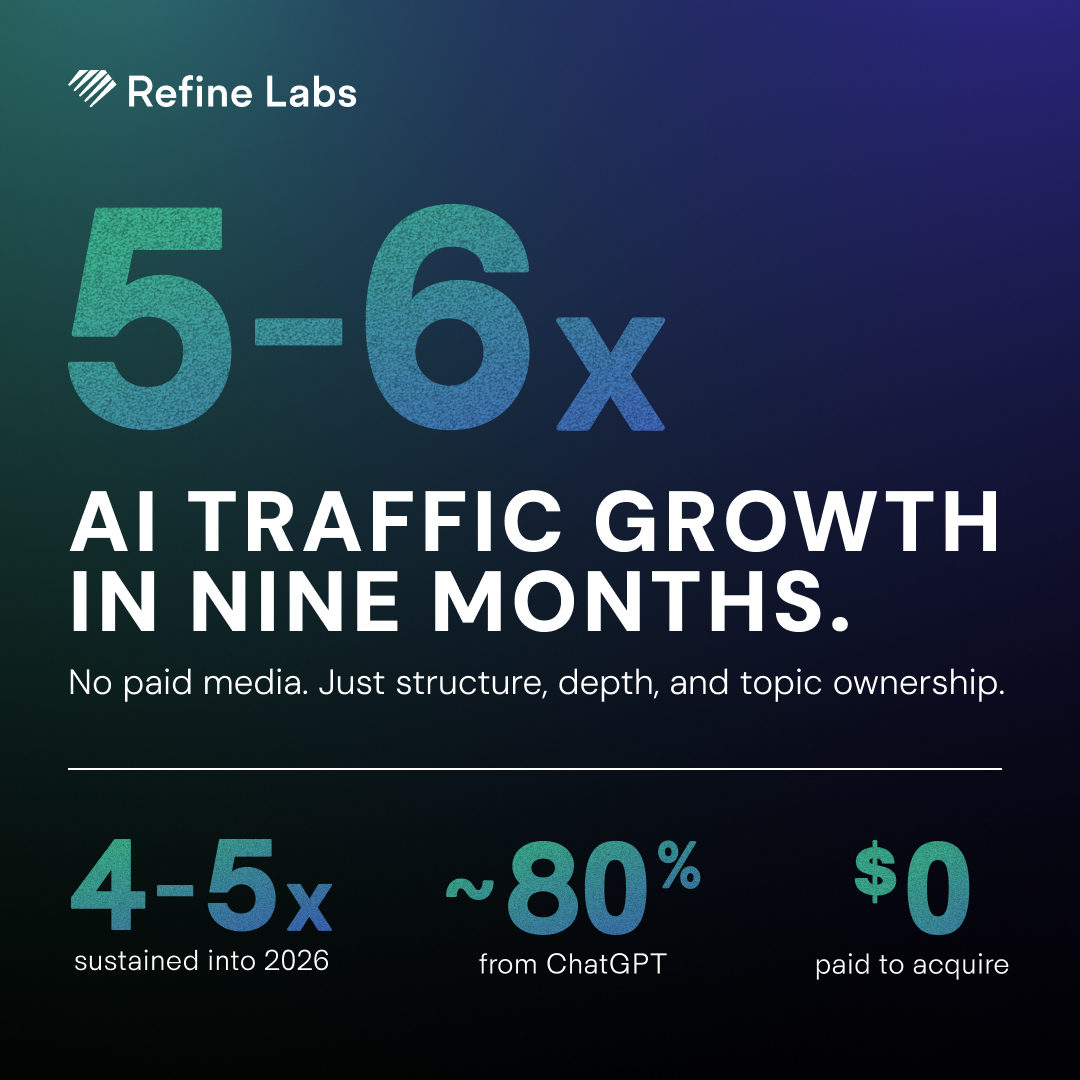
The April inflection is not subtle. Before that point - three full months of essentially flat activity. After it, a consistent upward trend that compounds through the rest of the year and peaks in December at approximately 5-6× the January baseline. Importantly, January and February 2026 are still running at 4-5× baseline. This isn't a spike that collapsed. It's a new floor.
January through March weren't failures - they were baseline. The bars in the chart for those months are barely visible. ChatGPT was sending occasional sessions. Perplexity even less. Gemini essentially nothing. Month-over-month, there was no meaningful growth in any direction.
What this told us: we were not a source LLMs were choosing to cite. Our content was crawlable. It existed. It wasn't bad. But it wasn't structured the way language models retrieve information and that gap was the whole problem.
April is where the work started. The first thing we changed wasn't what we wrote - it was how we thought about why we were writing it.
Traditional SEO is about signals: keyword density, backlinks, domain authority, crawl budget. All of those still matter. But LLM discovery works on a different logic. A language model isn't ranking pages - it's deciding what to cite. It's looking for content that is structurally clear, topically authoritative, and easy to extract a precise answer from.
Once you see that distinction, the content changes you need to make become obvious.
Q2 proved the thesis. Q3 was execution at scale. We shifted from rewriting existing pages to publishing new assets built specifically for LLM retrieval. The goal was to become the definitive reference on specific topics within our space - the source an AI would reach for when someone asked a relevant question.
We published a series of long-form deep dives. Not blog posts - reference documents. Each one structured like a comprehensive guide rather than a thought leadership piece.
Q4 is where compounding becomes visible. The cornerstone content from Q2 and Q3 had been indexed, cited, and reinforced. New content published in Q4 picked up traction faster because we already had established authority in these topic clusters. Each new piece benefited from the infrastructure we'd built over the previous six months.
There are a few things we'd flag as genuinely explanatory versus coincidental.
Topic ownership compounds. The biggest driver wasn't any single piece - it was the cluster effect. Once we had three or four deeply structured pages on Brand, Demand, and Expand, new content in those areas picked up traction faster. LLMs have a model of what topics different sources are authoritative on. Once you're established in that model, staying there is easier than getting there.
Structure is a feature. The single highest-leverage change we made was treating H-tags as answer containers rather than navigational labels. Every H2 should be able to stand alone as a question and its section as the answer. This one change likely drove more LLM citations than any other tactical edit we made.
Depth beats volume. We published fewer pieces but made each one comprehensive. A 2,500-word deep dive consistently outperforms five 500-word takes on the same topic for LLM citation purposes. The publishing cadence slowed - the citation rate increased.
Technical structure multiplies content quality. All the content work in the world gets discounted if page structure is messy. Clean URLs, proper H-tag hierarchy, logical internal linking - these determine whether LLMs can correctly attribute content to your domain.
This started as a hypothesis in April 2025: if we write content the way language models want to retrieve it, they'll cite us more. The data confirmed it. But the more useful takeaway is that this playbook is not exotic or out of reach. It doesn't require a massive budget, a specialized team, or technical knowledge most marketing organizations don't have.
It requires clarity of thought, consistency of execution, and patience to let the compounding happen. We built the infrastructure over 9 months. The chart reflects that.
If you're running content for a B2B company and AI referral traffic is still flat, the gap is almost certainly structural - not creative. The question is whether an LLM can find a clear answer in your content and attribute it to you with confidence. Most sites can't pass that test yet.
Refine Labs is the leading B2B demand generation agency that has helped over 300+ B2B companies accelerate revenue growth and improve marketing ROI with innovative marketing strategies.
Learn more at www.refinelabs.com. Connect with us on LinkedIn and YouTube.
Listen to our Podcast with weekly episodes Stacking Growth.
Blog
Why Humor Works in B2B Marketing | Refine Labs
Why humor builds trust and cuts through B2B marketing noise—and how to use it to make your brand memorable without losing credibility.
February 27, 2026
The common misconception people have about B2B marketing is that it has to be creatively safe and tediously corporate, because anything to the contrary would put precious ad dollars at risk.
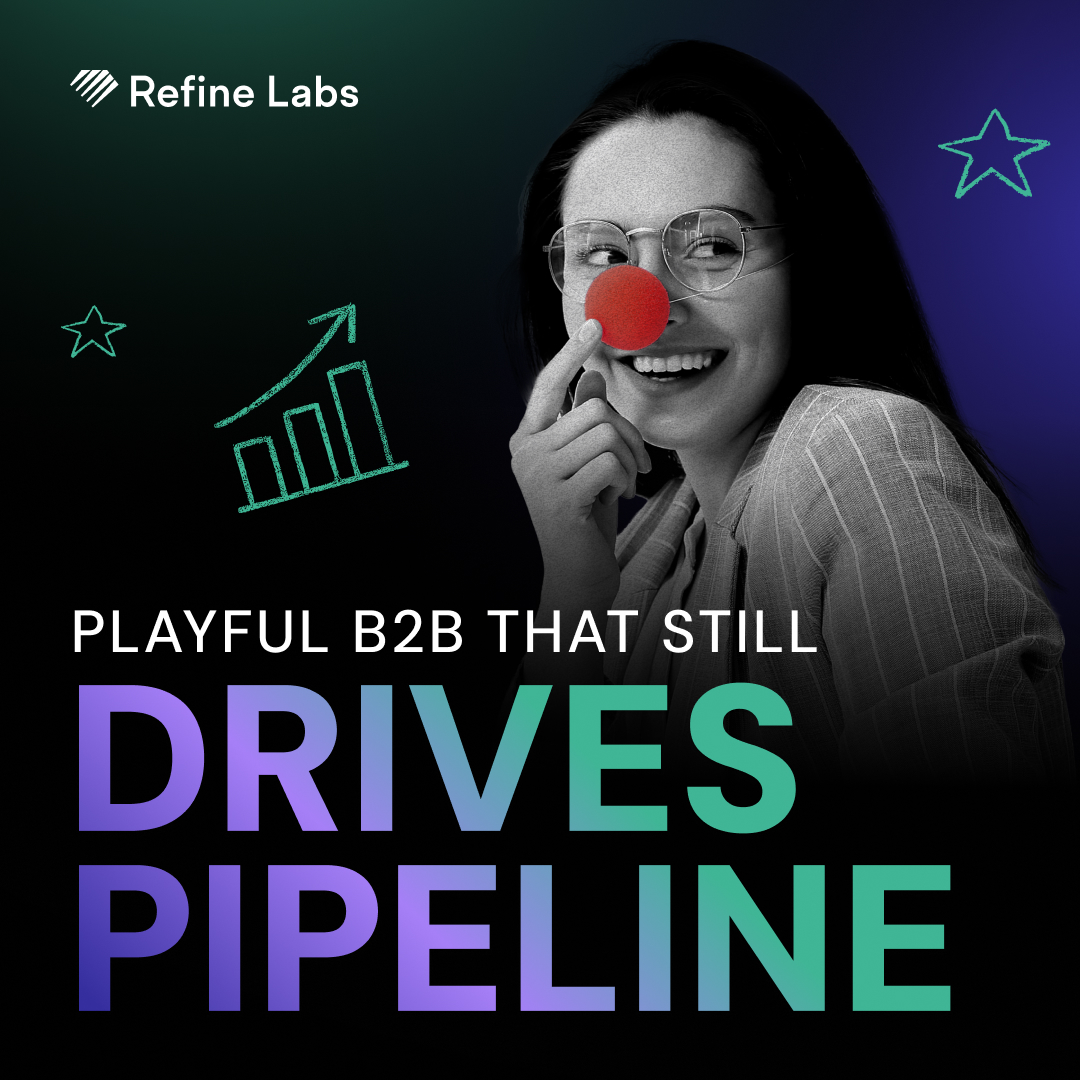
Well, we at Refine Labs are here to break the stigma. Because as it turns out, playfulness and pipeline aren’t mutually exclusive. Our customers would agree.

Within such a crowded market, ads that take themselves too seriously only add to the noise. It’s the ones that experiment with tone that truly stand out and stop the scroll. Memorability is the name of the game.
Our theory: When it comes to creating a campaign, humor is the difference between unforgettable and unremarkable.
Believe it or not, folks, you can have fun and get a laugh while still turning a profit. Who would’ve guessed?
With seemingly every marketer obsessed with optimization, growth, and efficiency—few are willing to make a leap and do anything different. And as a result, most ads you see on your feed just aren’t, well…interesting.

Generic is reliable, and reliable is better for your bottom line. But in the long run? Not so much. Because when all your brand pumps out is stale content, that’s all you’ll be known for.
Humor breaks the sea of sameness in B2B land. It makes ads more memorable, improves recall, boosts shareability, and helps reduce spend by lowering ad fatigue and driving conversion.
In other words, silly sells.
Now, let’s talk about what this means from a creative standpoint.
The other misconception people have is that injecting humor into your creative can cheapen or trivialize your brand, such that buyers and competitors alike wouldn’t take you seriously.
Really?
It’s as if posting a meme is tantamount to putting on a red wig and a clown nose.
We’d argue the opposite is actually true. Lacking real personality, avoiding humor at all costs, refusing to do anything remotely interesting—THAT cheapens your brand.
You’ll only lose your audience if your sense of humor doesn’t fit your voice and tone. For example, Gen Z brainrot probably wouldn’t work for Salesforce, but a brand like Slack or Figma might be more forgiving. Know your lane and stick to it.
The most memorable brands aren’t ones you sit across from in a surgically lit boardroom. They’re the ones you crack jokes with over pastrami sandwiches.
They’re funny. They’re approachable. But most of all, they’re real.
In advertising, humor works.
Just ask Wendy’s. Or Duolingo. Or heck, even Amazon.
And if that’s not enough, the Journal of Business Research found that more than 70% of B2B buyers consider humor an effective advertising tactic. But according to IPG Mediabrands’ Kara Manatt, only 36% reported seeing humor in B2B ads regularly.
That’s telling. It doesn’t just show appetite—it shows opportunity. Almost three-fourths of the market look for funny ads, but only about one-third sees them.
Why?
Once again, it all goes back to apprehension. Marketers are afraid of losing credibility or status. But that’s just pride talking.
There appears to be a conflation of professionalism with stoicism. But professional doesn’t mean boring. An untucked shirt can still be buttoned up.
At the end of the day, brands are supposed to be human. Even in B2B, there’s another person on the opposite end of those ads. Banter with them, make them laugh, and you’ll earn their trust. It’s that simple.
Legendary ad man and forefather of modern demand David Ogilvy once said, “The best ideas come as jokes. Make your thinking as funny as possible.”
You heard the man. It’s guffaw time.
Learn more at www.refinelabs.com. Connect with us on LinkedIn and YouTube.
Listen to our Podcast with weekly episodes Stacking Growth.
Blog

The Real Cost of Attention in B2B LinkedIn Advertising — Refine Labs
We analyzed $11M in LinkedIn spend across our client portfolio and found something most B2B marketers never measure: the cost per hour of human attention. Here's what it means for Brand, Demand, and Expand.
February 19, 2026
Most B2B marketers know that brand awareness campaigns are cheaper than lead generation. That is not a controversial claim. What almost nobody does is quantify what that actually means in terms of attention economics — the real unit of value that every downstream metric depends on.
We analyzed $11M in LinkedIn spend across our client portfolio. Instead of starting with CTR or CPL, we started with time. Specifically: how much does it cost to buy one hour of human attention, and how does that cost change depending on how you spend?
The answer changes how you think about budget allocation entirely.
Cost per lead is a downstream metric. It tells you what happened after attention was converted into an action. That is useful. But it tells you nothing about how efficiently you purchased the attention that made the conversion possible.
Cost per hour of attention works differently. It measures the price of the input the human time and cognitive engagement that feeds every downstream metric in your system. If you do not know what you are paying for that input, you are optimizing outputs without understanding costs.
Think about it in financial terms. A CFO does not measure profitability without understanding cost of goods. Attention is the cost of goods in a B2B marketing system. Every lead, every pipeline opportunity, every closed deal downstream was built on a foundation of purchased attention. The question is: at what price?
At scale, across multiple clients, the portfolio average is roughly $25 per hour of human attention. That number is far more strategic than cost per click. And when you break it down by objective and format, the implications become significant.
When cost per hour is broken down by LinkedIn campaign objective, a consistent pattern emerges across the portfolio. Brand and video objectives buy attention efficiently. Lead generation and conversion objectives buy it at a significant premium.
The gap between the most and least efficient objectives is not marginal. In some cases the difference is 2 to 3 times the cost per hour. That means shifting $1M from Brand Awareness to Lead Generation does not just shift volume. It increases the underlying price of human attention across your entire system.
Most teams do not think about budget allocation this way. They think in terms of leads and pipeline. But those outputs are built on attention inputs. If you are paying 2 to 3 times more per hour of attention in Lead Gen than you would in Brand, you are running an expensive system for reasons that may not be visible in your standard reporting.
The format-level data reinforces the objective-level findings. Not all formats buy attention at the same price or the same depth.
The practical implication: if you are optimizing purely for click rate or engagement rate, you may be funding formats that generate shallower attention at a higher blended cost. Chasing efficiency metrics in isolation does not always produce an efficient system.
This is not an abstract argument for brand spending. It is a mathematical framework for understanding where investment is yielding attention and at what price.
If Brand buys attention at $18 to $22 per hour and Lead Generation buys it at $40 to $80 per hour, your blended cost structure is heavily influenced by how you allocate budget between them. This is why overfunding Demand without supporting Brand increases system-wide pressure over time.
The sequence is predictable. CPL rises. Frequency rises. Creative fatigue accelerates. Marginal returns decline. And the standard response is to increase Lead Gen budget, which compounds the problem rather than solving it.
When leadership says "we need more leads," the more strategic response is not "increase Lead Gen budget." It is: "What is our blended cost per hour of attention, and how do we lower it while maintaining conversion efficiency?" That question elevates the conversation from tactical to financial.
Most marketing teams report activity. Impressions, clicks, leads, pipeline. Those are outputs. They tell leadership what happened. They do not tell leadership how efficiently the inputs were purchased.
Cost per hour of attention reframes the conversation entirely.
One of the most practical applications of this framework is as an early warning system. Standard reporting metrics like CPL and ROAS are lagging indicators. They tell you something has gone wrong after it has already affected performance.
Cost per hour of attention is a leading indicator. If cost per hour is rising month over month, pressure is building in the system before CPL spikes. You can see the problem forming and respond to it while the cost of correction is still low.
The monthly trend data from the portfolio already shows volatility in cost per hour by format and objective. That volatility is signal data. Most teams will not track it. The ones that do will have a structural advantage in how they manage and defend their budgets.
Start by calculating cost per hour of attention for your own LinkedIn spend. The methodology is straightforward: take total spend, divide by total engagement hours generated, and get your blended cost per hour. Then break it down by objective and format.
What you are looking for is the gradient. Where are you buying attention cheaply? Where are you paying a premium? And is the premium you are paying in high-cost objectives justified by the downstream performance those objectives produce?If your Brand and Video objectives are generating attention at $15 to $20 per hour and your Lead Gen objectives are generating it at $60 to $80 per hour, that is a 3 to 4 times spread. That spread is fine as long as the warmed audience pool is large enough to justify the conversion investment. If the pool is small because Brand has been underfunded, you are running a structurally expensive system that will get harder to defend over time.
The goal is not to eliminate Lead Gen spending. The goal is to understand the economic gradient between your motions and manage the blended cost of attention deliberately rather than by default.
f you do not measure cost per hour of attention, you are optimizing downstream outputs without understanding the price of the input. That is a solvable problem. The data exists in every ad account. The methodology is simple. What has been missing is the framing.
Cost per hour of attention is not a vanity metric. It is the unit economic foundation of every B2B media program. CFOs understand unit economics. Boards understand efficiency curves. When marketing starts speaking that language, the budget conversation changes.
We analyzed $11M in LinkedIn spend to get to a $25 average. Your number will be different. But the gradient will look similar. And once you can see it, you cannot unsee it.
Blog
.jpg)
Employee Profiles Outperform Brand Pages on LinkedIn
10 months of LinkedIn data shows employee profiles consistently outperform brand pages—even normalized per follower. See the numbers.
February 17, 2026
Employee profiles on LinkedIn outperform brand pages by a significant margin - even when you control for audience size. We analyzed three employee profiles and the Refine Labs brand page across 10 consecutive months, normalizing all results per 1,000 followers to remove the scale advantage. The gap didn't close. In several periods it expanded. This post shows exactly what we found and what it means for how B2B companies should think about LinkedIn as a distribution channel.
Before comparing performance, audience size has to be established. Raw comparisons between accounts with dramatically different follower counts produce meaningless results - of course an account with 40,000 followers generates more impressions than one with 5,000. That's scale, not performance.
The Refine Labs brand page has approximately 43,000 followers. Two of the employee profiles analyzed sit just below that range. One is significantly smaller. This is not a comparison between a niche account and a massive brand page - the audiences are comparable enough to make the analysis legitimate.
Once that baseline was established, we moved to the core methodology.
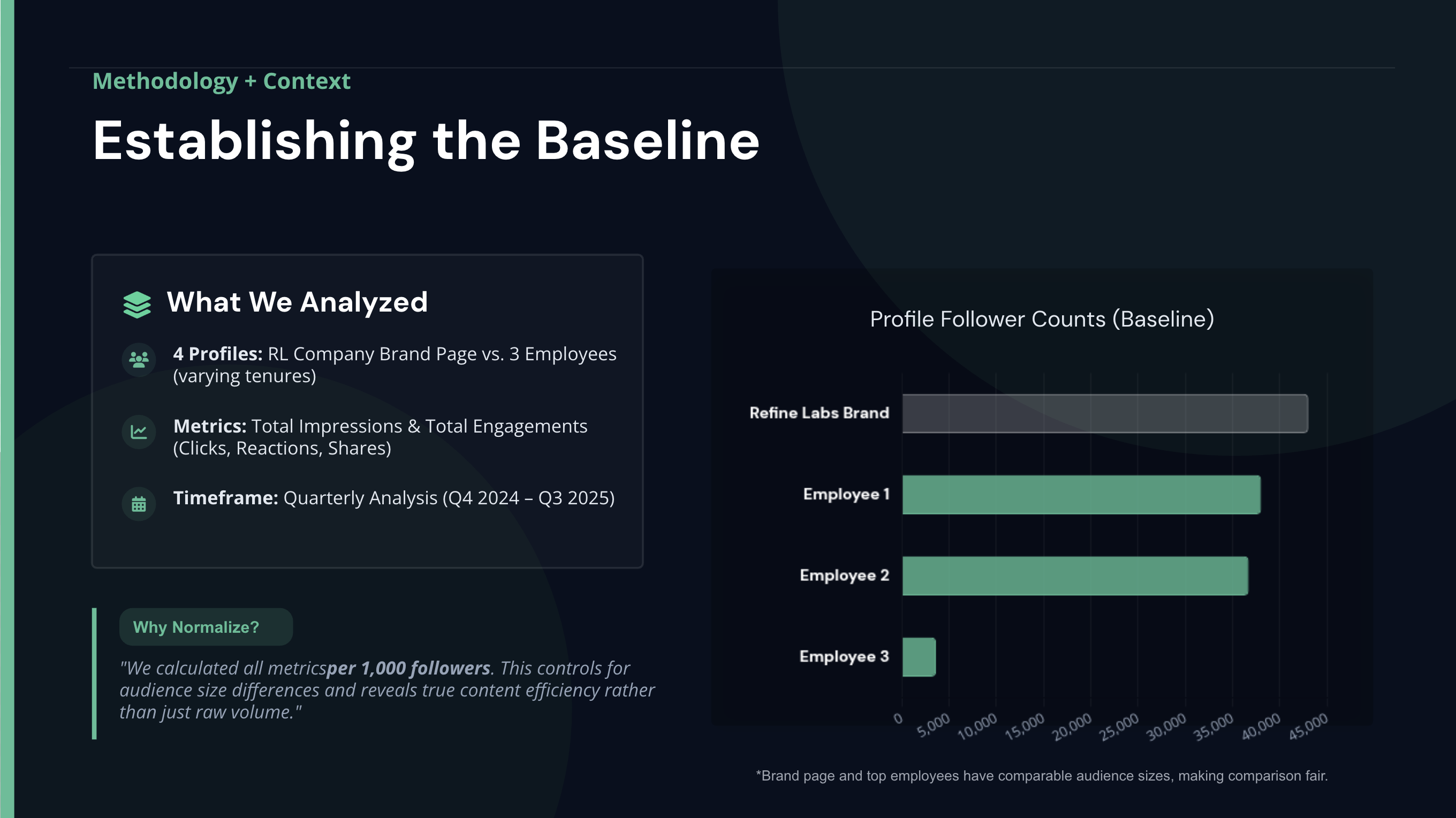
Most teams look at total impressions and stop there. On the surface, employee profiles often generate strong total reach. But raw totals don't answer the important question: how efficiently is each profile generating distribution relative to its audience size?
Someone with 40,000 followers should produce more impressions than someone with 5,000. That's not insight - that's the scale. To make the comparison meaningful, we calculated impressions per 1,000 followers across every profile and every month in the dataset.
Now we're measuring distribution efficiency, not size. That one change made the results much harder to dismiss.
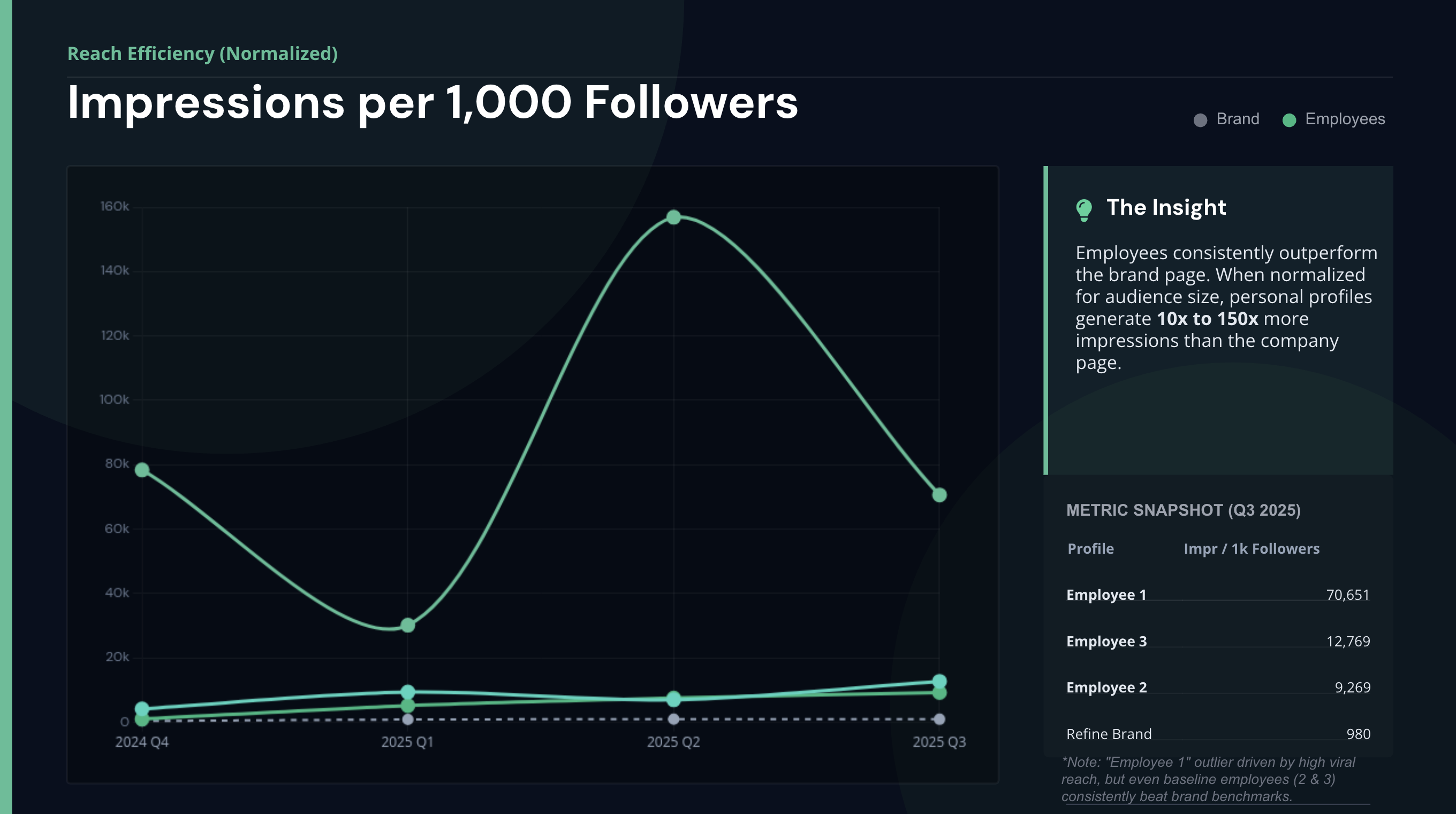
Even removing the highest-performing employee from the comparison, personal profiles consistently outperformed the brand page by a wide margin. This wasn't an isolated quarter. The relative gap appeared across multiple periods. That suggests something structural, not something caused by one exceptional post or one strong month.
LinkedIn distributes content from people more efficiently than content from company pages, even when audience size is comparable.
Impressions show distribution. Engagement shows intent. We applied the same normalization logic to engagements - total engagements ÷ follower count × 1,000 - across the same profiles and time period.
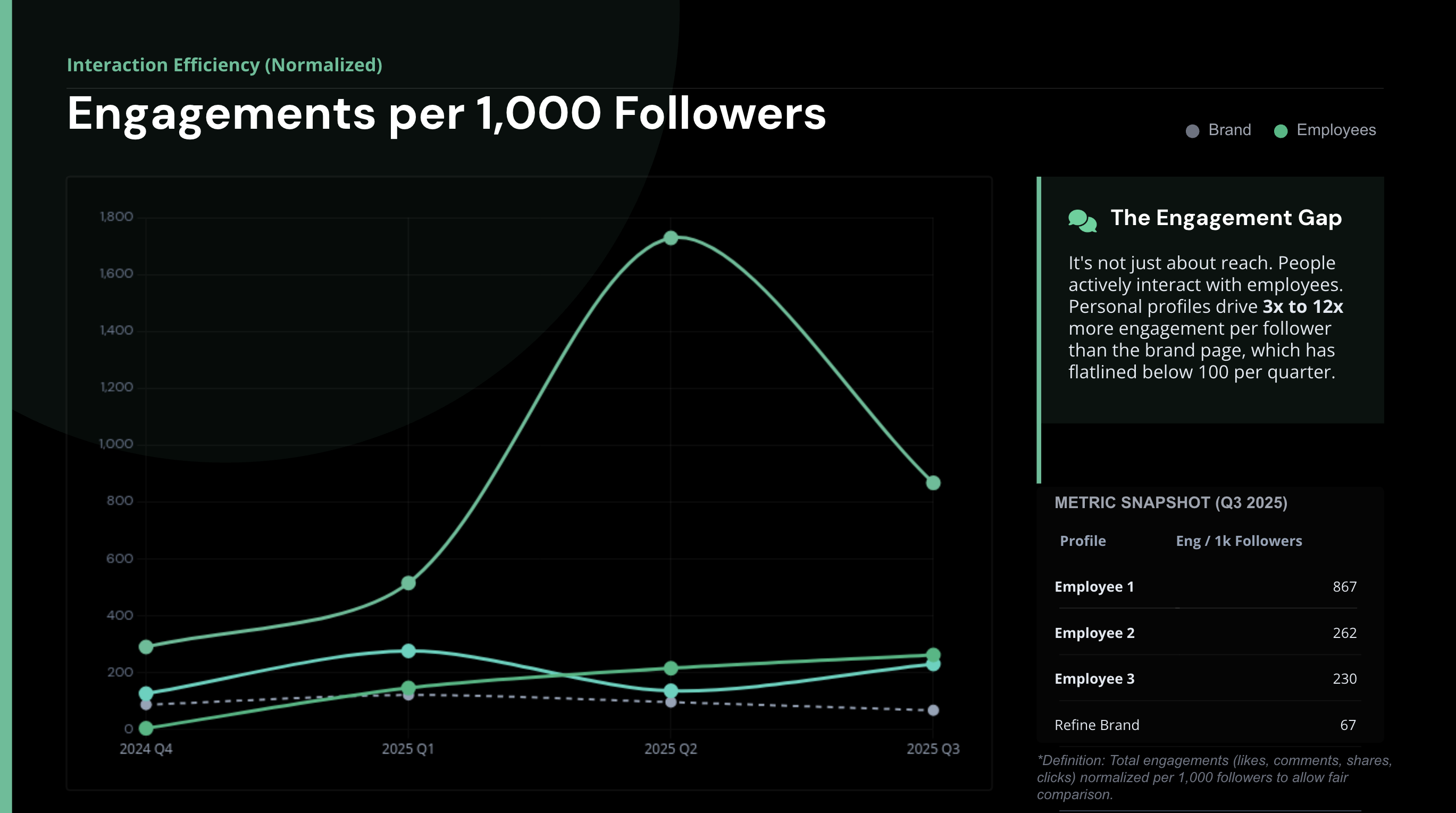
The engagement gap is even more pronounced than the impression gap. This matters because engagement is a proxy for trust. Audiences are not only seeing employee content more frequently, they are choosing to interact with it more frequently.
That distinction is important. Distribution can be gamed. Trust cannot. And trust is what compounds over time.
One viral post can distort quarterly data. So we analyzed performance monthly across 10 consecutive months to check whether the relative advantage was real or a function of outlier content.
The answer: yes, there are spikes. LinkedIn performance is inherently volatile. But the relative advantage of employee profiles over the brand page persists across months. The gap narrows and widens depending on content quality and posting cadence but the hierarchy remains consistent.
This is not a one-time anomaly. It is a structural platform dynamic that shows up repeatedly in the data.

LinkedIn is architected for person-to-person interaction. That design decision directly influences how content gets distributed in the feed. The platform rewards individual voices more generously than brand accounts and the normalized data makes that bias measurable rather than anecdotal.
Company pages still serve an important role. They anchor employer brand, support paid distribution, provide social proof, and house content in a central location. But organic feed dynamics favor individuals. When impressions and engagement are normalized per 1,000 followers, the platform's structural preference becomes visible in the numbers.
This is not a content strategy problem. It is a platform mechanics reality that content strategy has to account for.
Many companies interpret employee advocacy as a soft initiative. Encourage leaders to post. Share company updates occasionally. Hope something lands. That approach consistently underestimates the opportunity and the data makes clear why.
If employee profiles are structurally more efficient at generating reach and engagement, then advocacy has to be treated as a distribution system with the same rigor applied to any other channel. That means measuring it, enabling it, and building repeatable infrastructure around it.
This is not about forcing every employee to post daily. It is about identifying leverage points and measuring them with the same rigor applied to paid media or pipeline programs.
The long-term implication is not just increased impressions, it is defensibility. An employee's audience, voice, and engagement history compound over time in a way that a brand page simply cannot replicate.
Brand pages can be built quickly. A competitor can stand up a company LinkedIn presence in a week. Trust in a human voice cannot be manufactured or purchased. It accumulates through consistent, credible content over months and years.
When employee advocacy is supported intentionally with the right framework, the right voices, and the right measurement it becomes a distribution asset that grows more valuable the longer it runs. Competitors cannot easily copy that. That is what makes it durable.
From a Brand → Demand → Expand perspective, employee advocacy is not a side tactic or a culture initiative. It is a core distribution mechanism that strengthens every stage of how a B2B company grows.
The conversations that result from consistent employee content rarely begin with "I saw your company page." They begin with "I've been following your posts." That difference between brand recognition and personal trust is what makes employee advocacy structurally different from every other LinkedIn tactic.
A few years ago we published the original study showing that personal LinkedIn profiles outperformed the company page by a wide margin five times more engagement at the headline level. The number got attention. But the pushback was predictable.
Some said the follower counts weren't equal. Others assumed that normalizing the data would shrink the advantage. A few believed the algorithm would eventually level the playing field and favor brand pages more over time.
So we went back and ran it again. This time we normalized everything. Impressions per 1,000 followers, engagement per 1,000 followers, quarter by quarter, month by month across 10 consecutive months.The gap didn't close. In several periods it expanded.
That removes the easy excuse. It is not just about scale. It is not just about raw follower count. It is about how the platform distributes content and how people choose to engage. LinkedIn consistently rewards people over logos and that structural reality shows up in normalized data the same way it shows up in raw totals.
Company pages are not irrelevant. They anchor your brand presence, house your content, create credibility when someone checks you out, and support paid amplification. They serve a role.
But they are not your primary organic growth engine on LinkedIn. People are.
If your LinkedIn strategy is concentrated almost entirely on your company page, you are likely underutilizing your real distribution advantage. The data is consistent across quarters, across profiles, and across normalization methods.
Employee advocacy is not a branding exercise. It is a distribution system. Treat it like one.
Refine Labs is the leading B2B demand generation agency that has helped over 300+ B2B companies accelerate revenue growth and improve marketing ROI with innovative marketing strategies.
Learn more at www.refinelabs.com. Connect with us on LinkedIn and YouTube.
Listen to our Podcast with weekly episodes Stacking Growth.
Blog

Story Archetypes That Drive Demand
How B2B brands use Hero, Guide, Rebel, and Caregiver story archetypes to sharpen positioning, build trust, and drive demand generation.
January 29, 2026
Every brand has to answer the same question: Who are we?
In B2B, that answer can easily get buried under features, buzzwords, and complexity. What’s often missing isn’t capability or value — it’s a point of view. A sense of role. A clear way for buyers to understand not just what a brand does, but how it shows up in their world.
One way I’ve found helpful is thinking in characters.
Story archetypes are universally recognizable roles rooted in fundamental human experiences. We can easily identify the Hero, the Guide, the Caregiver, the Rebel, and others because they help us quickly orient ourselves in a narrative. When brands adopt a clear archetypal role, they give their audience an intuitive shortcut to understanding who they are and why they exist.
When that role is clear and consistently reinforced, brands become easier to recognize, easier to remember, and ultimately easier to choose.
Where Archetypes Come From
Archetypes didn’t originate in marketing. They come from storytelling.
Long before brands, campaigns, or platforms existed, people used stories to make sense of the world around them. Across cultures and time periods, the same roles showed up again and again: the Hero who faces a challenge, the Guide who offers wisdom, the Caregiver who protects the vulnerable.
These roles have persisted for so long because they’re useful. Archetypes help us quickly understand relationships, power dynamics, and intent within a story. They give us orientation — who we’re meant to root for, who we can trust, and what role each character plays.
That’s what makes them so memorable. Archetypes reduce the mental effort required to process information by tapping into patterns we already recognize. Instead of asking someone to learn something new, they help them recognize something familiar.
In a B2B context, where decisions are complex and stakes are high, that kind of clarity matters. Buyers don’t want to decode a brand. They want to understand, almost instantly, how it shows up for them.
The Archetypes That Matter Most in B2B
Not every archetype translates cleanly to a B2B context. The ones that tend to drive demand do so because they align directly with how buyers make decisions.
_________________
The Hero
Role: The force that creates progress and delivers results.
In B2B, the Hero is often less about the brand itself and more about the customer. Hero brands position themselves as courageous partners — helping clients conquer big challenges, master complexity, and achieve meaningful outcomes by taking a strong stance against industry obstacles.
Demand impact:
Builds aspiration and confidence. Buyers can picture success and see themselves on the other side of the problem.
____________________________
The Guide
Role: The trusted expert who helps navigate complexity.
Guide brands position themselves as advisors — offering clarity, experience, and deep understanding to help buyers make smarter decisions. They differ from Hero brands in an important way: rather than saving the customer, they empower them.
Demand impact:
Reduces perceived risk and shortens decision cycles by making buyers feel supported, not sold to.
____________________________
The Caregiver
Role: The protector of people, outcomes, or values.
Common in healthcare, HR, cybersecurity, and mission-driven spaces, Caregiver brands emphasize trust, responsibility, and long-term impact. Their messaging centers on safeguarding what matters most.
Demand impact:
Builds emotional reassurance and credibility, particularly when stakes are high.
___________________________
The Rebel
Role: The rule-breaker offering a better way forward.
Rebel brands disrupt convention through innovation. They push for better solutions and attract buyers who are frustrated with existing models and ready for change.
Demand impact:
Appeals to early adopters and change-oriented buyers who want to differentiate.
____________________________
Choosing a Role (and Sticking to It)
The most effective B2B brands don’t try to play every archetype. They choose one primary role and reinforce it consistently across messaging, creative, and experience.
That consistency is what makes archetypes work. When a brand’s role is clear, buyers don’t have to work to understand it — they recognize it.
And recognition is often what turns attention into demand.
Archetypes Aren’t Personalities — They’re Commitments
It’s worth saying what archetypes are not.
They aren’t costumes. They aren’t tones you swap in and out depending on the campaign. And they aren’t about being clever or entertaining for its own sake.
Archetypes are commitments.
Choosing an archetype means deciding how your brand consistently shows up — what it emphasizes, what it deprioritizes, and what role it plays in the buyer’s story. A Guide brand doesn’t suddenly act like a Rebel when results slow down. A Caregiver doesn’t default to provocation just to stand out.
Archetypes force a decision. The brands that struggle to decide who they are are often the ones left behind.
Final Thought
Every brand is already telling a story. The only question is whether it’s intentional.
Archetypes give teams a shared understanding of who they are, how they show up, and what role they play in the market.
In a crowded B2B landscape, clarity isn’t just nice to have. It’s what makes a brand recognizable, memorable, and ultimately chosen.
_________________|
Refine Labs is the leading B2B demand generation agency that has helped over 300+ B2B companies accelerate revenue growth and improve marketing ROI with innovative marketing strategies.
Learn more at www.refinelabs.com. Connect with us on LinkedIn and YouTube.
Listen to our Podcast with weekly episodes Stacking Growth.
Blog
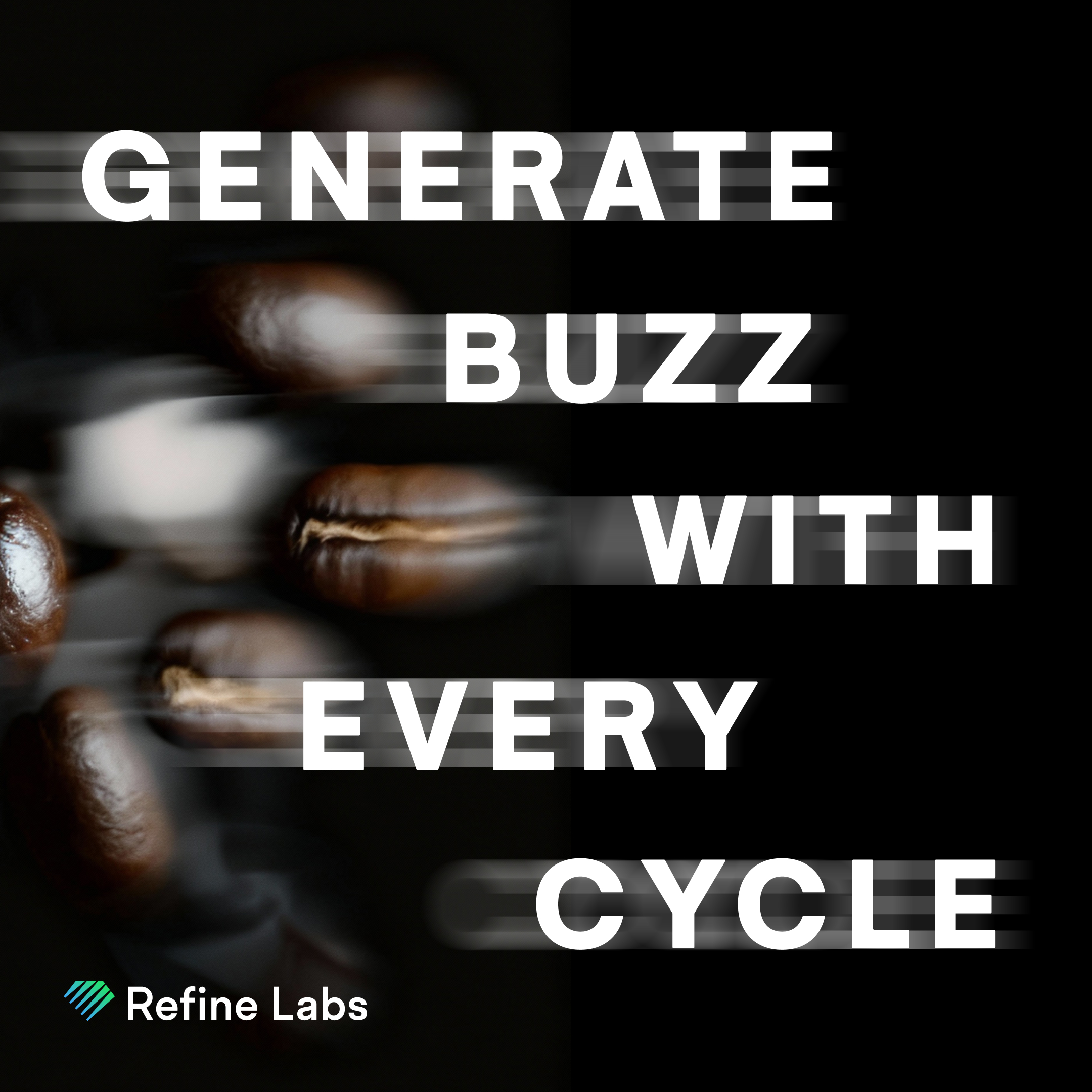
From Roast to Revenue: Crafting a B2B Marketing Campaign That Generates Buzz
Inside The Refinery: how Refine Labs built a coffee-inspired B2B brand campaign to spark demand, boost engagement, and generate buzz.
January 20, 2026
At Refine Labs, we’re always looking for ways to move the needle in the B2B marketing space. Most of the time, these efforts are directed toward our clients, but in this case, we felt compelled to look inward at our own brand.
Despite building out hundreds of campaigns for customers, rarely have we as an agency created one for ourselves. This all changed at the end of last year.
To begin Q4 2025, we sat down as a team to ideate on a campaign that would breathe new life into the Refine Labs brand for the new year. Something that felt B2C while still being distinctly B2B.
We tossed around some concepts and thought-starters to get the ball rolling. Electricity. Stimulation. Buzz. Eventually, this brainstorming session led us to the idea of energy drinks. A universal symbol of productivity and inspiration.
Still, something felt missing. We were on the right track but hadn’t necessarily found the right solution. Then it hit us: coffee. The lifeblood of business - something that most of us marketers rely on daily to get us through the day. It felt approachable but premium. Dynamic but focused.
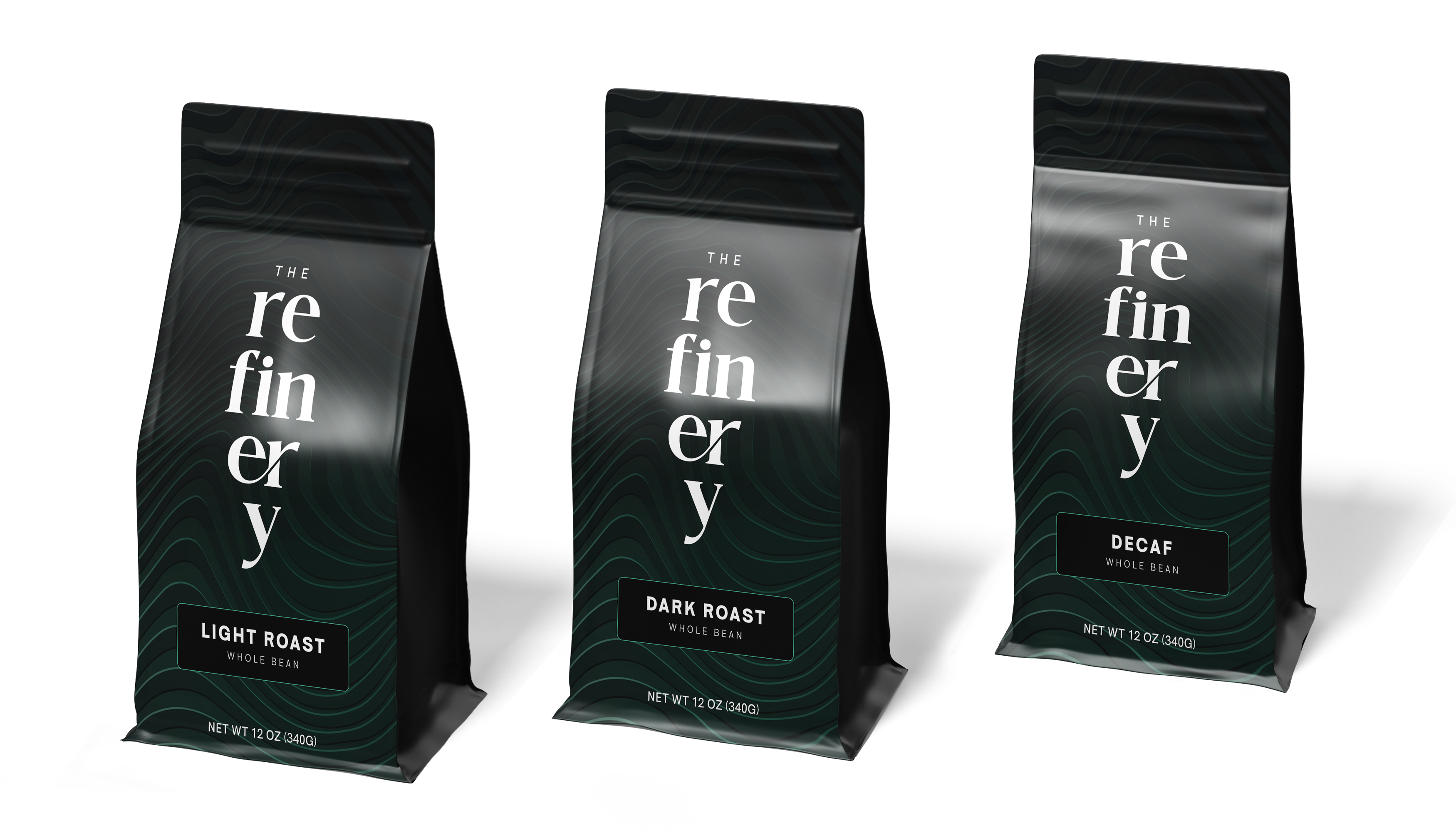
The plan was to create a campaign around a “fake” coffee brand called The Refinery that we’d use as a foundation for a full marketing ecosystem of touchpoints, from ads to a landing page to an immersive quiz experience.
And so for months, we spent our non-billable hours between client projects building out these caffeine-inspired assets.
We started off with what we do best: paid social ads. A slate of scroll-stopping pieces that would intrigue demand marketers with parallels between espresso and their expertise-using headlines like “Wake up your pipeline” and “Scalability in every sip.”
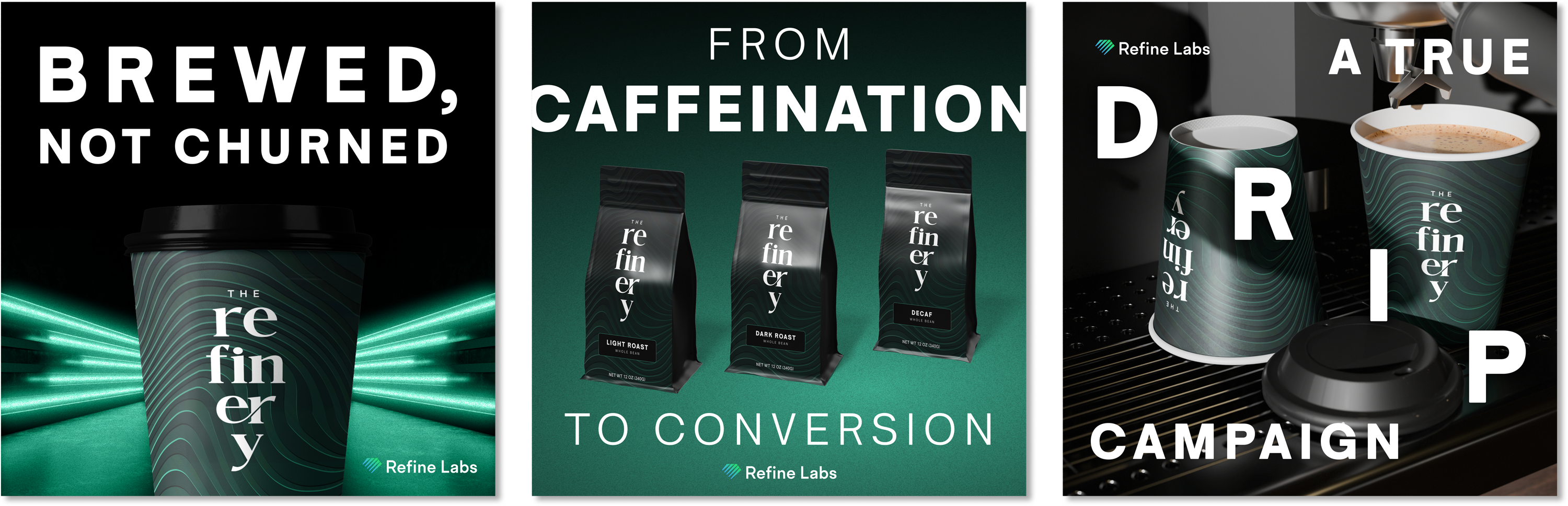
From there, the next phase brought these ideas into a digital hub. We crafted a themed landing page that used coffee to explain Refine Labs’ service offerings. And to ratchet up engagement, we put together a personality quiz to create a sense of individual identity but also community amongst these marketers.

The last thing left to do was to create anticipation and buzz for our upcoming campaign. With teaser posts on organic social as well as invitations to take our quiz, we wanted to whet the appetite to start off 2026.
And thus, The Refinery was born.
----------
Refine Labs is a B2B demand generation agency that has helped over 300 B2B companies accelerate revenue growth and improve marketing ROI. Learn more at www.refinelabs.com. Connect with us on LinkedIn and YouTube. Listen to our Podcast with weekly episodes Stacking Growth.
Blog
Paid Search Playbook
Up to 90% of B2B paid search budgets are wasted on low-intent clicks. Get the playbook for rebuilding Google Ads around buyer intent.
November 4, 2025
Stop wasting budget. Start capturing real demand.
Most paid search programs look efficient on paper.
They hit goals, report clean metrics, and make dashboards look great. But underneath, they burn money on the wrong clicks.
Across hundreds of B2B accounts, we’ve seen up to 90% of spend wasted on low-intent traffic.
The pattern is almost always the same:
We see search as a capture channel. Not a create channel.
When buyers are already in-market, your job is to meet them with precision.
Fewer keywords. Stronger intent signals. Smarter tracking.
This playbook shows you how.
Most teams pay for clicks that never become opportunities.
Bidding on “cloud accounting” does not mean you are reaching buyers.
Add intent tokens like “software,” “solution,” or “platform,” and now you are filtering for people ready to buy.
That one change can turn wasted budget into pipeline.
We have seen up to 90 percent of spend disappear when intent is unclear.
We audited a multi-product, mid to large enterprise software account. The goal was simple. Line up spend, conversion type, and buyer intent. Then judge efficiency.
What the data showed

What it means
Volume is not value. Intent clarity drives efficiency. Budget needs purpose and guardrails. This is why we designed our paid search startegy playbook.
Accounts chase volume, not intent.
Filter every keyword through intent tokens like software, solution, price, or best.
Campaigns built by product or match type give Google the wheel.
Segment by buyer intent so you control where money goes.
CPL and raw conversions hide the truth.
Track cost per HIRO and CAC. That is what maps to revenue.
This is the system we use to rebuild search for efficiency and intent.
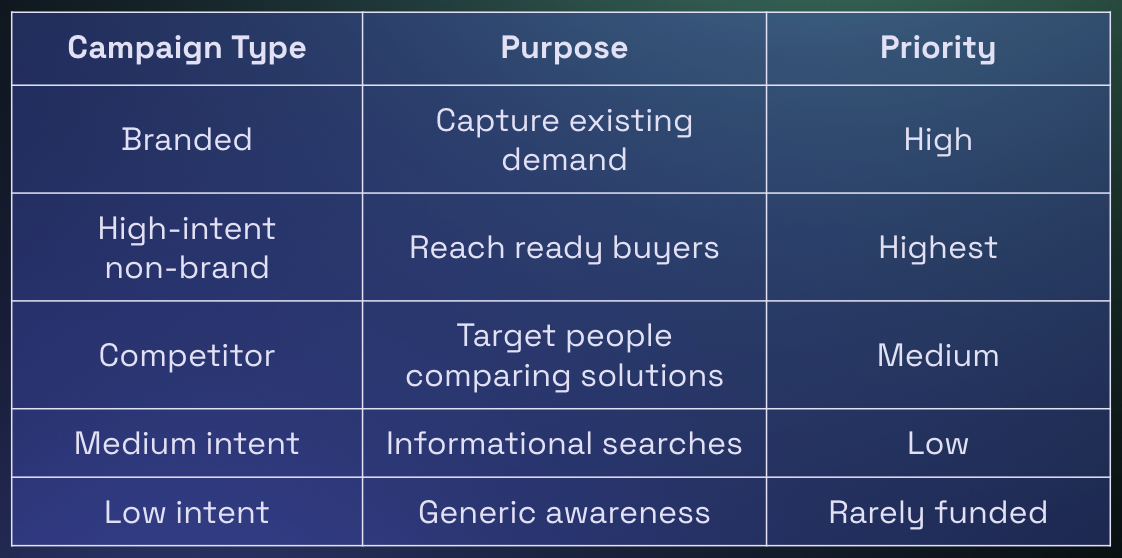
Identify the keywords that signal someone is ready to buy.
Use Search Query Reports to pull the terms with buying language.
Apply five negative lists:
Group related keywords into Single Theme Ad Groups (STAGs).
Segment by intent level so spend follows value.
Start with Manual CPC or Enhanced CPC to learn.
After 30 or more high-intent conversions per month, test Max Conversions.
When stable, move to Target CPA and lower the target gradually.
Only track actions that show real buying intent.
Connect CRM to Google Ads and import HIROs and Closed-Won.
Set high-intent actions as primary so the algorithm optimizes for value.
Most users will not click, but they still see your brand.
Lead with your brand in Headline 1.
Use 10 to 15 strong headlines per RSA with proof, outcomes, and use cases.
Add sitelinks, callouts, and image assets. Skip lead form extensions.
Fewer total leads. Higher quality. Lower CAC.
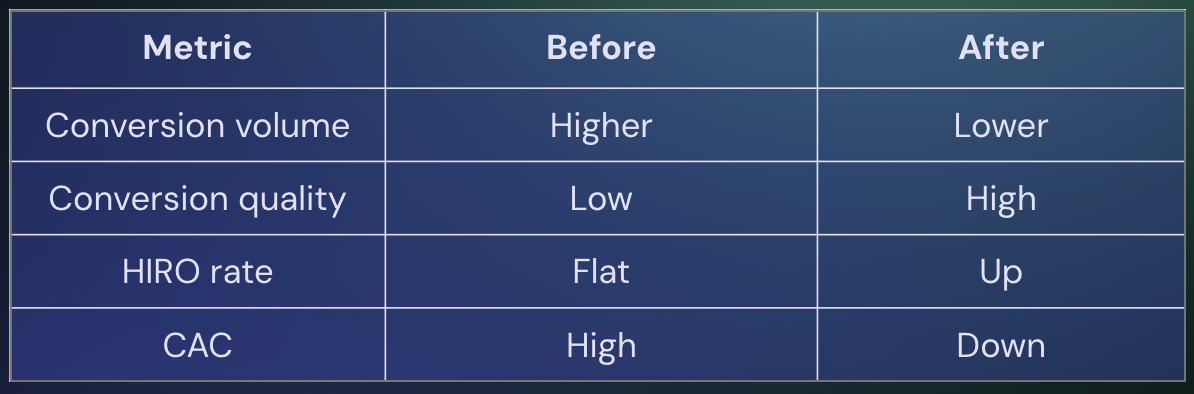
Fewer leads. Better deals. Real efficiency.
Cleaning up search often frees 20 to 40% of budget.
Use it to create demand at the top of the funnel.
LinkedIn. Video. Strong content that builds brand memory.
Search captures the 1% in market.
Brand reaches the other 99%.
Everything you need to apply this playbook in The Vault:
Explore templates in The Vault
Check it out.
----------
Refine Labs is the leading B2B demand generation agency that has helped over 300+ B2B companies accelerate revenue growth and improve marketing ROI with innovative marketing strategies.
Learn more at www.refinelabs.com. Connect with us on LinkedIn and YouTube.
Listen to our Podcast with weekly episodes Stacking Growth.
News
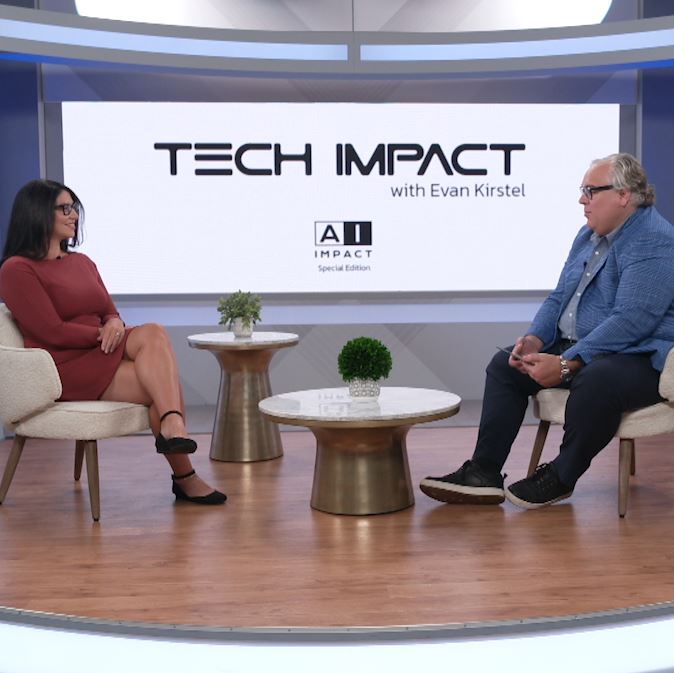
Megan Bowen on National TV: The Future of B2B Marketing Starts Here
Refine Labs CEO Megan Bowen goes on national TV to break down why lead generation is broken and how Brand-Demand-Expand fixes it.
October 8, 2025
When Refine Labs launched, it wasn’t to be another marketing agency. It was to fix a system that wasn’t working anymore.
For too long, B2B marketing has optimized for the wrong metrics - lead counts, MQL targets, gated PDFs - while ignoring how buyers actually make decisions.
On her first national TV segment, Refine Labs CEO Megan Bowen joined Tech Impact to talk about how the market is changing and why she believes the next decade of growth will look nothing like the last.
“On paper, it looks like it’s working,” Megan said. “You spend $20K and you get 500 leads. The math works. The problem? Those leads aren’t buying.”
She shared how teams get stuck chasing vanity metrics that don’t drive pipeline.
Lead volume feels productive - but it’s deceptive.
Refine Labs’ data shows that most of those names never convert, wasting time, budget, and trust.
Her point was simple: stop optimizing for volume and start optimizing for intent.
That shift is uncomfortable for many executives used to immediate output. But when you measure pipeline, win rates, and CAC instead of form fills, you uncover what actually drives growth.
Megan also introduced Refine Labs’ Brand–Demand–Expand model - a framework designed to help companies grow efficiently in today’s B2B landscape.
“Most companies don’t need another funnel,” she said. “They need a system that builds trust early, captures intent when it matters, and compounds growth after the sale.”
Brand builds preference before the search.
Demand captures and converts that attention when buyers are ready.
Expand turns customers into the next growth engine.
Companies that align all three don’t just create motion - they create momentum.
The segment also touched on Refine Labs’ recent strategic investment from Grandin Holdings - a move that signals their next stage of growth.
“This wasn’t about hype or headcount,” Megan explained. “It’s about scaling what works to more B2B companies globally.”
With tighter budgets, rising AI adoption, and board-level pressure for efficiency, Megan made it clear:
The agencies that win won’t be the biggest. They’ll be the ones that adapt—and deliver real outcomes.
Finally, Megan addressed the elephant in every marketing boardroom: AI.
“AI won’t save bad marketing,” she said. “It’ll expose it.”
AI is already changing how buyers research and evaluate vendors. From using ChatGPT to compare products to summarizing pricing instantly, buyers now see through empty tactics faster than ever.
That means unclear messaging, broken buyer journeys, and disconnected systems are no longer just inefficiencies - they’re competitive risks.
“AI isn’t the threat,” Megan added. “It’s the wake-up call. The companies that thrive will be the ones who combine strong strategy, creativity, and brand clarity with the power of AI.”
Refine Labs has worked with nearly 300 B2B companies to redefine how modern marketing drives growth.
As Megan closed her segment, her message was clear:
Watch the full segment on our YouTube channel
News

Megan Bowen: Most Admired Business Leader to Watch 2025
Refine Labs CEO Megan Bowen named a Top Business Leader to Watch by Time Iconic for her people-first, innovation-driven leadership.
October 8, 2025
Every company hits a moment when the future isn’t about repeating what worked, but redefining what will.
For Refine Labs, that moment came this year.
When Megan Bowen became majority owner and CEO, it wasn’t a handoff. It was a rebuild - a new era for the company and for the kind of leadership that shapes it.
Megan’s story was recently featured in Resilient and Transformative: Leading Refine Labs Into an Era of AI, Innovation, and Culture-Driven Success.
It’s not a highlight reel. It’s an honest look at the choices, risks, and principles that got her here - from early startup days to leading through market shifts, acquisitions, and now, transformation.
She’s built her career on doing the hard things most people avoid. Taking a pay cut to start over in a new industry. Building teams from scratch. Leading companies through IPOs and exits. And now, stepping into ownership during one of the most dynamic periods in B2B marketing.
“A leader’s inner world becomes their outer world, and in turn, the company’s reality. For me, doing the inner work isn’t optional - it’s essential.”
That belief sits at the core of her leadership - and it’s reshaping how Refine Labs operates.
This next chapter is about more than growth. It’s about building a company that values people as much as performance, purpose as much as profit.
Megan’s approach flips the traditional model on its head. When employees are supported, challenged, and trusted, they build better outcomes for customers - and that drives better business results.
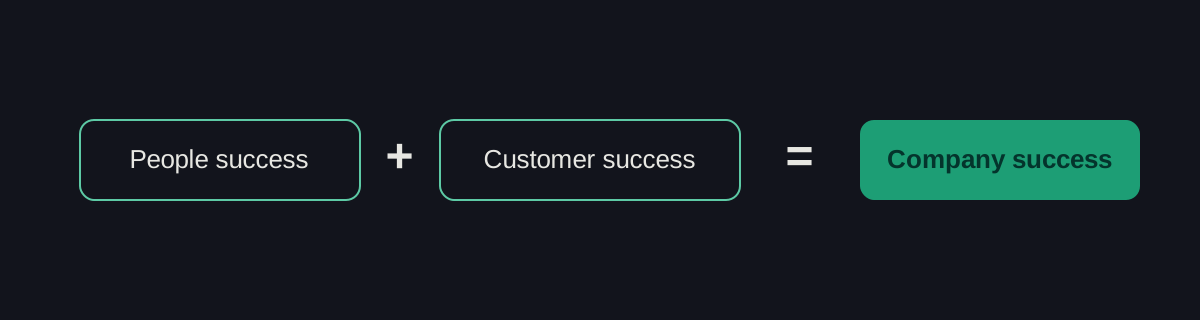
“People success equals customer success equals business success.”
It’s a simple formula, but it’s one that few companies actually live by.
Under Megan’s leadership, Refine Labs is reimagining how B2B growth works. AI isn’t a buzzword here - it’s a tool that’s used intentionally. The systems we’re building are designed for long-term efficiency and creative innovation, not short-term wins.
By 2028, Megan’s vision is clear: Refine Labs will be the global talent destination for top marketers and the leading partner for AI-enabled, sustainable growth.
But the story is about more than goals. It’s about how you lead when everything changes — when markets contract, when the team shrinks, when the playbook no longer applies.
“There’s no growth without discomfort. The biggest wins often start as the stickiest problems.”
The feature captures that tension - the mix of resilience, curiosity, and grit it takes to evolve both a company and yourself at the same time.
It’s the story of what happens when leadership meets reinvention head-on.
Read the full feature: Resilient and Transformative: Megan Bowen, Leading Refine Labs Into an Era of AI, Innovation, and Culture-Driven Success
Blog

The CFO Case for Brand Marketing: A Master Class
How to justify brand marketing spend to your CFO—debunk ROI myths, measure real impact, and show how brand makes performance work harder.
August 28, 2025
If you’ve ever sat across from a CFO trying to justify why brand matters, you know how tough that conversation can be. The numbers never feel clean. The ROI slides don’t land. And half the time you walk out feeling like you lost ground instead of making progress.
That’s why we kicked off a three-part series with Dale Harrison. Hosted by myself and the team at Refine Labs, this first session goes deep on one of the hardest topics in modern B2B marketing: how to make the case for brand investment when the finance team is pressing for proof.
Some of these objections are understandable. Others are just silly – if you’re a $20M company “everyone” does not know you. At least the way you need them to.
It’s not whether brand matters. It’s really how we measure and justify it in terms that finance actually believes.
Making it attribution agnostic. Amortizing brand spend justifiably against sales cycles. And more than anything, measuring against margin where the ROI is much more aligned to the real world of finance not the fairytale land of marketing.
Here is why brand marketing is essential in B2B, why traditional ROI math sucks in explaining it, and how to frame the conversation in a way your finance leader will respect.
The biggest roadblock is measurement and data.
In B2C, brand ROI is easier to connect because of short purchase cycles, larger audiences, and cleaner attribution. Marketing IS sales. There is no sales team to manage and close deals, or sales is never sourcing deals directly.
In B2B, it gets messy. Go to market programs obfuscate credit. Departments fight for who sourced what, and pipeline sources get diluted against one another in the name of “efficiency”.
You know, sales or marketing-sourced?
Common objections for brand are as predictable as they are lazy:
This is absurd when put to even the faintest of pressure testing. Here’s what the data shows if common sense can’t get you there:
Brand’s job is simple: make sure buyers know you exist and you are one of the preferred options before they enter the market.
CFOs do not care about “pipeline influenced” or “marketing sourced.” Marketers do because it gives attribution.
CFOs care about the P&L. So framing your ROI discussion around margin is how you get taken seriously.
So how do you think about margin? Well, the gold standard for any marketer who wants to measure ROI without being held to last touch or multi-touch attribution needs to understand the incremental contribution margin of marketing.
That comprises the following costs center factored into your ROI:
Most marketers walk into the room with ROI math that does not hold up. For example:
One of these numbers is reality. The others are what martech vendors sell you through suspect math.
If you are claiming 12x ROI, finance knows you are wrong. In fact they probably snicker as you leave the board room. They are fluent in the numbers you are not.
They know sales comp, delivery costs, and long purchase cycles matter. And they actualize all of those. They laugh quietly at inflated ROI numbers because they do not reflect reality.
This credibility gap is why marketing loses budget battles.
Marketers pit brand and performance against each other. They shouldn’t. It’s not brand vs. performance. It’s brand and performance. Always has, always will be.
They work together but in different time horizons.
Brand does not take a long time to work. It works instantly for in-market buyers and keeps working for future buyers as long as memory associations last. It’s just not neatly attributable. It never will be.
That is also why brand spend makes performance spend more efficient. If a buyer already knows you, your search ads, social posts, and retargeting convert faster and cheaper.
Example:
A biotech company ran billboards on key traffic routes into major research facilities. Within an hour of the billboard going live, branded search volume jumped 20 to 30 percent. The effect lasted for two to three months after the billboard came down.
That is brand memory in action. And performance benefited directly.
Highly targeted performance ads cost up to ten times more per impression.
If you are only optimizing for efficiency (cheap clicks, low wastage), you miss the bigger picture. The right lens is effective CPM to your ICP which means the cost to reach future buyers even if many impressions look “wasted” on paper.
Brand is usually the cheaper way to scale awareness across the right audience.
Performance marketing is the way to get direct ROI - especially if you're at an earlier company stage and need the immediate impact to be beyond reproach.
Brand is measurable if you piece the right measurement picture in place. Some are leading and other lagging indicators, but they all matter:
These metrics will not give you perfect ROI but they will give you defensible, finance-friendly proof points.
Brand is not about vague storytelling. It is a financial multiplier.
Brand is the factory building. Sales is the assembly line. Performance is the quick trigger.
Without the building, nothing runs as smooth as it could
Modern B2B marketing is not about choosing between brand and performance. It is about understanding how they compound and arming yourself with the right measurement language to win the CFO conversation.
Want to learn more? We'll be back. Or checkout the full episode on our Youtube Channel here.
----------
Refine Labs is the leading B2B demand generation agency that has helped over 300+ B2B companies accelerate revenue growth and improve marketing ROI with innovative marketing strategies.
Learn more at www.refinelabs.com. Connect with us on LinkedIn and YouTube.
Listen to our Podcast with weekly episodes Stacking Growth.
Blog

How to Answer “Is This Working?” Without Guessing | Refine Labs
How to prove marketing impact under Q4 pressure using motion-based signals instead of guesswork—Refine Labs' approach to demand gen reporting.
August 18, 2025
Q4 is here! Planning decks are flying around.
You’re trying to close the year strong and show that next year’s plan is rooted in something real.
But somewhere in the middle of it all, you get hit with the question:
“Is this working?”
And if you’re like most marketers right now, that question isn’t coming from a place of curiosity.
It’s coming from pressure.
To justify spend.
To prove the headcount.
To defend the bet you made six months ago that hasn’t fully paid off yet.
We get it. We’re feeling it too.
At Refine Labs, we’ve had to answer this question more in the past 3 months than we did all year.
Not because things aren’t working.
But because when budgets tighten and goals shift, the expectations change.
And the work that takes time suddenly doesn’t feel like enough.
In Q4, “Is this working?” hits different.
You don’t just need to explain what’s happening now.
You need to set the tone for 2026.
So instead of scrambling for an answer when someone asks, we started building a better one into our reporting.
Here’s what that looks like:
We don’t answer this question generically.
We answer it by motion.
We name the motion first so everyone’s aligned on what the goal actually was.
Revenue takes time. Especially in Q4.
So if we’re doing brand work, we show growth in branded search, better self-reported attribution signals, or upticks in direct traffic to key pages.
If it’s demand, we look at conversion efficiency. Not just volume. Win rate by source, sales velocity, and cost per opportunity.
And if it’s expand, we’re looking at usage, upsell engagement, and churn signals. Things that show traction before revenue hits the spreadsheet.
We’re not always done. So we’re honest about it.
We say: “Here’s what we’re seeing now. And here’s what we expect to happen next if it keeps going.”
It’s not about fake confidence.
It’s about clarity.
You’re not guessing. You’re giving people a reason to stay focused and aligned going into the new year.
Pull your current list of marketing initiatives.
For each one, ask:
Even just writing this down will help you defend your strategy without being defensive.
It gives you a cleaner way to frame results, even when the numbers aren’t final yet.
It also helps you gut-check if you’re trying to prove something that was never built to deliver overnight results.
But you do need to build confidence in where you're going.
Leadership doesn’t always need perfection. They just need to know that you know what matters, what’s moving, and what to look for next.
We’re using this exact framework to guide how we communicate our wins, our work-in-progress, and the path forward for 2026.
It’s not perfect. But it’s working.
----------
Refine Labs is the leading B2B demand generation agency that has helped over 300+ B2B companies accelerate revenue growth and improve marketing ROI with innovative marketing strategies.
Learn more at www.refinelabs.com. Connect with us on LinkedIn and YouTube.
Listen to our Podcast with weekly episodes Stacking Growth.
Blog

Are Your Marketing Motions Set Up to Succeed? | Refine Labs
Mapped your Brand-Demand-Expand strategy but not your team structure? Here's how to assign ownership and close gaps in each motion.
August 18, 2025
Over the last few weeks, we’ve shared how we’re using Brand, Demand, and Expand to reset how we approach marketing at Refine Labs.
We’ve talked about how to measure each motion in a way that actually makes sense.
We walked through how we think about budgeting across them.
And we just covered why goal-setting often breaks down when you try to force every motion into the same timeline or target.
All of that matters. But there’s something else we’re starting to talk about more internally - the people behind the motions.
How teams are set up.
Where ownership lives.
What support systems exist, and where they’re missing.
This one is new for us.
We’re still figuring it out.
We’re sharing it now because we know other teams are probably thinking about the same thing.
This is less of a “playbook” and more of a starting point. A perspective. A way to pressure test what you’re asking of your people and where the friction actually comes from.
We’ve seen this happen across clients and inside our own team.
You launch a brand motion, but no one owns narrative, creative, or distribution.
You run performance programs, but paid media is doing channel strategy, copy, ops, reporting, and testing all at once.
You say customer marketing matters, but no one in marketing is actually connected to what happens post-sale.
The gaps show up slowly. But they add up.
At Refine Labs, we started feeling it when our teams were stretched too thin.
We had the right intent. But we didn’t have clear ownership across motions.
Brand was showing signs of life, but no one was reviewing performance or leading strategy across channels.
Demand was inconsistent because we had ideas but not enough creative support to execute them properly.
Expand had momentum with Vault, but we didn’t have a clear post-sale owner for content, experience, or measurement.
And when we looked at it, it wasn’t a people problem. It was a structure problem.
We had good people. We just hadn’t set them up to focus, prioritize, and scale the things that mattered.
We asked ourselves:
If we believe in Brand, Demand, and Expand as three core motions... what kind of team structure actually supports them?
We’re not trying to build three silos.
But we are trying to be clearer about who owns what and where each motion needs support.
Right now, we’re starting small:
It’s not a reorg. It’s a way to gut check if we’re giving each motion the time, focus, and support it needs to work.
This isn’t polished yet. But here’s a working framework you can use with your team.
Step 1: For each motion - Brand, Demand, and Expand - write down:
Step 2: Identify tension points
Step 3: Ask where you’ve made assumptions
You don’t need to solve it all at once. Sometimes clarity is enough to shift how a team works.
This is still new territory for us. We’re thinking out loud.
And we’re inviting feedback as we go.
If Brand, Demand, and Expand are the structure behind how you market, this is the conversation about how you actually resource it.
Not just in headcount, but in focus, support, and ownership.
If you’re rethinking your 2026 org plan or trying to scale smarter without burning your team out, we’d love to hear how you’re approaching this too.
Send us a note. Leave a comment. Or share what’s worked for you.
We’re still figuring it out. And that’s the point.
– Refine Labs
----------
Refine Labs is the leading B2B demand generation agency that has helped over 300+ B2B companies accelerate revenue growth and improve marketing ROI with innovative marketing strategies.
Learn more at www.refinelabs.com. Connect with us on LinkedIn and YouTube.
Listen to our Podcast with weekly episodes Stacking Growth.
Blog

How to Set Better Marketing Goals | Refine Labs
Not every marketing goal should tie to pipeline. Learn to set motion-specific goals for brand, demand, and expand that reflect real ownership.
August 18, 2025
Stop setting the same goals for every motion. Not everything should be measured in pipeline.
Most teams set goals like this: "We need to drive more pipeline. Here’s the number. Work backward."
On paper, it sounds fine. But in practice, it falls apart.Because not every part of marketing is built to deliver pipeline in 30, 60, or even 90 days.
Brand takes time.
Expand plays out over quarters.
Even demand, depending on your cycle, might not show up the way leadership expects.
But the pressure for marketers is always the same:
"Show impact."
"Show ROI."
"Show results."
And when every motion is measured like it should drive revenue tomorrow, you either make bad decisions or spend most of your time defending the right ones.
At Refine Labs, we’ve been guilty of this too.
We’d say brand matters, but set goals that only looked at form fills.
We’d run random expand initiatives, but not build them into our planning cycle.
And demand? That was always the default when things got tight. But first thing to pull back on when priorities shift.
So heading into 2025, we started talking about and building goals around what each motion might be responsible for.
Better said, this isn’t about doing less. It’s about setting expectations that didn't set up our team up to fail. Or burn out.
We don’t try to hold everything to the same metric anymore.
Here’s how we break it down:
Brand
The goal isn’t conversion. The goal is awareness, memory, and trust.
We track things like:
If these are moving, demand gets easier. That’s the signal.
Demand
This is where pipeline actually lives. But pipeline alone isn’t the goal.
We look at:
If leads are up but deals aren’t closing, that tells us something isn’t landing. The intent might not be there, or the targeting is off, or the offer is too generic.
Expand
The goal here is to keep customers and grow them.
This doesn’t show up in MQLs or campaign dashboards.
We look at:
This is new for us, and we’re still getting better at tracking it. But we’re building in syncs between marketing, service-delivery leadership to make sure we’re supporting growth, not just acquisition. We'll get there. But it takes time!
If you’re heading into planning and want to build better targets, here’s a quick framework we’re using now.
Brand might be about increased recall or positioning consistency.
Demand might be about improving win rate, not just volume.
Expand might be about reducing churn from specific cohorts.
Don’t let your OKRs or KPIs lie to you.
If brand is doing its job, you won’t see it all in Salesforce.
If demand is being measured by MQLs, you’ll end up chasing volume instead of revenue.
If expand isn’t in your planning, you’ll spend more time replacing revenue than growing it.
Your team needs clarity, not just targets.
You can have aggressive goals. But they have to make sense for what each motion is actually built to do.
We’re using this inside Refine Labs now as part of our 2026 planning reset.
And it’s already helping our teams get out of the cycle of proving impact too fast and into a rhythm that supports long-term results.
If you want your marketing to work, the goals have to work first.
----------
Refine Labs is the leading B2B demand generation agency that has helped over 300+ B2B companies accelerate revenue growth and improve marketing ROI with innovative marketing strategies.
Learn more at www.refinelabs.com. Connect with us on LinkedIn and YouTube.
Listen to our Podcast with weekly episodes Stacking Growth.
Blog

How to Budget Across Brand, Demand, and Expand | Refine Labs
How to allocate your B2B marketing budget across Brand, Demand, and Expand—real examples, budget ranges, and planning tips for GTM growth.
August 18, 2025
(And avoid wasting half your marketing plan)
Let’s talk about budget.
Because no matter how solid your strategy looks in a deck, if the budget doesn’t match what the business actually needs, your team is going to spend the next quarter spinning.
Over the past few weeks, we’ve been talking about the three core marketing motions: Brand, Demand, and Expand. What they actually mean. What good execution looks like. How to measure each one in a way that’s realistic.
Now we’re bringing it together with the one thing that either builds momentum or quietly stalls it: your budget.
Right now, there’s pressure to show results fast. So it’s no surprise teams default to what’s familiar and usually whatever shows up cleanly in attribution software.
That usually means dumping most of the budget into performance marketing. Because it looks good on paper. Because it’s easier to justify. Because you can point to a dashboard.
But that’s not how strong brands grow. And it’s definitely not how sustainable, efficient businesses scale.
A lot of companies default to overfunding Demand.
It shows up in pipeline. It’s tied to revenue. It’s easier to defend in a QBR.
But here’s what happens when demand gets overfunded without the other motions in place:
The issue usually isn’t the spend itself. It’s misalignment between what the business needs and what marketing is actually resourced to do.
At Refine Labs, we’ve been doing the same gut checks internally. We realized our budget still leaned too heavily toward demand and didn’t reflect where our actual growth opportunities were.
So we stopped starting with “how much should we spend on each channel” and started with:
That question alone are changeing how we plan.
In H2, here’s how we're adjusting in real-time based on that:
This wasn’t about big swings. It was about getting honest and fixing the gaps we’d ignored for too long.
If you want to run the same exercise we did, here’s what we recommend:
Step 1
Pull your last two quarters of inbound revenue. Get enough volume to see patterns. If your sales cycle is long, go even further back.
Step 2
Map each deal back to its real source.
Use self-reported attribution, attribution software, sales notes, call recordings. Whatever helps get closer to the truth.
Step 3
Label the origin by motion. Did that deal come from Brand, Demand, or Expand activity?
Step 4
Compare the results to your budget.
If you spent 80 percent of your budget on paid programs, but your best inbound came from organic or word of mouth, that’s a misalignment.
If 40 percent of your revenue came from existing customers, but Expand got zero investment, that’s another gap.
We’re doing this right now. Not as a one-time audit. As an input to 2026 planning. And we’re adjusting in real time based on what’s working, not just what’s easy to defend.
There’s no perfect ratio, but here’s the working model we’re using at Refine Labs:
You don’t need to follow these exact numbers. The goal isn’t balance. It’s clarity.
What’s broken right now?
What’s not getting funded?
What needs to move, and what’s in the way?
Let that guide the budget.
You can say brand matters, but if 90 percent of your spend goes to paid search, then brand is not a priority.
You can say customer success is core to your business, but if marketing isn’t involved post-sale, you’re leaving growth on the table.
Budgets tell the real story. Not slide decks.
So if you’re heading into 2026 planning, ask yourself:
You don’t need to rebuild everything. But if what’s driving growth today looks nothing like what you’re funding, it’s time to reset.
We’re doing that work now. So we figured we’d share!
- Evan
----------
Refine Labs is the leading B2B demand generation agency that has helped over 300+ B2B companies accelerate revenue growth and improve marketing ROI with innovative marketing strategies.
Learn more at www.refinelabs.com. Connect with us on LinkedIn and YouTube.
Listen to our Podcast with weekly episodes Stacking Growth.
Blog

Expand: The Most Overlooked Motion in B2B Growth Strategy | Refine Labs
Post-sale is where real B2B growth happens. See how the Expand motion drives retention, expansion revenue, and customer advocacy.
July 17, 2025
Most B2B teams celebrate the win and then move on. Big mistake. If you're only focused on net new, you're missing the part of the funnel that actually drives efficient, predictable revenue: Expand. Because real growth? It happens after the contract is signed.
Expand is everything that happens post-sale to retain, grow, and activate your customers.
It’s not just customer success. It’s not just onboarding.
It’s a go-to-market motion focused on turning customers into your strongest revenue engine:
They stay longer
They buy more
They advocate on your behalf
And they reduce CAC by driving referrals and branded demand
You can’t scale efficiently if you’re always replacing churn.
And you can’t rely on brand and demand alone if your product doesn’t deliver.
It’s not owned: Nobody “owns” Expand. It sits between CS, marketing, and product, so it gets deprioritized.
It’s not measured: Retention is often tracked at a high level, but without clarity on what influences it.
No one’s looking at engagement signals, value realization, or content usage post-sale.
It’s not planned for: Most go-to-market strategies end at the closed/won stage.
That leaves customers to figure it out, and puts expansion and advocacy at risk.
It’s a coordinated system, not a side project.
Here’s what that includes:
Onboarding experience that delivers quick wins
Customers see real value within the first 30 days. It’s clear. It’s simple. It’s supported.
Content and playbooks for customers
Not marketing fluff. Real, helpful material for adoption, best practices, and optimization.
Revenue touchpoints mapped to customer maturity
Upsell and cross-sell offers come at the right time with clear ROI, not just a bigger price tag.
Customer-led content and advocacy
Top users become case studies, references, podcast guests, speakers. They build your brand and credibility faster than any paid media can.
How marketing fits into Expand
Marketing’s job doesn’t stop at the sale.
The best teams support CS with:
And they work with sales to:
Marketing helps create demand. It should also help expand it.
Here’s how to know your Expand motion is working:
Net Revenue Retention (NRR) - Are you growing within your base?
Churn rate - Are you retaining the right customers?
Product adoption & engagement - Are customers seeing value and using it?
Expansion revenue % - How much of your growth is from existing accounts?
Time-to-value - How quickly do customers experience success?
Advocacy participation - Are customers willing to promote you?
If you’re not tracking this, you’re flying blind on your most cost-effective growth channel.
Expand isn’t the afterthought. It’s the multiplier. And in this market, efficient growth wins.
If Brand gets you known…
And Demand gets you chosen…
Expand is what makes it sustainable.
Make it a motion. Give it a budget. And build it into your 2025/2026 plans.
-----------
Refine Labs is the leading B2B demand generation agency that has helped over 300+ B2B companies accelerate revenue growth and improve marketing ROI with innovative marketing strategies.
Learn more at www.refinelabs.com. Connect with us on LinkedIn and YouTube.
Listen to our Podcast with weekly episodes Stacking Growth.
The reminder
Expand isn’t the afterthought. It’s the multiplier. And in this market, efficient growth wins.
If Brand gets you known…
And Demand gets you chosen…
Expand is what makes it sustainable.
Make it a motion. Give it a budget. And build it into your 2025 plan like your runway depends on it, because it probably does.
-----------
Refine Labs is the leading B2B demand generation agency that has helped over 300+ B2B companies accelerate revenue growth and improve marketing ROI with innovative marketing strategies.
Learn more at www.refinelabs.com. Connect with us on LinkedIn and YouTube.
Listen to our Podcast with weekly episodes Stacking Growth.
News
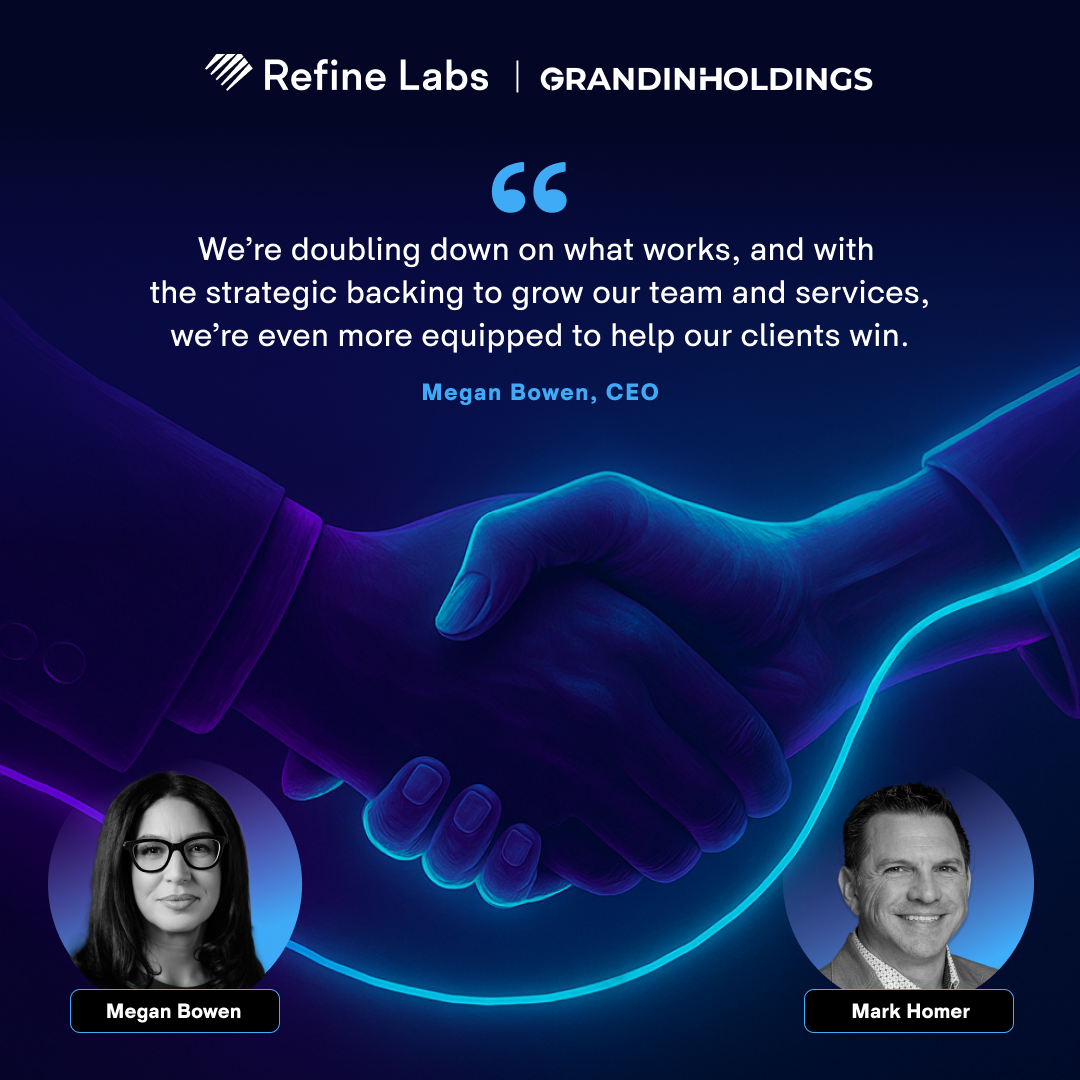
The Next Chapter | Refine Labs Ownership Update
Megan Bowen becomes majority owner of Refine Labs as Grandin Holdings invests and Chris Walker steps away. What's next for the agency.
July 17, 2025
After steering Refine Labs as CEO since 2024, Megan Bowen now steps into her new role as majority owner. Under her leadership, we’ll continue to modernize how B2B companies measure and execute marketing.
Chris Walker has decided to step away from Refine Labs to focus on new ventures. His vision laid the groundwork for everything we’ve achieved. We’re grateful to Chris and excited to see what he builds next.
We’re also excited to welcome Grandin Holdings as a strategic investor in Refine Labs. Their investment signals strong confidence in our future and mission. As part of this partnership, Grandin Holdings founder Mark Homer will join our board of directors. Mark brings deep expertise as a former agency owner who has successfully scaled and exited marketing businesses. His track record of people first leadership, operational excellence, and customer centric growth aligns perfectly with our values and long term vision.
Over the past five years:
We are more committed than ever to our mission and dedicating 2025 to scaling what works, experimenting and innovating with new strategies and tactics, and layering in AI-enabled innovation to evolve with the changing market conditions driven by the AI Era.
We’re energized, equipped, and ready to help you grow.
Thank you for being part of the ride. The best is yet to come.
- Megan Bowen (CEO)
Blog

Demand: Where Most B2B Marketing Stalls
Why demand generation is where most B2B marketing stalls—and how strong demand strategy lowers CAC and shortens sales cycles.
June 30, 2025
If brand builds the reputation, demand captures the moment.
But too often, B2B teams jump straight to demand without laying the groundwork.
That’s why the ad spend feels inefficient. That’s why inbound leads fall flat.
And that’s why sales is constantly asking for “better leads.”
A demand engine isn’t just lead gen. It’s the system that turns interest into pipeline.
And most teams are only running half the play.
Demand isn’t just filling the funnel.
It’s about helping the right buyers take the next step, when they’re ready, on their terms.
That means:
If your motion is still “run ads, get leads, pass to sales,” that’s not demand gen.
That’s marketing as a task rabbit.
Let’s call out the common gaps:
1. No clear definition of “high intent”
If every lead counts the same in your CRM, you’re not segmenting correctly.
Buyers who ask to talk to sales need a different path than someone downloading a PDF.
2. You’re over-rotated on paid
You can’t just pour more budget into LinkedIn and expect results.
If brand hasn’t been built, and if your landing pages don’t convert, you’re setting money on fire.
3. Your metrics don’t reflect revenue
If your top-line goals are leads or MQLs, you're optimizing for volume, not quality.
Demand needs to be accountable to pipeline, not just performance marketing metrics.
Look for these across your funnel:
If you’re not seeing these? You might be over-indexing on tactics and underinvesting in the system.
The goal isn’t just to measure more. It’s to measure what actually matters.
Here’s where to focus:
Cost per high-intent demo
- Efficiency of capturing in-market demand
SQO rate (demo → opp)
- Lead quality and qualification rigor
Pipeline velocity
- How fast and effectively deals move
Attribution mix
- Where actual revenue is coming from, not just where it was clicked
Conversion by source
- Which channels (direct, organic, paid, etc.) drive real pipeline
Bonus: if you’re doing ABM, measure engaged target accounts - not just clicks or form fills.
It’s not just “we’re running ads.”
It’s “our best accounts are actively engaging with us, and we’re turning that into qualified pipeline consistently.”
Here’s what’s behind that:
Good demand feels less like a campaign.
More like a system that runs every day, supports sales, and compounds over time.
Every missed conversion point is a demand leak. Patch those first before spending more.
Demand is what makes your marketing real.
It’s what connects the narrative to the pipeline.
It’s where your buyer finally steps forward and says, “I’m ready.”
But they only do that if you’ve made it easy.
And only if you’ve earned their attention in the first place.
So ask yourself:
Fix demand, and growth gets a whole lot simpler.
-----------
Refine Labs is the leading B2B demand generation agency that has helped over 300+ B2B companies accelerate revenue growth and improve marketing ROI with innovative marketing strategies.
Learn more at www.refinelabs.com. Connect with us on LinkedIn and YouTube.
Listen to our Podcast with weekly episodes Stacking Growth.
Blog

Brand: The Most Misunderstood Motion in B2B Marketing
Brand is B2B's most overlooked growth lever. See how strong brand reduces CAC, shortens sales cycles, and drives efficient growth.
June 17, 2025
Brand gets talked about a lot.
But in most B2B companies, it’s still misunderstood.
When the budget gets tight, brand is the first thing on the chopping block.
Because it's seen as a cost center, not a growth driver.
But brand isn't fluff. It's leverage.
It’s the reason you get invited to the table before you even know there’s a deal.
Brand is how buyers experience your company before they ever talk to sales.
It’s the reason someone types your name into Google instead of “top [category] tools.”
It’s why a CFO doesn’t block the deal.
It’s what turns “just another vendor” into the safer, more familiar option.
Brand isn't a logo refresh.
It’s the reputation you build through consistency, relevance, and value over time.
You don’t need a brand book to know it’s working.
You need real buyer signals. Like:
If you're not seeing those signs, you don’t have a brand motion.
You have marketing output without a lasting impression.
We’ve worked with nearly 300 B2B companies. Here's what actually builds brand:
1. Customer-led storytelling
Short-form content where customers share their approach, not testimonials. No script. Just smart people sharing what worked.
It builds credibility without feeling like a sales pitch.
2. Founder or leadership POV
Weekly posts from the CEO or product leader that unpack how they think. Not promo. Just real perspective.
Over time, this compounds into trust that no ad can replicate.
3. Useful content that earns shares
This could be a resource hub, a buyer’s guide, or a well-researched breakdown on a topic people actually care about.
If the only people reading your content are internal, it’s not brand.
Demand capture is expensive.
Buyers are skeptical.
And most B2B categories are overcrowded.
If you’re not building a brand, your paid spend is doing all the heavy lifting.
You’re competing on timing and budget, not preference.
Strong brand means lower CAC, faster sales cycles, and higher win rates.
Because buyers already believe in your value before they enter the funnel.
Brand isn’t impossible to measure. You just need to look in the right places.
No single metric tells the whole story. But patterns matter.
If your brand is working, the signals show up across the funnel.
If your brand motion doesn’t have clear goals, budget, and a team to run it, it’s not a motion.
It’s a side project.
You don’t have to spend like an enterprise company to build brand.
But you do need a plan. A way to distribute content consistently.
A feedback loop on what’s resonating.
And leadership buy-in that this is a long game worth playing.

Take a look at the last 90 days of activity. Ask:
If the answer is no, you’re not building brand.
You’re just making content.
We’ll go deeper into the demand and expand motions next.
But if you're looking to drive more efficient growth, this is the starting point.
Brand isn’t a campaign. It’s the foundation.
And it’s time more B2B teams treated it that way.
-----------
Refine Labs is the leading B2B demand generation agency that has helped over 300+ B2B companies accelerate revenue growth and improve marketing ROI with innovative marketing strategies.
Learn more at www.refinelabs.com. Connect with us on LinkedIn and YouTube.
Listen to our Podcast with weekly episodes Stacking Growth.
Blog

Brand, Demand, Expand: A Better Way to Structure B2B Marketing
Most B2B teams over-invest in demand and ignore brand and expand. Learn the three-motion framework built to drive sustainable growth.
May 28, 2025
Marketing didn’t break. We just stopped using it the right way.
Most B2B teams are stuck chasing pipeline without stepping back to ask the bigger question: are we building something sustainable? Or are we just filling gaps month to month?
It’s time to shift from a lead-chasing mindset to a strategy that compounds over time. One that makes sense to your buyers and your board.
This isn’t a funnel. It’s not a campaign. It’s three motions that already exist inside your company. You just haven’t aligned around them yet.
Brand. Demand. Expand.
The SaaS buyer has changed. They don’t want to be prospected. They want to explore, evaluate, and engage on their own terms.
That journey isn’t linear. And it definitely doesn’t belong to just one team.
Which is why brand, demand, and expand isn’t a new playbook. It’s a way to organize your go-to-market efforts around what actually drives revenue and what prevents churn.
If you want to grow efficiently, this is the foundation.
If people don’t know you, they won’t buy from you.
Brand is how you show up when no one’s actively looking for you yet. It’s trust, relevance, clarity, consistency. It’s what gets you remembered when they’re ready to evaluate.
In a market where 70% of research happens before sales ever gets a meeting, brand matters more than most teams give it credit for.
It’s not just logos and impressions. It’s what creates preference.
This is where most B2B marketers focus - paid search, content downloads, website CTAs, retargeting, demo requests.
It’s important. But demand can’t carry the whole team.
High-performing demand programs only work when your brand has already done the heavy lifting. They show up with clarity, relevance, and timing. They make it dead simple for ready buyers to take the next step.
But if you're running demand in a vacuum, you're playing a short game.
Most teams stop at the deal. That’s the mistake.
Expand is everything that happens after the contract is signed. It’s how you activate the customer, build advocates, unlock upsell, and increase retention.
It’s not just CS. It’s a company-wide commitment to delivering on what marketing promised.
If you’re not investing in expand, you're leaking revenue every quarter and it shows up in CAC, LTV, and NRR.
Here’s a quick reference to help map your activities. It’s not perfect or rigid. It’s here to help you pressure test how balanced your strategy really is.

Quick take: if most of your programs fall under demand, you’re not alone. But it also means you’re not building long-term leverage.
You don’t need to force equal weight but you do need intent behind what you’re doing and why.
Brand gets you known.
Demand gets you chosen.
Expand makes you profitable.
And every motion needs an owner. A budget. A set of metrics tied to revenue.
When marketing, sales, product, and CS align around these motions, you don’t just hit the number. You actually build momentum.
We’ll go deeper into each motion in upcoming weeks on how to measure them, how to staff for them, and how to shift resources when the board wants results now but the pipeline’s missing.
But for now, start here:
- Look at your plan
- Look at your team
- Ask yourself: do we have a strategy for each motion? or are we hoping good creative and more ads will save the quarter?
This is how B2B marketing grows up.
Let’s build it right.
-----
Refine Labs is a B2B demand generation agency that helps companies accelerate revenue growth with innovative marketing strategies.
Learn more at www.refinelabs.com. Connect with us on LinkedIn and YouTube. Listen to our Podcast with weekly episodes Stacking Growth.
News

A New Look for Refine Labs in 2025
Refine Labs unveils a new website built around its evolving GTM strategy—explore the latest playbooks and insights for B2B marketers.
March 17, 2025
When we launched Refine Labs in 2020, the B2B marketing landscape was vastly different. Over the past five years, we've undergone a significant evolution, including our leadership, strategy, execution, and the ways in which we assist companies in achieving profitable growth.
Behind the scenes, these last few quarters have been a period of intense focus, as we've refined our GTM approach, honed our strategic narrative, and adapted to the ever-changing market dynamics.
The launch of our new website is just one facet of our overarching evolution at Refine Labs. It signifies our commitment to staying ahead of the curve and advocating for the change that is required for B2B companies to be successful.
Throughout this year, we'll be unveiling a series of updated GTM playbooks within The Vault. These playbooks will showcase the continuous evolution of our philosophy and will encompass a wide range of strategies, including Paid Search, Paid Social, Reddit, ABM, and an updated perspective on marketing measurement. We believe that these playbooks will provide our clients with actionable insights and strategies that they can use to drive growth and achieve their business objectives.
Change is an essential component of progress, and we're merely at the outset of our journey. Our core vision – to change the way B2B companies measure and execute marketing– remains unchanged. However, our mission has evolved to focus on helping midmarket and enterprise B2B companies design and execute a modern demand strategy to drive improved ROI of their digital marketing programs.
We're excited to continue pushing the boundaries of what's possible and to help our clients navigate the change required to be successful today.
Stay tuned for more updates in the near future and read more about our philoosphy here.
With Gratitude,
Megan
Refine Labs, CEO
News

Refine Labs Releases Revenue Performance Assessment Templates to Analyze Marketing Performance
Free Revenue Performance Assessment templates from Refine Labs to help marketing leaders analyze and communicate real performance.
March 6, 2025
Now, more than ever, companies need to know what’s driving revenue and what’s not. Nailing these insights is critical to create a successful revenue plan.
For the first time, Refine Labs is unlocking their three-step approach that helps revenue leaders understand the impact of their programs. This approach has been successfully deployed with more than 100 B2B SaaS companies.
Access the full Revenue Performance Assessment today for free in The Vault.
Refine Labs conducts a Revenue Performance Assessment at the beginning of each client engagement. This three-step process takes inputs from your pipeline sources, your buyer’s behavior, and paid media performance to provide a holistic analysis of your revenue programming. You’ll walk away knowing the efficiency of your marketing efforts, and where you can make significant ROI improvements.
Step One: Pipeline Source Analysis:
A high-level view of the entire new acquisition business engine; compares contributing pipeline sources to one another, and examines how they’re impacting the business.
The end deliverable will give you an overall understanding and benchmark of the pipeline sources on multiple variables, not just pipeline creation, giving you insight on how to strategize for ongoing growth, and positioning you to be a revenue partner in the business.
Step Two: Split the Funnel:
This exercise splits out how your buyers are entering the marketing funnel, gauges performance throughout the funnel, and identifies what the largest contributors to marketing revenue are.
You will learn to spotlight which inbound points of conversion are capturing demand and driving revenue. This tells you where to adapt your strategy, what to do more of, and what to stop doing.
Step Three: Paid Performance Analysis:
This analyzes how much you’re spending in paid media to drive pipeline.
Completing this step helps identify where you are over or under-investing in paid media, how much revenue paid media is driving, and the return on investment. These inputs help assess whether your company should reevaluate its paid strategy.
To access the full Revenue Performance Assessment, sign up for The Vault. You can also learn more about how Refine Labs can build and analyze your revenue programs by booking time with the team.
Transform your marketing to create breakthroughs in growth with Refine Labs - the account-based marketing and demand generation firm for B2B companies using Salesforce or HubSpot. Trusted by more than 200+ high-growth companies, Refine Labs experts bring your company narrative to life and rapidly drive it into market with all your best-fit customers using industry-leading demand creation strategies.
Learn more about Refine Labs at www.refinelabs.com. Connect with us on LinkedIn, TikTok. Listen to our Podcasts - Stacking Growth.
News

Refine Labs Study Confirms Measurement Gap in Software-Based Attribution & Releases Hybrid Attribution Framework
Refine Labs' study reveals a 90% measurement gap in software-based attribution and introduces a hybrid framework that captures dark social.
March 6, 2025
A Refine Labs data study concluded there was a 90% measurement gap in what software-based attribution is claiming versus what first-party customer-led data is showing. Specifically, “dark social” channels and programs.
The study, conducted over twelve months, involved 620 declared-intent conversions, software-based and self-reported attribution data, and $21.5MM in closed won annual recurring revenue.
The results demonstrated the measurement gap the agency calls The Attribution Mirage – the term used to define the current state of revenue attribution that is over-reliant on software-based tracking methods and fails to properly measure demand creation programs.
Dark social channels and programs, including social media, podcasts, word of mouth, and communities, are drastically under-reported or entirely missed by software-based attribution.
For example, in the collected data set, Podcast was attributed to 53% of revenue ($11.4MM closed won revenue) via self-reported attribution, but 0% was attributed to the Podcast by software-based attribution.
You can access the full data study published in The Vault, a research & content library.
As a direct result of the learnings of this study, Refine Labs has created a Hybrid Attribution Framework, recommended to B2B revenue teams to more effectively measure the impact of demand creation programs, especially within dark social. The Hybrid Attribution Framework accurately attributes the impact of multiple marketing channels on a business's revenue, providing valuable insights into the effectiveness of programs that are creating and capturing demand.
Refine Labs has implemented this framework with dozens of their service customers in The Lab and customers report it has been a huge unlock in showing executives the business value of a demand creation strategy.
"This is a significant milestone for modernizing demand gen and we plan to continue challenging the status quo to help revenue leaders make informed business decisions for their go-to-market strategy," said Chris Walker, Chairman of Refine Labs.
Learn more about how Hybrid Attribution can change your business and how to implement it.
Refine Labs helps mid-market and enterprise B2B SaaS companies change the way they measure and execute marketing. Our demand strategies drive qualified leads, maximize ROI, and reduce acquisition costs for profitable, sustainable growth.
Learn more about our philosophy at www.refinelabs.com. Connect with us on LinkedIn, TikTok. Listen to our Podcasts Stacking Growth.
News

Personal LinkedIn Profiles Outperform Company Pages with 5x More Engagement
Data shows personal LinkedIn profiles drive 2.75x more impressions and 5x more engagement than company pages. Here's what it means for B2B.
March 6, 2025
A Refine Labs data study confirms that sharing information through a personal LinkedIn profile drives 2.75x more impressions and 5x more engagement when compared to a company profile.
This study reviewed 7 employees' personal LinkedIn profiles and compared their posts to the Refine Labs LinkedIn page over the same time period. Post results were averaged for the analysis time period.
Despite having an average follower count, 46% lower than the Refine Labs company page, the employees averaged more than 2.75x the impressions and 5x the engagement per post. This validates the hypothesis that people prefer to engage with people. People engage less with brands.
Since this research was first published, the LinkedIn algorithm has continued to evolve. Company page reach has become more volatile, but employee-led distribution still plays a meaningful role in building brand trust when paired with consistent positioning and repetition. We break down how this fits into a broader Brand → Demand → Expand strategy here.
The normalized breakdown, including impressions and engagement per 1,000 followers, is detailed in our updated LinkedIn employee vs. brand research.
Refine Labs recommends that you employ a robust strategy by enabling your employees to complement your company page's organic and paid efforts. With over 100+ clients, they deliver LinkedIn strategy, content, and media execution to drive growth and engagement for their clients.
"We lead by example, both in how we build our company and how we support our customers. The key is to create content that people want to know about and distribute it where they're already spending their time," said Megan Bowen, President of Refine Labs.
To access the full organic LinkedIn playbook, sign up for The Vault. You can also learn more about how Refine Labs can help you execute your LinkedIn strategy by booking some time with the team.
Transform your marketing to create breakthroughs in growth with Refine Labs - the account-based marketing and demand generation firm for B2B companies using Salesforce or HubSpot. Trusted by more than 300+ high-growth companies, Refine Labs experts bring your company narrative to life and rapidly drive it into market with all your best-fit customers using industry-leading demand creation strategies.
Learn more about Refine Labs at www.refinelabs.com. Connect with us on LinkedIn and YouTube. Listen to our Podcast with weekly episodes Stacking Growth.
News

Refine Labs Unveils Pipeline Sources, a New Way to Measure GTM Efficiency
Pipeline Sources measures GTM efficiency by buying intent, not volume. See how it helps B2B teams find where real pipeline comes from.
March 6, 2025
Companies that categorize their leads or MQLs by department incentivize teams to focus on volume rather than efficiency (e.g. Inbound Marketing, Outbound Sales, Partner). But efficiency should be the goal, and that's where Pipeline Sources comes in.
Pipeline Sources is a new way to measure the success of an "all-bound" GTM strategy that removes the emotion and conflict that arise when comparing traditional department-focused approaches. This new approach allows for easier efficiency optimizations.
Refine Labs' research confirms that not all MQLs are created equal. Instead of focusing on volume, revenue leaders should focus on buying intent. How the buying group enters the pipeline is highly correlated with buying intent and can predict sales performance metrics like ACV, sales cycle length, and conversion and win rates.
To illustrate this, Pipe™ - declared intent website conversions - showed a sales velocity of $3.4M, with a HIRO win rate of 25%, and a lead-to-win rate of 8%, compared to Cold Outbound sales velocity of $1.1M, with an SQO win rate of 15%, and a lead to win rate of 5%.
Refine Labs has successfully implemented Pipeline Sources with its full-service clients in The Lab to drive alignment between GTM teams and drastically improve GTM efficiency.
"Revenue teams that are measured on metrics that matter - qualified pipeline and revenue - should recognize this reality immediately because it’s the fastest path to hitting your goals," said Chris Walker, Refine Labs CEO.
Sign up for your free Vault account to access the fundamentals of Pipeline Sources and revolutionize your approach to measuring GTM efficiency.
Transform your marketing to create breakthroughs in growth with Refine Labs - the account-based marketing and demand generation firm for B2B companies using Salesforce or HubSpot. Trusted by more than 200+ high-growth companies, Refine Labs experts bring your company narrative to life and rapidly drive it into market with all your best-fit customers using industry-leading demand creation strategies.
Learn more about Refine Labs at www.refinelabs.com. Connect with us on LinkedIn, TikTok. Listen to our Podcasts - Revenue Vitals, Stacking Growth.Refine Labs is challenging the traditional department-focused approach to understanding pipeline activity with its new measurement principle, Pipeline Sources.
News

Refine Labs' Paid Social Philosophy Proven to Drive Revenue Impact at Scale
How 300+ B2B companies use Refine Labs' paid social philosophy—zero-click content and native campaigns—to drive real revenue impact
March 6, 2025
Refine Labs' is sharing the step-by-step guide to their unique approach to paid social, which has been validated over years of observation, experimentation, and execution at scale, resulting in proven revenue impact.
Through their ongoing work with over 300+ B2B companies, Refine Labs has developed a different mindset and approach to paid social that matches how buyers have evolved. Rather than treating social media as a lead generation engine, they see it as an awareness channel and when executed effectively it drives increased opportunities and revenue.
The core of Refine Labs' paid social philosophy is leveraging native, zero-click content to create net new demand within the target market. This is done by running a combination of ungated content and product/feature-focused campaigns to an audience constructed to reach the ideal customer profile. The goal is not to optimize for direct-response conversions in-platform, but instead to spark the ICP's attention when they're not in-market to buy and position Refine Labs' clients to be top of mind when they are ready.
"When switching to this paid social philosophy, especially if you've historically executed lead generation campaigns, you can expect a lower platform conversion volume since you'll be using custom conversions for declared-intent actions only," said Chris Walker, CEO of Refine Labs. "However, change your measurement model, optimize for reach and in-feed consumption, and you will improve your product's awareness and overall revenue impact."
For the first time, Refine Labs is unveiling their refined and proven philosophical approach to utilizing paid social media, which has been successfully deployed by over 100 B2B SaaS companies to date.
To access The Fundamentals and Philosophy of Paid Social playbook, sign up for The Vault. You can also learn more about how Refine Labs can help you execute your paid social strategy by booking some time with the team.
Transform your marketing to create breakthroughs in growth with Refine Labs - the account-based marketing and demand generation firm for B2B companies using Salesforce or HubSpot. Trusted by more than 200+ high-growth companies, Refine Labs experts bring your company narrative to life and rapidly drive it into market with all your best-fit customers using industry-leading demand creation strategies.
Learn more about Refine Labs at www.refinelabs.com. Connect with us on LinkedIn, TikTok. Listen to our Podcasts - Revenue Vitals, Stacking Growth.
News

Refine Labs Announces New Pricing for Content and Creative Campaigns
Refine Studios' creative philosophy: using zero-click content to create demand, capture interest, and convert it into pipeline and revenue.
March 6, 2025
Refine Labs has stormed the market since its inception in 2019. Their traction can be accredited to their disruptive and proven point of view on revenue marketing, demystifying attribution challenges, and their ability to give brands a competitive edge with creative.
Through their ongoing work with over 100+ B2B companies, Refine Labs has developed a different mindset and approach to creative media helping brands elevate their strategic narrative, positioning, and category story across web, digital, and social.
Refine Studios' creative philosophy centers around utilizing native, zero-click content to accomplish three key objectives: generating new demand, capturing existing market demand, and converting interest into valuable meetings and revenue. This is all achieved by leveraging a brand's unique differentiator—their story.
“In a world where it’s harder than ever to stand out. A good product isn’t enough. Feature wars are table stakes. And digital real estate is noisier than ever between your competition and the ocean of other content created across brands, industries, and platforms,” said Triana Mills, VP of Creative at Refine Labs.
If you’re looking for creative that elevates your strategic narrative, learn more at refinelabs.com.
Transform your marketing to create breakthroughs in growth with Refine Labs - the account-based marketing and demand generation firm for B2B companies using Salesforce or HubSpot. Trusted by more than 200+ high-growth companies, Refine Labs experts bring your company narrative to life and rapidly drive it into market with all your best-fit customers using industry-leading demand creation strategies.
Learn more about Refine Labs at www.refinelabs.com. Connect with us on LinkedIn, TikTok. Listen to our Podcasts - Revenue Vitals, Stacking Growth.
News

Refine Labs’ New Framework Helps Marketing Leaders Optimize Pipeline Performance
Refine Labs' new framework helps marketing leaders optimize pipeline performance and do more with less in today's B2B marketing era.
March 6, 2025
Refine Labs, a leading B2B demand generation marketing firm, announces the release of its Inbound Buying Experience Framework. Designed to optimize gaps in B2B SaaS buying experiences and solve revenue leaks, this comprehensive resource breaks down the process into four distinct phases, accompanied by optimization categories that enable modern revenue leaders to identify areas for improvement across people, processes, and technology.
A recent study conducted by Chili Piper and Navattic shows the average vendor response time is two days and 2.3 emails are sent per inbound request. Knowing 78% of B2B customers purchase from the vendor that responds first, and sales teams are only able to work the leads once they’ve been properly handed off and routed from marketing, means most companies are likely leaving revenue on the table.
Recognizing the importance of a seamless lead handoff process, Ashley Lewin, Senior Director of Demand Generation at Refine Labs, emphasizes, "This framework and audit help teams align, remove friction, and update processes to drive more revenue from their best-converting funnel, ultimately driving more revenue for the business."
Refine Labs' Inbound Buying Experience Framework shows you how to optimize your website's demand conversion path to increase conversion rates and get more pipeline from the same funnel. The framework focuses on removing friction from form fill to qualified (HIRO) opportunity.
The framework cites the benchmark for declared intent conversion form fill to qualified opportunity should be 30-40%.
Refine Labs has also developed a comprehensive Buying Experience Audience Template to complement the playbook. This resource empowers revenue leaders to quickly identify gaps in their prospect’s journey so they can stop revenue leaks and get back to hitting revenue goals.
For marketing leaders seeking tactical ways to optimize their inbound buying experience, Refine Labs invites them to join The Vault, a knowledge hub filled with valuable resources, including the Inbound Buying Experience Framework. To access this exclusive content and take their revenue generation strategies to the next level, sign up at https://vault.refinelabs.com/sign-up.
About Refine Labs
Transform your marketing to create breakthroughs in growth with Refine Labs - the account-based marketing and demand generation firm for B2B companies using Salesforce or HubSpot. Trusted by more than 200+ high-growth companies, Refine Labs experts bring your company narrative to life and rapidly drive it into market with all your best-fit customers using industry-leading demand creation strategies.
Learn more about Refine Labs at www.refinelabs.com. Connect with us on LinkedIn, TikTok. Listen to our Podcasts - Stacking Growth.
Blog

What Your Brand Colors Are Saying To The Market
How color psychology shapes your B2B SaaS brand's message—and how to choose brand colors that strengthen demand generation.
March 6, 2025
Last month on Stacking Growth Snacks, Monica Beesting mentioned how Color Theory plays into the way she builds a creative campaign. We asked her for a few more details on the psychology behind it all, and she gave us some great insights!
Color psychology refers more to the emotions a specific color evokes in people and the ideas that color communicates. There are specific natural receptions like sadness or hunger cues that are tied to certain colors and help products bring in an audience.
Color theory is the way colors work together by mixing primary, secondary, and tertiary colors in an image. It focuses on how colors mix, what colors complement each other, and combinations to avoid.
In our design work, we try to mix the two together to make an ad more attention-getting in a feed. We choose a strong base color that evokes a positive psychological response and then use a unique secondary color outside the typical brand choices to “break the brand”, resulting in creative that creates demand.
Why is the Refine Labs Logo blue and green?
Green conveys a fresh quality, like a meal made with premium ingredients or a refreshing quality like a crisp soda or a good night’s sleep. Refine Labs is dedicated to providing fresh, non-obvious insights into the B2B space while presenting high quality creative work that approaches the space in a new, innovative way.
Blue comes up quite a bit in the B2B space because it communicates trustworthiness and reliability. This cool hue creates a calmness in the viewer that eases stress and anxiety, reducing doubt about the ‘what ifs' these industries hold. Embarking on a journey with a new agency can be a source of anxiety for a brand, so the blue in our logo helps to reaffirm our experience and the care we take with our clients.
Combining these two colors to convey trustworthiness and a fresh approach, we’ve also wanted to capture the energy that Refine Labs brings to our clients by choosing hyper-saturated tones of each color and grounding them on a black background to show a sleek professionalism.
Our creative branch, Refine Studio, has recently started incorporating purple which is a color that evokes creativity as well as luxury. Historically, purple was one of the most expensive dyes available, so it became associated with royalty and wealth. Adding purple into our design branch helps to reinforce the high quality creative design our clients receive and spark their own creativity.
Check out the Refine Studio creative gallery by Refine Labs to see work by our incredibly talented Creative team!
News

Refine Labs' Step-by-Step Forecasting Resources, Now Available in The Vault
Free step-by-step revenue forecasting and planning resources from Refine Labs, now available in The Vault for B2B marketing teams.
March 6, 2025
For years, revenue teams have approached revenue, goal-setting, and budget planning in a way that's siloed, clunky, and ineffective. Traditionally, goals are set via a top-down approach siloed by department. Overly complicated growth models are built in Excel using non-meaningful equations to back into targets dictated by leadership. And there isn't regard for ramp time, accurate resources, or realistic conversion rates.
This planning style leaves revenue teams scrambling to reach a revenue goal that's set without consideration for historical performance, seasonality, realistic vs. stretch goals, or trade-offs between Pipeline Sources.
Refine Labs has helped over 200+ high-growth B2B companies break down silos across GTM teams and accredits a key part of their success to their modern approach to revenue forecasting and planning.
Today, all members of The Vault now have access to Refine Labs' step-by-step Revenue Forecasting & Planning resources, empowering all revenue leaders to confidently plan and respond to questions like these:
“As revenue leaders head into planning cycles for the second half of the fiscal year, accurate forecasts are critical. The planning resources we’ve created will get you there step by step,” said Cassidy Shield, CRO at Refine Labs.
To access the full Revenue Forecasting & Modeling resources, sign up for The Vault. You can also learn more about how Refine Labs can build and analyze your revenue programs by booking time with the team.
Transform your marketing to create breakthroughs in growth with Refine Labs - the account-based marketing and demand generation firm for B2B companies using Salesforce or HubSpot. Trusted by more than 200+ high-growth companies, Refine Labs experts bring your company narrative to life and rapidly drive it into market with all your best-fit customers using industry-leading demand creation strategies.
Learn more about Refine Labs at www.refinelabs.com. Connect with us on LinkedIn, TikTok. Listen to our Podcasts - Revenue Vitals, Stacking Growth.
News

Marketing QBR Best Practices
Best practices for running marketing QBRs that communicate performance clearly—from Refine Labs' CRO and Senior Director of Demand Gen.
March 6, 2025
Being able to effectively communicate performance in a concise, memorable way is a top-skill marketers need to get more buy-in, resources, alignment, overall understanding, and/or uplevel their careers. This is also a top area of opportunity Refine Labs spots within companies and is on a quest to help other marketers improve their skills.
One of the best areas to start is with the marketing Quarterly Business Review (QBR), which is presented to key stakeholders inside and outside of the business.
If you're looking to elevate your next QBR, register for Stacking Growth Live, Wednesday, June 28th at 10 am PT / 1 pm ET.
QBRs are structured meetings and reports designed for key stakeholders throughout the business, whether board members or senior management. They’re a forum to discuss the business’s health, goals, plans, and strategies the team has set out to achieve.
This doesn’t mean that QBRs are an exhaustive presentation of everything marketing did in the quarter.
The stakeholders want to know if marketing is helping grow the business or not, based on the agreed-upon goals, and what insights marketing has to continue the company-wide strategy.
As a result, these meetings and reports help identify any areas in performance that may need to be spotlighted to fix and set out a plan for the next quarter+ to achieve.
Nailing a strong marketing QBR can be tricky. Typically, the biggest problems Refine Labs sees in presentations are:
Overall, effectively communicating performance, aside from QBRs, is an invaluable skill. It allows for more resources, buy-in, alignment, and understanding.
Refine Labs is hosting a special edition of Stacking Growth Live to cover their 12-step checklist to improving QBRs. They’ll walk the audience through how to improve your decks and delivery to your next QBR.
If you're looking to elevate QBRs to communicate performance effectively, join Refine Labs' CRO, Cassidy Shield, and Senior Director of Demand Generation, Ashley Lewin, on Wednesday, June 28th at 10 am PT / 1 pm ET. Register for the event here.
Transform your marketing to create breakthroughs in growth with Refine Labs - the account-based marketing and demand generation firm for B2B companies using Salesforce or HubSpot. Trusted by more than 200+ high-growth companies, Refine Labs experts bring your company narrative to life and rapidly drive it into market with all your best-fit customers using industry-leading demand creation strategies.
Learn more about Refine Labs at www.refinelabs.com. Connect with us on LinkedIn, TikTok. Listen to our Podcasts - Stacking Growth.
News

The Marketing Tactics We Need to Leave Behind | Megan Bowen
Megan Bowen breaks down the outdated marketing tactics B2B teams should retire—and the demand creation strategies replacing them.
March 6, 2025
Let’s start at our ideal state and work backwards. Ideal state: we measure our success not by the quantity of leads generated, but by the quality of the conversations ignited.
Okay, that sounds great! So now what? How?
It’s easy to feel like just another marketing team on the MQL hamster wheel - trying to push for the right strategies but constantly being asked for MORE LEADS. Things feel murky, and campaign-by-consensus creates uninspiring results. Another gated ebook that’s at best a little pathetic, and at worst, pretty insulting? Doing what you’ve always done isn’t working, but doing something new is a gamble. You’ve got pressure to pick a metric and prove it’s going in the right direction, and you’re not incentivized to take risks.
Real marketing results don’t just appear like magic - it requires the right strategy, strong execution and time. So how do you get off the MQL hamster wheel for good and transform into an architect of a measurable demand gen strategy that personally resonates, transforming passive observers into active participants? How do you guide your team to do the same?
Imagine your prospects open their inbox and find a message that not only piques their curiosity but seems to speak directly to them, threading the needle between professional insight and personal intrigue. Buyers are more discerning than ever. Engaging them requires more than just traditional tactics. It demands a deep dive into the realm of dark social, podcasts, and the power of community (by the way, we’ve got the frameworks and playbooks to help you start exploring these topics).
Capturing demand is one piece of the puzzle. But demand creation is just as important. Ideally, demand flourishes naturally, and leads aren’t just numbers. They’re engaged participants in a shared journey. Every touchpoint is an opportunity to inspire. But you’ve got to be willing to leave behind the marketing tactics that don’t work anymore.
At Refine Labs, we’ve always kept it real with you about the secret sauce behind our digital marketing strategy. Businesses work with us because we’re strategically aligned to how customers actually buy.
So in the spirit of full transparency, our mission remains as clear and steadfast as ever. We’re doubling down on what makes us stand out: our relentless pursuit of changing the way all B2B companies measure and execute marketing. Part of that is helping you navigate the transition from lead gen to demand gen. Let’s get into the details.
Buyer behavior is undergoing a seismic shift. You have two choices: pivot with it, or fall behind. What exactly is shifting?
First off, innovation cycles are accelerating at dizzying speeds. That means the window to capture market interest before the next big thing arrives is tiny. Blink and it’s too late, the window has slammed shut.
Second, the balance of power has tipped towards the customer. Today's buyers seek information on their own terms. They do their own research and resist intrusive sales tactics. Can you bother someone into becoming a customer? No. Today’s buyers just ignore annoying sales plays.
Measuring marketing has also grown more complex. There’s more data, but it turns into a terrible burden. You can paint the picture a thousand different ways. Which picture illustrates the real problem areas and key growth levers? You don’t have to be a data scientist to discern meaningful insights from all the noise, but sometimes it feels like you do. If you want to gauge true impact on revenue and customer acquisition, it’s not a simple “dollars in to dollars out” equation.
Lastly, the pallor of risk-aversion has chilled what once felt like the Wild West of marketing innovation. Organizations don’t want to take big bets. More stakeholders are involved in purchasing decisions. There’s a fear of failure that stifles bold moves. So marketing teams plod onward, doing what they’ve always done.
But for teams who dare to make a change, the ROI is there. Take Clari, who was running a traditional approach with marketing. They believed they were pulling the appropriate levers for paid advertising. They expected buyers would see their ads, click the ads, and convert to buy their product. Full stop. But it wasn’t working. So Clari boldly revamped messaging and positioning, measurement alignment, and their mindset. They went from doing “what they were supposed to do” to looking at what actually worked. They optimized Google ads to focus on high-intent buyers only, among other measures. The result was a staggering 67% reduction in acquisition costs, and a 64% increase in win rates. They won big by prioritizing relevance, engagement, and education over the traditional sales funnel.
The age-old marketing pillars that seemingly uphold our industry are due for a fall. Once unshakeable beliefs about gated content and traditional lead gen are showing cracks. Marketers keep choosing to invest in these myths, because they’re comfortable. And because not investing in them means replacing them with something unknown. But the buyer behavior shift is here, whether we’d like it to be or not. So here’s what needs to go.
Some teams still believe that gated content is the golden ticket to lead generation. You’re standing at a door, and all you need to do is whisper the secret password (hint: it’s your email address), and you’ll get access to the VIP party.
But here’s the thing. The party has moved. It’s out in the open, in the vibrant, dynamic streets of dark social. Here, content flows freely, unencumbered by gates, directly into the hands of those eager to engage on their own terms. It’s where buyers are no longer occasional visitors at trade shows, but are perpetually mingling in the community, absorbing insights through social channels, podcasts, and beyond—without once hitting a "submit" button.
Refine Labs Tip: When shifting to a demand creation approach, your advertising budget allocation should change too. Refine Labs typically recommends a roughly 60-80% demand creation / 20-40% demand capture advertising split (most companies will have this reversed).
Then there’s the idea that you can trick people into becoming leads. This outdated belief is rooted in tactics that prioritize quantity over quality. But today, high-intent interactions —those moments when potential customers show real interest— are the gold standard. They far outstrip the value of leads captured through less forthright means.
Take NFP, who started creating sales enablement material that actually spoke to sales prospects. Working with Refine Labs, they analyzed opportunities to optimize marketing efforts like: programs, advertising, creative, and their website, and sales processes like: sales messaging, scheduling, lead conversion rate, and overall CRM cleanliness.
What happened? A 233% increase in ROI, a 75% reduction in sales cycle length, and a 20% higher ACV. Not too shabby.
It’s also time to retire the “spray and pray” approach. Not all leads were created equal, so you shouldn’t treat them equally.
The difference in funnel performance between high-intent and low-intent sources is staggering. High-intent leads aren’t just more likely to convert. They’re likely to do so more efficiently and effectively. Our research shows that while 500 high-intent leads (demo requests, “contact us” form submissions, other hand-raisers) might convert to 101 customers, 3,000 low-intent leads (gated content, events attendance, review sites) might only convert to 36.
Demand gen focuses on creating and nurturing genuine interest within targeted communities. It's about drawing in the hand-raisers, where every interaction is laden with potential. Traditional lead gen relies on casting a wide net in the hope of snagging a few interested parties, regardless of their readiness to buy or align with the offered solutions. And it just doesn’t work.
Refine Labs Tip: Each pipeline source should be correlated with the intent level of the buyer, how far they are in the process, and the motion that got them into the funnel, not the department or team who sourced the pipeline. However, pipeline sources can and should work together to create a halo effect. For example, your event pipeline source can create awareness for someone when they're early in their buying process, but come into your pipeline through your website.
“AI will replace content teams,” they said. “We will run our content strategy through AI writing tools alone,” they said. But in their current form, AI tools will not replace content teams. In fact, AI tools only increase the value of human-centric storytelling.
Resonant brand narratives—those that truly connect with an audience on an emotional level—cannot be manufactured by algorithms alone. AI might craft content, but it's the human touch that infuses stories with empathy and nuance. This is where genuine engagement is born. At Refine Labs, we’ve found that when we honestly share our experiences and challenges, we find a whole world of engagement and opportunity.
AI writing tools are but a means to an end; the brush, not the artist. You, the storyteller, are the artist.
Buying decisions don’t start and end with Sales. Give some credit to everyone else (and take a little pressure off your Sales teams, too). When you place the buyer decision squarely on your Sales team, you’re neglecting the nuanced way that buyers make purchasing decisions.
Refine Labs' insights reveal that only a small fraction of the buying process—merely 5%—involves direct interaction with Sales teams. So if you really think that Sales holds the reins throughout the buyer's journey, you’re mistaken.
Take LinkedIn, for example. Buyers naturally congregate and share information there. When an organization’s executives have a platform on LinkedIn, they share their expertise and provide their opinionated viewpoints on relevant matters. It becomes an organic and pressure-free channel to drum up trust. With organic content development, you respect your audience, and you give freely without the expectation of a transaction in return.
It’s time to leave the sales-centric view of the buyer’s journey behind. Today, peer voices resonate louder than sales pitches. A product or service’s value is validated through communal endorsement rather than persuasive selling. That shouldn’t diminish the importance of Sales. But it should help you think about Sales in the context of a broader, more integrated approach.
Refine Labs Tip: Aim for a hybrid-attribution model. Software-based attribution is heavily skewed toward demand capture (paid search, retargeting, SEO, CRO, direct mail). Meanwhile, demand creation(podcasts, events, organic social, word-of-mouth, PR) is significantly under-reported by current “best practices”, resulting in marketers not investing appropriately or not effectively executing demand creation strategies. By collecting, analyzing, and aggregating qualitative customer insights as an input, you can leverage self-reported and software-based attribution together. That’s hybrid-attribution.
It can feel next-to-impossible to accurately track marketing efforts. But far from being nebulous and hard to quantify, marketing today can be guided by clear metrics and precise measurement frameworks. The key lies in formulating the right balance between demand creation and demand capture.
Refine Labs customer Splash is one organization who flipped the script with their marketing measurement frameworks. Together, we focused primarily on a demand creation strategy. Over the year-long partnership, Refine Labs introduced new platforms, shut down low-performing platforms, and continued fine-tuning targeting and messaging. These efforts ultimately resulted in an 80% increase in qualified (HIRO - high intent revenue opportunity, deal stage that converts at 25% or greater for the last rolling 6 months) pipeline and a 32% decrease in cost per qualified HIRO opportunity.
It’s all well and good to complain about what’s not working. So what does work? What’s the playbook for getting to our ideal state?
From our perspective, you get to your ideal state through the right mix of creating demand, capturing demand, and converting demand. This tripartite approach recognizes the nuanced journey of the modern buyer. That journey begins with genuine engagement in organic spaces: useful podcasts, vibrant social media communities, and insightful peer discussions. Not only is this approach effective, it’s a lot more fun. It just requires a little bravery, and the willingness to move beyond outdated marketing tactics.
Let’s keep talking. If you’d like to work with us directly, book a strategy call today.
News

Refine Labs Launches Split the Funnel Analysis to Help Leaders Re-Architect their Strategy for Revenue
Refine Labs' Split the Funnel framework identifies wasted spend hidden inside the MQL model—and shows leaders how to re-architect for revenue.
March 6, 2025
Modern marketing teams should be accountable for revenue. But most companies don’t analyze their marketing performance with revenue in mind. In fact, many companies hold marketing accountable for leads or meetings, with no rigor around or regard for how many of those ultimately convert into revenue.
When pressure gets put on the marketing budget, it starts to become very clear what’s working and what’s not. Especially when you scrutinize each program against actual return on investment (revenue) instead of cost per Marketing Qualified Lead.
In this framework the Refine Labs team recommends the following steps:
Chris Walker, CEO of Refine Labs says, “This framework shows you exactly how you want buyers to enter the pipeline (when capturing demand) for maximum sales velocity and sales team efficiency. You’ll also know exactly why buyers choose to take those paths to enter pipeline and what triggers, channels, and tactics move them to conversion. With all of these insights, you can re-architect your strategy that optimizes for revenue.”
Refine Labs' Split the Funnel Framework shows you how to identify what is driving revenue for your business and what is not so that you can optimize your resourcing, staffing, and program spend accordingly.
The firm has also developed a comprehensive Split the Funnel Template to complement the framework. This resource empowers revenue leaders to quickly identify gaps in their strategy to stop ineffectively deploying marketing and get back to hitting revenue goals.
For marketing leaders seeking tactical ways to optimize their program efficiency, Refine Labs invites them to join The Vault, a knowledge hub filled with valuable resources, including the Inbound Buying Experience Framework. To access this exclusive content and take their revenue generation strategies to the next level, sign up at https://vault.refinelabs.com/sign-up.
Transform your marketing to create breakthroughs in growth with Refine Labs - the account-based marketing and demand generation firm for B2B companies using Salesforce or HubSpot. Trusted by more than 200+ high-growth companies, Refine Labs experts bring your company narrative to life and rapidly drive it into market with all your best-fit customers using industry-leading demand creation strategies.
Learn more about Refine Labs at www.refinelabs.com. Connect with us on LinkedIn, TikTok. Listen to our Podcasts - Revenue Vitals, Stacking Growth. Refine Labs, a leading marketing firm, announces the release of its Split the Funnel Framework. Split the Funnel is highly effective in identifying wasted spend in a pure marketing qualified lead model, which most B2B SaaS companies still run due to outdated demand waterfall models and misguided requirements for digital touchpoint-based attribution.
News

The Next Chapter | Refine Labs Welcomes Megan Bowen as CEO
Megan Bowen is promoted to CEO of Refine Labs as Chris Walker moves to Executive Chairman—see what's next for the agency's growth.
March 6, 2025
It’s with deep pride that I share the news that we’ve promoted Megan Bowen to CEO of Refine Labs, and that I’ll be moving into the position of Executive Chairman. This is an important step in Refine Labs’ journey and one that comes with long consideration and careful planning. She’ll start in the new role effective January 8, 2024, and I am so excited for what she’ll do for this company.
Megan joined Refine Labs in August 2020 as Chief Operating Officer (COO) and Co-Owner, and has since been instrumental in all aspects of the growth and maturity of the company. She is a selfless leader who puts the team and company first and always operates with empathy and integrity. Employee engagement and employee satisfaction scores continue to improve every quarter through Megan’s leadership & focused culture initiatives.
Her unwavering commitment to customers ensures we’ll continue to optimize and innovate our offerings to maximize customer value delivery. I’ve had the pleasure of working closely with Megan for the past 3+ years and admire all these special qualities that make her the perfect person to lead Refine Labs in the next phase of our journey.
Refine Labs is on strong footing: we’re in a strong financial position, we have a team of the most talented and dedicated people, and we’ve built the leading revenue-focused B2B digital agency that early adopters are excitedly adopting and thriving. We have a strong leadership team of true experts in their respective fields; and now we have an incoming CEO in Megan who has the talent, drive, and passion to take Refine Labs to the next level.
I love this company more than I can easily express. We have the best customers, the ways we deliver outcomes for customers are the most innovative and most effective in the market, and above all, we’ve built a team and culture that I’m proud to be a part of every single day.
I’ve been running Refine Labs for 5 years. I started the company in my living room in 2019 with one $100/hour client contract. I could’ve never imagined how amazing the company and team would turn out to be. I had no idea then that Refine Labs would become what it is today - a destination for top talent, an influential voice, and a market leader in the B2B Marketing space.
It’s easy in these moments to think back over the past five years and relive the special memories, cringe at the missteps, and just generally stand in awe at how far we’ve come. We found so many big opportunities and simultaneously encountered so many hurdles along the way. But for every challenge we’ve faced, there’s always been a solution. One of my favorite things about Refine Labs is that everyone knows this journey to fundamentally change the B2B Marketing space isn’t going to be easy, and they’re all ready to face these challenges head-on and find solutions. Each new chapter in a company’s evolution presents an opportunity to get better and stronger.
On January 8, Megan will officially be CEO and I’ll be Executive Chairman. We’ve worked on planning and orchestrating this transition for some time now, and many CEO duties have already been transitioned to Megan. I’m fully confident in Megan to take 100% ownership of all CEO duties and lead our talented team into the next phase of our journey in 2024 and beyond. Following the full transition of my CEO duties, I look forward to an ongoing role as Executive Chairman as a key strategic partner to Megan and the company.
I want to thank each and every one of you for hard work and dedication to Refine Labs, our customers, and our mission to fundamentally change how B2B companies execute Marketing. I look forward to the new heights we’ll reach with Megan at the helm.
News

Refine Labs Announces DemandGPT, Custom AI Assistant for Demand Gen Marketing
DemandGPT brings AI-powered search to The Vault, tapping 450,000+ hours of demand gen expertise to help B2B marketers find answers fast.
March 6, 2025
Today, Refine Labs announced the launch of DemandGPT, an AI-powered feature integrated into its intellectual property warehouse, The Vault. DemandGPT leverages Vault content developed from over 450,000 hours of collective insights from Refine Labs’ team members over the past five years, and integrates with ChatGPT to generate personalized IP roadmaps, UI navigation, and content discovery for Vault product users.
The Vault contains content developed from Refine Labs' insights gained through delivering fractional demand marketing and creative services to over 200 B2B customers. The Vault positions users to learn the Refine Labs foundations and deploy a demand plan that drives results. Playbooks and templates guide users through step-by-step implementation for executing new frameworks and strategies in their companies’ marketing engines.
With DemandGPT, users experience enhanced interaction within The Vault, facilitated by Maxwell, Refine Labs' AI chat host. Maxwell, powered by ChatGPT and trained on The Vault's repository, delivers personalized assistance and insights, enhancing the user experience with content engagement.
Members of The Vault can now seamlessly engage with Maxwell to:
Megan Bowen, CEO at Refine Labs, emphasizes, "The Vault is one way B2B companies can learn how to implement a modern demand strategy. The release of DemandGPT empowers marketers to unlock the full potential of our platform, facilitating continuous learning and growth alongside Refine Labs experts and leading B2B marketing teams across industries."
Blog

B2B Paid Media Benchmarks - Guide for B2B Marketers
Demand generation is a critical component of any successful marketing strategy. As a B2B demand generation manager, setting realistic expectations, accurately measuring performance, and continuously optimizing campaigns are essential. This guide provides a clear framework for implementing demand generation benchmarks across various channels.
March 6, 2025
Demand generation is a critical component of any successful marketing strategy. As a B2B demand generation manager, setting realistic expectations, accurately measuring performance, and continuously optimizing campaigns are essential. This guide provides a clear framework for implementing demand generation benchmarks across various channels.
Benchmarks help you set realistic goals, measure performance, and identify areas for improvement. They provide a standard against which you can compare your campaigns, ensuring you are on track to achieve your objectives.
We analyzed data from over 30 B2B SaaS companies between January 1st and December 31st, 2023. The analysis covered $8.2 million in spend and 308 million impressions across Meta (Facebook & Instagram) and LinkedIn.
Meta (Facebook & Instagram)
- CPM (Cost Per Thousand Impressions):
- Facebook: $4.00 (-35% YoY)
- Instagram: $5.00 (-20% YoY)
- CTR (Click-Through Rate):
- Facebook: 0.60% (+10% YoY)
- Instagram: 0.50% (+8% YoY)
Insight: Meta channels have seen a significant decrease in CPM, making them more cost-effective. CTR has increased, indicating better engagement.
How to measure performance, set expectations, and optimize campaigns
Demand generation is a critical part of any modern B2B marketing strategy. For demand generation managers, the ability to set clear expectations, measure the right metrics, and optimize based on performance is what drives growth.
This guide outlines current demand generation benchmarks across key platforms like LinkedIn and Meta (Facebook and Instagram), with data from $8.2 million in spend across 30+ B2B SaaS companies in 2023.
Benchmarks help marketers:
Without them, it’s difficult to know what success looks like or where you stand.
Refine Labs analyzed data from January 1 to December 31, 2023, across 30+ B2B SaaS companies. The dataset included:
This data powers the channel, objective, and placement-level benchmarks below.
Takeaway: Meta platforms are becoming more cost-effective, with improved engagement rates.

Takeaway: LinkedIn remains high-cost, but quality and engagement justify continued investment.

Takeaway: Traffic campaigns consistently deliver the strongest CTRs. Lead gen and awareness require higher spend and offer lower conversion performance.
Takeaway: Stories drive better engagement at a lower cost. Reels require higher investment and more compelling content to perform.
Takeaway: Document ads are emerging as a high-performing format, especially for deep, value-driven content.
Emerging Formats:
Trend: In-feed content is dominating. Meta costs are dropping, while LinkedIn remains expensive but sticky.
Compare your campaign data to industry benchmarks to identify gaps and opportunities.
Refine your creatives, placements, and targeting. Test new formats like Document Ads and Thought Leader Ads to stay ahead.
Use benchmarks to guide budget allocation. Don’t over-invest in one channel just because it’s familiar or easier to attribute.
Benchmarks are not static. They’re a starting point. The most successful teams treat them as part of an ongoing feedback loop, not a final answer.
If you're running demand programs and want help aligning budget with ROI, Refine Labs has helped hundreds of B2B companies do exactly that. Let’s talk.
___
Check out the Content Hub for more insights from Refine Labs.
Blog
-1.png)
The Refine Labs Demand Philosophy
Explore the shift from Lead Generation to Demand Generation and its impact on B2B marketing strategies and business results. The tips and tricks to help you unlock more revenue.
March 6, 2025
Switching from Lead Generation to Demand Generation in B2B Marketing
Evan Hughes, VP of Growth at Refine Labs, kicked off the first episode of Stacking Growth Snacks with a deep dive into what it really takes to shift from a traditional lead generation model to a modern demand generation strategy.
This conversation covered everything from core definitions to tactical paid media insights, all grounded in how B2B buying behavior has changed.
Demand generation is a marketing strategy focused on building awareness and interest in a brand or product across multiple channels.
Unlike lead generation, which is focused on immediate conversions and collecting contact information, demand generation takes a long-term view. It prioritizes brand authority, delivers value through content, and meets buyers where they already spend time.
Evan describes it as a shift away from legacy tactics toward a strategy that builds trust and positions the brand as a resource buyers want to engage with.
Evan outlines three distinct stages that make up a full demand generation strategy:
This stage is about generating interest and brand awareness before a buyer is in-market. It usually happens in paid social environments like LinkedIn or Meta, where educational content introduces your solution and creates curiosity.
Once a buyer starts showing intent, demand capture channels help bring them into a conversation. This often happens through search engines or review sites. The goal here is to be ready when someone starts looking and to offer a frictionless path to connect with your sales team.
This final stage focuses on how quickly and efficiently you can convert interest into revenue. It includes enablement tools and internal alignment between sales, marketing, and operations to help move hand-raisers through the funnel.
Evan explains the difference using a simple analogy: push versus pull. Demand generation pushes content and value into the market, creating awareness and interest. It leverages content, creative, and social channels to reach potential buyers. Lead generation pulls people in through gated content or form fills, often prioritizing quantity over quality. While it may deliver short-term results, it rarely creates long-term brand equity or revenue growth.
B2B buyers no longer rely on sales reps to make decisions. They do their own research using peer reviews, social media, and third-party content. Evan emphasizes that marketers need to meet buyers where they are. This includes creating content that educates without asking for anything in return. As he puts it, "Dark social is an environment for social community and awareness, and making sure that people trust and value you."
With buyers moving independently through their journey, your website plays a critical role in demand conversion. If your site cannot help buyers take the next step when they are ready, your strategy will fall short. According to Evan, your website can either accelerate momentum or create unnecessary friction.
Evan encourages marketers to think differently about how they use paid media.
Refine Labs allocates 60 to 70% of paid media budget toward demand creation. This includes content that drives word-of-mouth and builds trust in dark social environments.
Only 30% is allocated toward demand capture, such as paid search. Evan warns that many teams overi-nvest here simply because it is trackable and tied to last-click attribution. While that may look good in a report, it does not always reflect the true value of your marketing engine.
The Refine Labs approach is to maintain a healthy balance between content creation, platform strategy, and buyer engagement.
Refine Labs has worked with over 300 B2B companies using this demand philosophy. Evan shared a story of one customer who saw a 20% drop in lead volume, but a significant increase in qualified, revenue-generating opportunities. This proves that success is not about driving more leads. It is about driving better outcomes.
Demand generation is not a trend. It is a reset. Marketers are moving away from formulaic lead capture and into long-term brand building. The focus is now on authenticity, helpful content, and adapting to how buyers actually make decisions today. If you are thinking about making the switch, take the time to build the right strategy. Invest in content. Align with sales. Measure the right outcomes.
That is how you build a demand engine that actually works.
For more, watch the whole series on YouTube or listen on Spotify.
Blog
.png)
Optimize Your Inbound Buying Experience
Sidney Waterfall, SVP of GTM Strategy at Passetto, joined us for Stacking Growth Snacks to share tips on optimizing the inbound buyer experience and improving funnel conversion rates. It’s a 3-part episode you shouldn’t miss. Pressed for time? Here’s a checklist to get started.
March 6, 2025
Another quarter is flying by, and capturing revenue is crucial. Don’t waste your prospect’s time with unnecessary steps in their buying process.
Sidney Waterfall, SVP of GTM Strategy at Passetto, joined us for Stacking Growth Snacks to share tips on optimizing the inbound buyer experience and improving funnel conversion rates.
It’s a 3-part episode you shouldn’t miss. Pressed for time? Here’s a checklist to get started.
There’s a lot to consider, but shouldn't this be a priority? No customer likes a poor buying experience.
Want to hear more? Check out our 3-part episode of Stacking Growth Snacks:
Blog

What Is the ROI of Your Marketing Programs?
Learn how to measure the true ROI of your B2B marketing programs. Refine Labs shares 7 key ROI metrics—from CAC to payback period—to help marketing leaders prove impact, defend budgets, and optimize performance in 2025.
March 6, 2025
Whether you're stepping into a new marketing role or rethinking your strategy after a tough QBR, one question keeps surfacing:
This was the focus of our July Expert Session, where Chris Walker and Tom Wentworth broke it down for our Refine Labs audience. If you're under pressure to prove impact, this is what you need to know.
Marketing budgets are leaner. Teams are smaller. Scrutiny is higher.
Executives want proof that every dollar spent on marketing is contributing to revenue. That means it is no longer enough to show activity—you need to show outcomes. Below are the key ROI metrics we use with clients to measure real marketing impact. Start tracking these if you want to defend your budget and improve performance.
Formula:
Inbound or Pipe™ revenue (Closed Won) ÷ Total variable marketing spend (excluding headcount)
This metric tells you how much revenue you're generating for every $1 spent on programs like paid media, content syndication, sponsorships, and events. Review it quarterly for a clean ROI view.
Includes:
This gives you a full picture of how much it really costs to acquire one customer. It is a baseline efficiency metric for your entire marketing team.
How many months does it take to recoup the marketing cost of acquiring a customer?
Shorter payback periods = faster ROI = better capital efficiency.
Track this to understand how quickly marketing investments are returning value.
This metric isolates paid media spend.
Formula:
Total ad spend ÷ Number of new customers from paid media
Use this to evaluate the performance of your advertising channels specifically—without muddying the data with salaries or tech costs.
Similar to Marketing CAC Payback Period, but only for paid media.
This shows how long it takes to break even on a paid media investment per customer. If your team is doubling down on ads, this metric becomes critical.
Raw spend numbers are not enough. Always pair budget data with performance context.
Instead of saying “We spent $200K on paid media,” show how that spend translated to revenue, pipeline, or efficiency gains. It builds trust and makes the case for continued investment.
Aim to benchmark your Marketing CAC and Ad CAC Payback Period between 6 to 9 months.
This is the range we use across high-performing B2B programs. If you're outside of it, it's a signal to reevaluate your mix, targeting, or funnel strategy.
So if your leadership team is asking about ROI, don't panic. Start by measuring what matters and focus on metrics that tie marketing performance directly to business outcomes.
Need help building your ROI model or comparing benchmarks? Refine Labs has worked with hundreds of B2B companies to do exactly that. Reach out or explore more resources in the Vault.
Blog

Top Questions Demand Marketers are Asking
Explore top demand generation questions answered, from dark social to calculating customer acquisition costs, and how to align your strategy with modern B2B buyer behavior.
March 6, 2025
We get it—there's a ton of great content out there, but who has the time to sift through it all? That's where Maxwell, our DemandGPT search partner, comes in. In the past 90 days, Maxwell has tackled over 500 of your demand generation-related questions that helps expedite searching 1,000’s of pages of our GTM content to help you find answers quicker.
The primary focus of these questions revolves around various aspects of demand generation, lead generation, and marketing attribution. Here are the topics that sparked the most interest:
1. Getting Started with Paid Social and Search Campaigns
2. Understanding Dark Social and the HIRO Pipeline
3. Measuring and Reporting KPIs
4. Developing Content Strategies
5. Tracking and Analyzing Metrics
.jpeg)
What is Dark Social?
Dark social refers to hidden word-of-mouth channels that drive brand advocacy, share content, and influence others with interactions never being tracked e.g. internal Slack communities. Sharing posts internally. Facebook grounds. These moments where B2B buyers learn about problems, explore solutions, research suppliers, and make decisions are referred to as ‘dark’ because they’re not tracked in the traditional attribution tools. The challenge: companies misalign their GTM strategies based on attribution vs. tangible data that aligns to the buyer journey.
Word of mouth channels powered by the maturity of the internet that scale advocacy, sharing of content, and other forms of word-of-mouth that don’t get tracked by attribution software and don’t create intent data.
Dark social channels fall into these main categories:
- Social networks (LinkedIn, Facebook, TikTok, etc.)
- Content platforms (Spotify, YouTube, Apple Podcasts, etc.)
- Communities (Slack, Discord, Facebook Groups, Reddit, etc.)
- Direct word of mouth (texts, phone calls, Zoom meetings, direct messages, etc.)
- 3rd party meet-ups or events (physical, virtual, and hybrid)
- Internal company conversations (Slack, email, meetings, etc.)
These channels are where critical activities in the B2B buying journey happen, including problem awareness, problem verification, solution exploration, requirements gathering, supplier research, supplier selection, decision validation, and more.
As suggested by dark in dark social, these touchpoints, while highly impactful, are not measured appropriately by software-based attribution. And because companies can’t measure activity in these places as they’re accustomed to, many executive and revenue leaders don’t understand how meaningful this new buying behavior is and how much of a growth opportunity they’re missing by ignoring it.
Is your strategy aligned with today's buyer behavior, or are you over-relying on attribution software?
How to Calculate CAC
Customer Acquisition Cost (CAC) is the cost of gaining a new customer through marketing and advertising. Businesses must gauge how effective their customer acquisition strategies are to determine if their GTM strategy is sustainable.
Advertising CAC: This is the cost of getting each customer through specific advertising platforms. Tracking these costs by platform helps identify which channels work best.
Formula: Advertising CAC= Total Advertising Spend / # of Marketing Sourced Customers
Marketing CAC: This metric includes all marketing overhead costs like salaries, benefits, and marketing technology. It gives a full picture of what it takes to acquire a new customer.
Formula: Marketing CAC = Total Marketing Costs / # of Marketing Sourced Customers
Blended CAC: Included all marketing overhead costs and all sales overhead costs too.
Formula: Blended CAC = (Total Marketing Costs + Sales) / # of Customers Acquired
Bonus: Acquisition Cost Payback Period: How long it takes to break even on each new customer, based on the amount you spent to acquire them.
Formula: acquisition cost payback period = customer acquisition cost / (annual contract value / 12) * If using annual contract value divided by 12 months
Today's B2B buyers are heavily influenced by peers, and not all channels can be tracked by tools and software. Recognizing this, understanding true CAC is essential for determining program effectiveness, especially with 2025 planning just around the corner.
_____
That's only the tip of the iceberg. For more of these top answers and to discuss them with over 5k+ B2B professionals, join us over in The Vault!
Blog

The Attribution Mirage
Explore the 2025 Refine Labs analysis comparing software-based and self-reported attribution. Learn how B2B marketers can uncover hidden revenue sources like dark social, podcasts, and peer referrals - and build a hybrid attribution model that reflects how buyers actually discover solutions today.
March 6, 2025
The attribution mirage is a term that describes a phenomenon that leads modern B2B marketers astray. It impacts every aspect of B2B marketing — from staffing to budgeting, and everything marketing teams work on.
What is it?
An attribution mirage is a phenomenon that occurs when a person, organization, or system attributes a success or failure to the wrong cause. This can happen when the true cause of something is complex or difficult to determine, and people instead attribute it to simpler or more easily identifiable factors.
How did the Attribution Mirage Emerge?
No one intended to create the attribution mirage. It “emerged” as a negative byproduct of our good intentions to show accountability and ROI from marketing investments.
We can trace three “eras” in how B2B buyers have discovered, researched, and evaluated products and solutions:
Analog Era
Website Era
Dark Social Era
Attribution first became important in the 1950s to gauge the effectiveness of mass media advertising. Self-reported “recall” and “awareness” were two key measures of campaign success.
With the rise of the internet, digital ads, and email marketing in the late 1990s and early 2000s, electronic attribution through trackable URLs, browser cookies, and other tactics developed. A key date: Google Analytics became broadly available in August 2006.
Unlike tradeshows, seminars, print ads, and direct mail, digital marketing and digital marketing vendors promise an ability to measure results more precisely. Compared to traditional “awareness” and “recall” measures, these digital tracking technologies provide a cornucopia of information for analysis, and fuel automated reporting and workflows.
Marketing technology vendors taught us the importance of impressions, opens, clicks, click-through-rate, conversions, conversion rates, cost per conversion, etc.
But in our delight from an avalanche of available digital attribution analytics, marketers overlooked a subtle, yet vitally important issue. Digital tracking technology, and self-reported awareness and recall measures are often capturing two different types of insights: where people first hear about a vendor or solution, versus where people first interact digitally with a vendor or solution.
Imagine this very typical scenario — a CMO investigating technology for her company.
How will the marketing departments for these four companies “attribute” these clicks and conversions?
Using software-based attribution, two companies would assign click and conversion success to SEO, and two companies would assign click and conversion success to Paid Ads.
Hooray! “Our SEO and paid ads are bringing us more leads.”
But if we asked our CMO for her self-reported attribution, she knows that for Companies A, B, and C the real source originates from a Slack community thread.
Only for Company D, whose paid ad caught her eye, is electronic attribution software ‘accurately’ attributing the clicks and conversions.
Our CMO could easily have learned about solutions through an ever-increasing range of sources: from her peers and respected professional colleagues to social networks, communities, and podcasts, for example.
.png)
The software-based attribution mirage rewards online resources and digital activity that software can detect.
Software-based attribution:
Today, these untracked interactions between people are called “dark social” because they happen out of sight of our attribution software.
This unbalanced attribution model can skew budgets, teams, and marketing activity toward what “seems to be working.” As the saying goes, if you can measure it, you can improve it.
But what if you’re not measuring something at all?
We conducted a 12-month test to simultaneously capture data collected by both software-based and self-reported attribution.
Our research objective was to better understand any potential gap between the two attribution sources. We wanted to identify what sources – in what quantities – are driving conversions to Marketing Sourced Opportunities and Closed/Won business.
We added a mandatory free-text field to our key declared intent conversion form (“Book a Strategy Call”):
“How did you hear about us?”
There was no leading text or suggestions to prompt responses on the form.
Data from this field was then reviewed in parallel with software attribution data from Hubspot.
This let us see the variances between self-reported and software attribution reports for every form submission.
The chart below shows the results gathered from the 620 conversions in the sample

Source: 2023 analysis of Refine Labs software attribution vs. self-reported response values.
NOTE: Self-reported answers often mention multiple sources.
The results:
Key takeaways:
But are Opportunities created from self-reported dark social sources any good?
The chart below shows results for deals that progressed to Closed/Won.

Source:
2023 Analysis of Refine Labs software attribution vs. self-reported response values.
NOTE: Self-reported answers often mention multiple sources.
Perhaps the most important takeaway from this chart is that dark social sources yield the most high-quality Opportunities that Close/Won — and software-based attribution is blind to this.
This full data study is published in The Vault if you want to see the entire report. Learn more here.
At Refine Labs, we have a GTM strategy based on active social media and podcast presence.
If we relied only on software-based attribution, it would look like our social media and podcast strategy were failing. But by capturing self-reported attribution, we can see a very different story.
What our software-based attribution uncovers is where and when people are interacting with our company’s digital presence. From a vendor-centric point of view, we often consider this the moment we “captured” that a prospect interacted with something of ours.
What software-based attribution does not reveal is where a prospect became aware of our company or solution — for example, when our CMO asked her peers in a Slack community for suggested vendors.
What we need is a new and more accurate way to think about attribution that provides a more comprehensive understanding.
Attribution should be measured on two levels:
Capture Demand Attribution (software-based)
Create Demand Attribution (self-reported)

The combined results of self-reported and software-based attribution give you hybrid attribution.
Self-reported attribution is what we learn when we ask directly, “How did you hear about us?” and our prospect, in their own words, gives us their answer.
These types of real-world answers demonstrate how awareness so often precedes any search engine queries or hyperlink clicks.
We can capture self-reported attribution by adding a mandatory open text-field question, without drop-down menus or suggestions, to key intake forms so prospects can describe in their own words — unaided — how they recall becoming aware of us.
Nowadays, these types of freeform answers can be automatically classified quite easily. (Advanced SRA Playbook Coming Soon)
Self-reported attribution gives you the insight to identify where demand is being created.
This is critical information to balance against software-based attribution, which identifies where demand is being captured.
The problem is getting worse.
Today, B2B buyers increasingly learn about vendors and solutions through a range of sources: from peers and respected professional colleagues to social networks, communities, and podcasts.
The more this happens, the more software-based attribution fails to provide a comprehensive picture of how and where prospects become aware of your company and its solutions — because software-based attribution can only pick up on digital signals.
Buyers are turning to these dark social channels as a response to today’s B2B solution purchasing realities:
Buyers are overwhelmed.
Buyers nowadays use their professional social connections to accelerate and simplify their solution discovery and exploration process. Said another way: buyers are using their social connections to speed their way through the first two stages of the Buyer’s Journey - Awareness and Interest.
Attribution seeks to reward what’s working.
Budgets are always tight, and marketers need to show positive ROI on their investments.
Software and self-reported attribution are both needed to build a complete picture of what creates demand and captures demand.
Would you like to know more?
Spotify
YouTube
Blog

The Art of B2B Copywriting
Discover The Art of B2B Copywriting, Refine Labs' 2025 playbook for writing clear, impactful brand messaging. Learn how to define your brand promise, cut through the noise, and create copy that resonates with modern B2B buyers—all inside The Vault.
March 6, 2025
Demand generation is more than just paid ads or an over-engineered SEO strategy. The key is defining the user's problem and presenting your product as the solution.
The challenge? Conveying this message effectively.
That’s where copy becomes so important in crafting your narrative.
In just the last six months, we've delivered thousands of meticulously refined headlines to our clients, ensuring their brands resonate with their audiences. We understand that many B2B marketers are juggling multiple objectives and challenges, often placing brand copy on the back burner.
Our goal is to change that. We've developed a proven formula to help you create impactful, jargon-free copy.
The new Vault Playbook will provide you with actionable tools and a framework to elevate your messaging and make your brand's voice stronger and clearer.
WHEN – July 25th, 2024
We released The Art of B2B Copywriting: a playbook for writing B2B brand campaign copy that's both focused and memorable. It explains elements of messaging that most marketers tend to ignore.
WHO – B2B brands who lack a distinct and cohesive identity and voice
Will use this to lay the groundwork for all copy that they write to give their brand a sense of direction and purpose.
WHAT – The brand promise
Is the emotional North Star that your customers can rally around. There isn't some complex formula or framework with bells and whistles. We break it down into a quick three-step process that anyone can follow and understand. We don't use a ton of jargon. It's simple, understandable, and digestible.
WHY – We want to equip B2B marketers
With the know-how to write B2B brand copy that's focused, memorable, intentional, and that sticks while cutting through the noise. Finding the emotional core of your business is foundational to writing great brand messaging and copy.
WHERE – In the Vault
Our learning and resource hub for B2B marketers. Filled with hours of content, GTM frameworks, and Demand Generation playbooks — join 5k+ users today!
Chapter 1: Look Inward
The first step of finding your why is looking at your brand with fresh eyes, a fresh perspective.
If you were just finding out about your brand for the first time, what are the initial bits of information you’d come across? Scour your archives for notable facts and figures. Dig deep by revisiting your company’s history, looking over previous marketing efforts for inspiration, and finding not only the most interesting but also the most relevant details about your business.
To illustrate this point, let’s use a fake brand as an example:
“Introducing DFNDR, a best-in-class cybersecurity platform. Founded in 2012 and with thousands of customers around the globe in various industries and of various sizes — from SMBs to multinational enterprises — DFNDR leverages zero trust principles to secure hundreds of billions of transactions daily and proactively keep businesses safe from even the newest and most sophisticated threats.”
Even with just this boilerplate language alone, there’s quite a bit we can gather and infer.
Having been around for more than a decade, there’s an air of authority and experience. Additionally, the more technological callouts frame the brand as a seasoned expert and establish credibility. This is a perfect place to start.
Combined with other research, this gives us enough information to move into the next step — drilling down and actually writing some potential positioning statements to identify that singular brand promise.
For more inspiration, ideas or to book a strategy call, check out our Creative Gallery.
Blog
Why Founder-Led Marketing Works
Discover why founder-led marketing builds trust, tells unique stories, and fosters direct connections with customers, driving long-term loyalty and real results for your brand.
March 6, 2025
You trust people more than logos. So does everyone else. Spend five minutes on LinkedIn and you’ll see it: posts from founders get way more engagement than anything from a company page. That’s not a coincidence.
When the founder is the face of the brand, it makes the company feel human. Their experiences, opinions, and tone cut through the noise. People remember it. They believe it. They follow it. And that builds trust.
Every founder has a story that no one else can tell. Why you started the company. What you’re trying to fix. What you actually care about. That story is what sets your brand apart. It’s more than just a nice origin - it’s the reason people root for you. It makes your business feel real.
In B2B, relationships are the moat.
When a founder shows up - on social, in a podcast, on stage - it creates a direct connection that lasts longer than any campaign. That consistency builds loyalty. It makes the brand more memorable. It turns customers into advocates.
Getting a founder into marketing mode doesn’t have to mean overhauling their schedule. Here’s how to start small but smart:
If your founder is hesitant (or like some - skeptical), here’s how to frame the conversation:
Founder-led marketing is about building trust, telling your story, and creating connections that drive real results. And here’s the kicker: no one can do it better than someone as close to the product.
Blog

The New Standard for Pipeline Qualification
Discover HIRO: a new framework for pipeline qualification that focuses on high-intent, high-quality opportunities to drive predictable revenue growth in B2B sales.
March 6, 2025
Not all pipeline is created equal, especially in today’s fast-changing B2B sales environment. Knowing which opportunities will convert and drive revenue growth can make or break your strategy. Enter HIRO (High Intent Revenue Opportunity) - a framework that redefines pipeline qualification and focuses on what matters most. Let’s dive into what HIRO is, why it’s a must-have, and how it’s transforming pipeline management.
HIRO stands for High Intent Revenue Opportunity. It’s a clear, standardized way to define and measure high-quality sales opportunities within your pipeline. Unlike vague or subjective pipeline metrics, HIRO centers around one consistent benchmark: a 25% or higher win rate.
The concept is simple: if at least one out of every four opportunities closes, your pipeline becomes a predictable path to revenue. This eliminates guesswork, creating a framework that everyone—from sales to marketing—can rally around.
Pipeline definitions vary wildly. Some teams label an opportunity as pipeline the moment it’s created. Others wait until a milestone like a product demo. This inconsistency muddies the waters, making it impossible to benchmark performance across teams or organizations.
HIRO solves this problem by introducing a consistent standard: opportunities with a proven track record of success. By focusing on high-quality opportunities, sales and marketing teams can align efforts and focus on revenue-driving activities.
These are opportunities stemming from clear, high-intent actions—like prospects explicitly requesting to speak with sales. This readiness indicates they’re serious about engaging, not just browsing.
HIRO opportunities must have a win rate of 25% or higher. This consistent baseline makes it easy to compare performance across teams, segments, or even industries.
HIRO works across all go-to-market channels - inbound, outbound, partner-driven, or events-based. Applying the same standard everywhere gives you a clearer view of what’s working and where to prioritize efforts.
With a framework like HIRO, you can compare results across market segments, go-to-market strategies, and even competitors. This lets you identify trends and make better-informed decisions.
Pinpoint which stages in your sales process meet the 25% win-rate threshold. This could be later-stage opportunities, depending on your sales cycle and CRM setup.
Break down your pipeline by source—like inbound, outbound, or partner-driven. This helps identify which channels deliver the highest-quality opportunities.
HIRO’s clarity allows both teams to work from the same playbook. By focusing on shared goals, friction decreases, and collaboration improves.
Backdate your HIRO framework to evaluate past performance. Use this data to uncover trends and set meaningful benchmarks for the future.
HIRO eliminates the ambiguity of traditional pipeline metrics. By establishing a clear definition of what makes an opportunity "high-quality," it helps teams focus on deals with the highest likelihood of success. Sales and marketing alignment becomes seamless, and pipeline predictability improves.
HIRO isn’t just a metric—it’s a mindset shift. By zeroing in on high-intent, high-quality opportunities, you’re equipping your team with a smarter, more efficient way to drive growth. Whether you’re looking to align teams, improve forecasting, or refine your go-to-market strategy, implementing HIRO could be the key to more predictable and sustainable revenue.
Featured