10 months of LinkedIn data shows employee profiles consistently outperform brand pages—even normalized per follower. See the numbers.

Evan Hughes
.jpg)
Employee profiles on LinkedIn outperform brand pages by a significant margin - even when you control for audience size. We analyzed three employee profiles and the Refine Labs brand page across 10 consecutive months, normalizing all results per 1,000 followers to remove the scale advantage. The gap didn't close. In several periods it expanded. This post shows exactly what we found and what it means for how B2B companies should think about LinkedIn as a distribution channel.
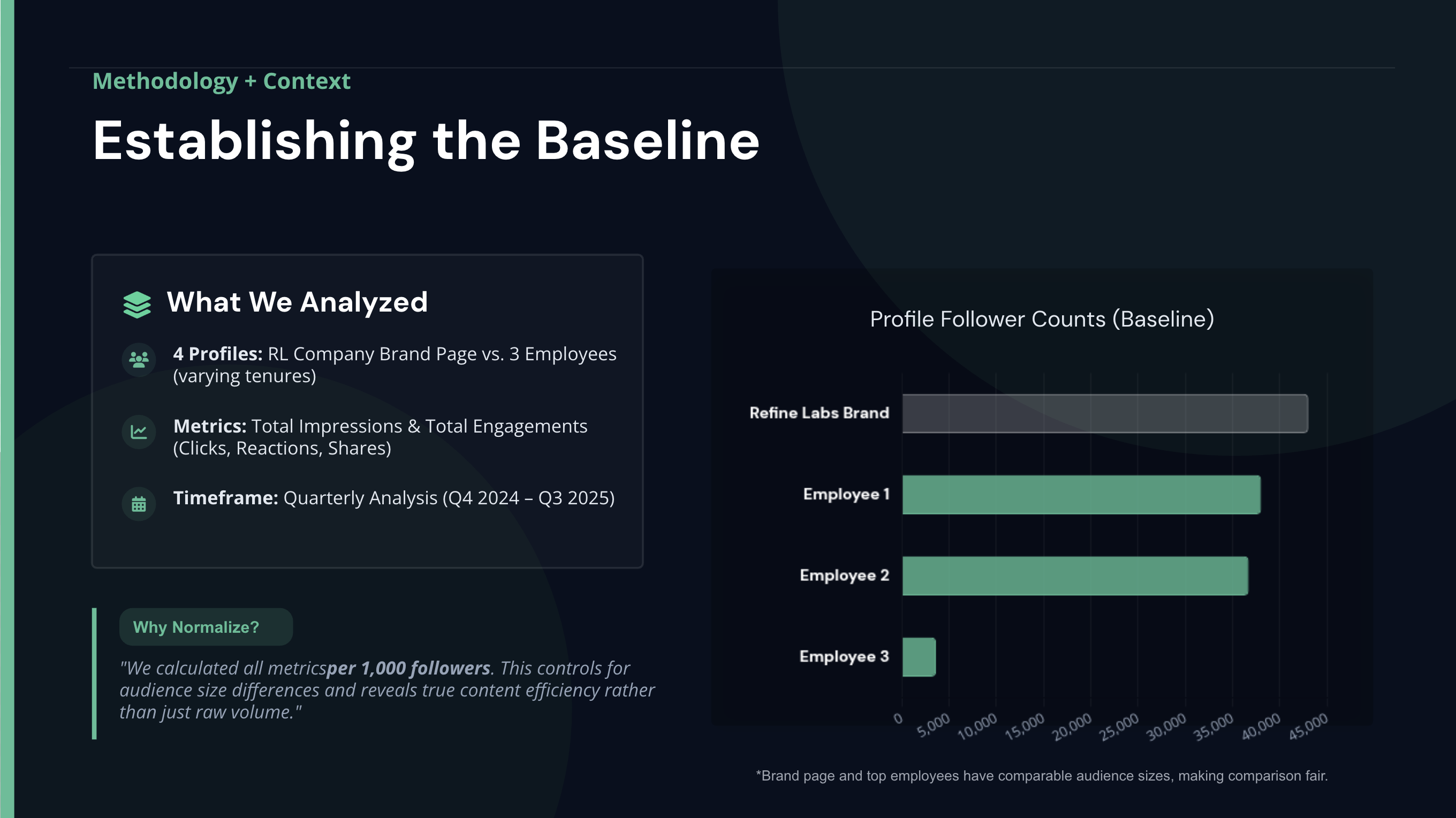
Before comparing performance, audience size has to be established. Raw comparisons between accounts with dramatically different follower counts produce meaningless results - of course an account with 40,000 followers generates more impressions than one with 5,000. That's scale, not performance.
The Refine Labs brand page has approximately 43,000 followers. Two of the employee profiles analyzed sit just below that range. One is significantly smaller. This is not a comparison between a niche account and a massive brand page - the audiences are comparable enough to make the analysis legitimate.
Once that baseline was established, we moved to the core methodology.
Most teams look at total impressions and stop there. On the surface, employee profiles often generate strong total reach. But raw totals don't answer the important question: how efficiently is each profile generating distribution relative to its audience size?
Someone with 40,000 followers should produce more impressions than someone with 5,000. That's not insight - that's the scale. To make the comparison meaningful, we calculated impressions per 1,000 followers across every profile and every month in the dataset.
Now we're measuring distribution efficiency, not size. That one change made the results much harder to dismiss.
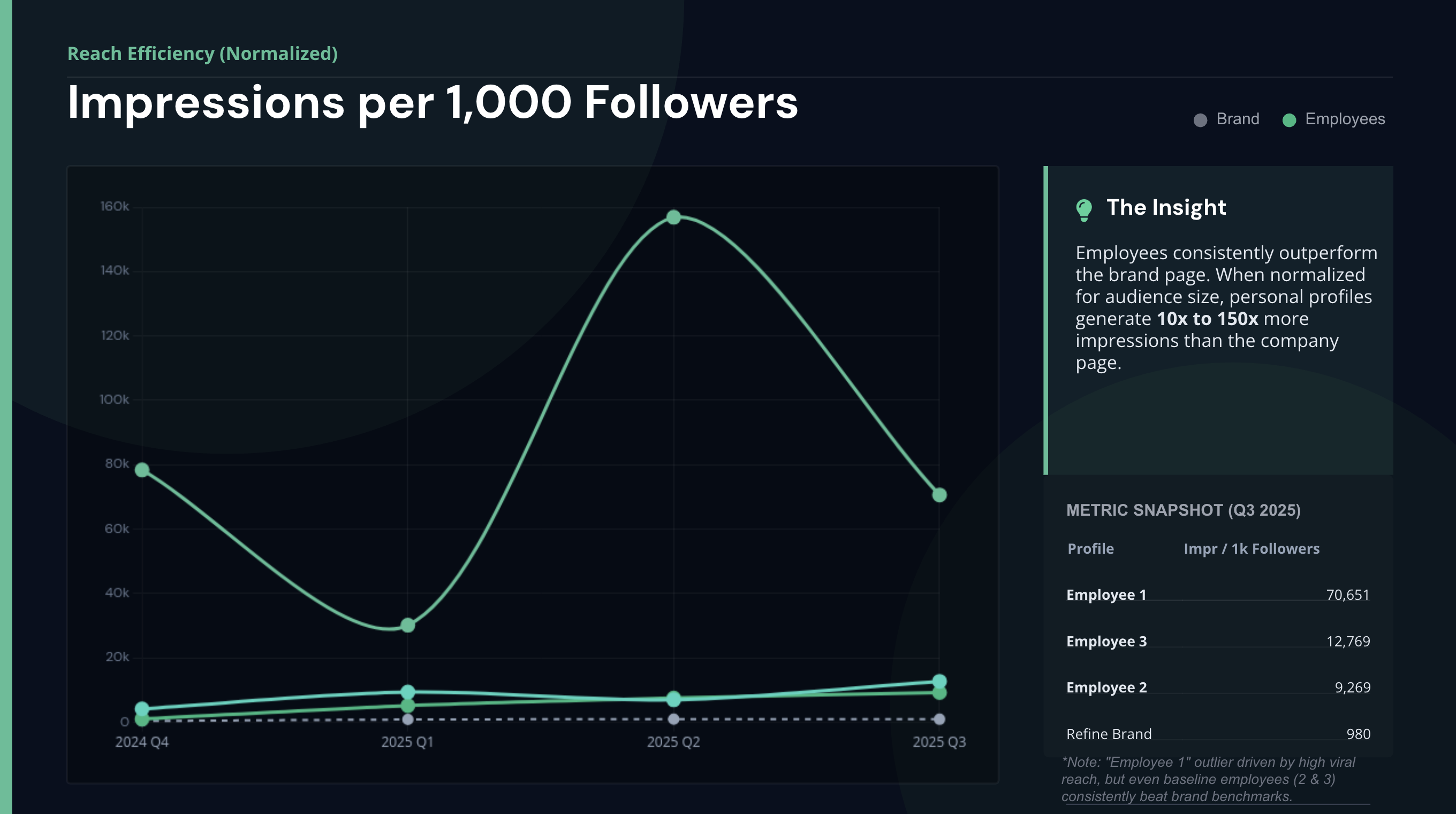
Even removing the highest-performing employee from the comparison, personal profiles consistently outperformed the brand page by a wide margin. This wasn't an isolated quarter. The relative gap appeared across multiple periods. That suggests something structural, not something caused by one exceptional post or one strong month.
LinkedIn distributes content from people more efficiently than content from company pages, even when audience size is comparable.
Impressions show distribution. Engagement shows intent. We applied the same normalization logic to engagements - total engagements ÷ follower count × 1,000 - across the same profiles and time period.
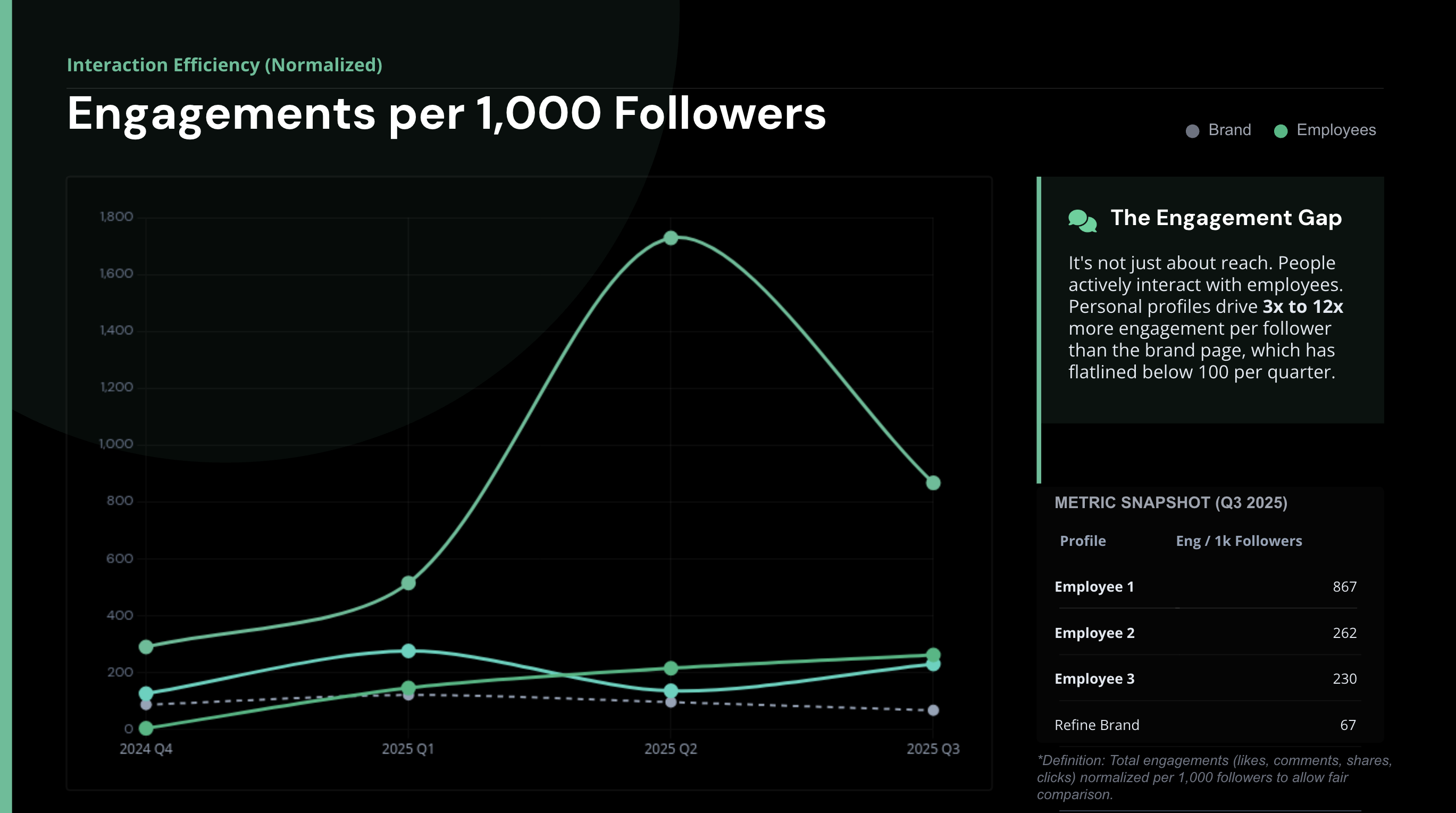
The engagement gap is even more pronounced than the impression gap. This matters because engagement is a proxy for trust. Audiences are not only seeing employee content more frequently, they are choosing to interact with it more frequently.
That distinction is important. Distribution can be gamed. Trust cannot. And trust is what compounds over time.
One viral post can distort quarterly data. So we analyzed performance monthly across 10 consecutive months to check whether the relative advantage was real or a function of outlier content.
The answer: yes, there are spikes. LinkedIn performance is inherently volatile. But the relative advantage of employee profiles over the brand page persists across months. The gap narrows and widens depending on content quality and posting cadence but the hierarchy remains consistent.
This is not a one-time anomaly. It is a structural platform dynamic that shows up repeatedly in the data.

LinkedIn is architected for person-to-person interaction. That design decision directly influences how content gets distributed in the feed. The platform rewards individual voices more generously than brand accounts and the normalized data makes that bias measurable rather than anecdotal.
Company pages still serve an important role. They anchor employer brand, support paid distribution, provide social proof, and house content in a central location. But organic feed dynamics favor individuals. When impressions and engagement are normalized per 1,000 followers, the platform's structural preference becomes visible in the numbers.
This is not a content strategy problem. It is a platform mechanics reality that content strategy has to account for.
Many companies interpret employee advocacy as a soft initiative. Encourage leaders to post. Share company updates occasionally. Hope something lands. That approach consistently underestimates the opportunity and the data makes clear why.
If employee profiles are structurally more efficient at generating reach and engagement, then advocacy has to be treated as a distribution system with the same rigor applied to any other channel. That means measuring it, enabling it, and building repeatable infrastructure around it.
This is not about forcing every employee to post daily. It is about identifying leverage points and measuring them with the same rigor applied to paid media or pipeline programs.
The long-term implication is not just increased impressions, it is defensibility. An employee's audience, voice, and engagement history compound over time in a way that a brand page simply cannot replicate.
Brand pages can be built quickly. A competitor can stand up a company LinkedIn presence in a week. Trust in a human voice cannot be manufactured or purchased. It accumulates through consistent, credible content over months and years.
When employee advocacy is supported intentionally with the right framework, the right voices, and the right measurement it becomes a distribution asset that grows more valuable the longer it runs. Competitors cannot easily copy that. That is what makes it durable.
From a Brand → Demand → Expand perspective, employee advocacy is not a side tactic or a culture initiative. It is a core distribution mechanism that strengthens every stage of how a B2B company grows.
The conversations that result from consistent employee content rarely begin with "I saw your company page." They begin with "I've been following your posts." That difference between brand recognition and personal trust is what makes employee advocacy structurally different from every other LinkedIn tactic.
A few years ago we published the original study showing that personal LinkedIn profiles outperformed the company page by a wide margin five times more engagement at the headline level. The number got attention. But the pushback was predictable.
Some said the follower counts weren't equal. Others assumed that normalizing the data would shrink the advantage. A few believed the algorithm would eventually level the playing field and favor brand pages more over time.
So we went back and ran it again. This time we normalized everything. Impressions per 1,000 followers, engagement per 1,000 followers, quarter by quarter, month by month across 10 consecutive months.The gap didn't close. In several periods it expanded.
That removes the easy excuse. It is not just about scale. It is not just about raw follower count. It is about how the platform distributes content and how people choose to engage. LinkedIn consistently rewards people over logos and that structural reality shows up in normalized data the same way it shows up in raw totals.
Company pages are not irrelevant. They anchor your brand presence, house your content, create credibility when someone checks you out, and support paid amplification. They serve a role.
But they are not your primary organic growth engine on LinkedIn. People are.
If your LinkedIn strategy is concentrated almost entirely on your company page, you are likely underutilizing your real distribution advantage. The data is consistent across quarters, across profiles, and across normalization methods.
Employee advocacy is not a branding exercise. It is a distribution system. Treat it like one.
Refine Labs is the leading B2B demand generation agency that has helped over 300+ B2B companies accelerate revenue growth and improve marketing ROI with innovative marketing strategies.
Learn more at www.refinelabs.com. Connect with us on LinkedIn and YouTube.
Listen to our Podcast with weekly episodes Stacking Growth.
Keep reading