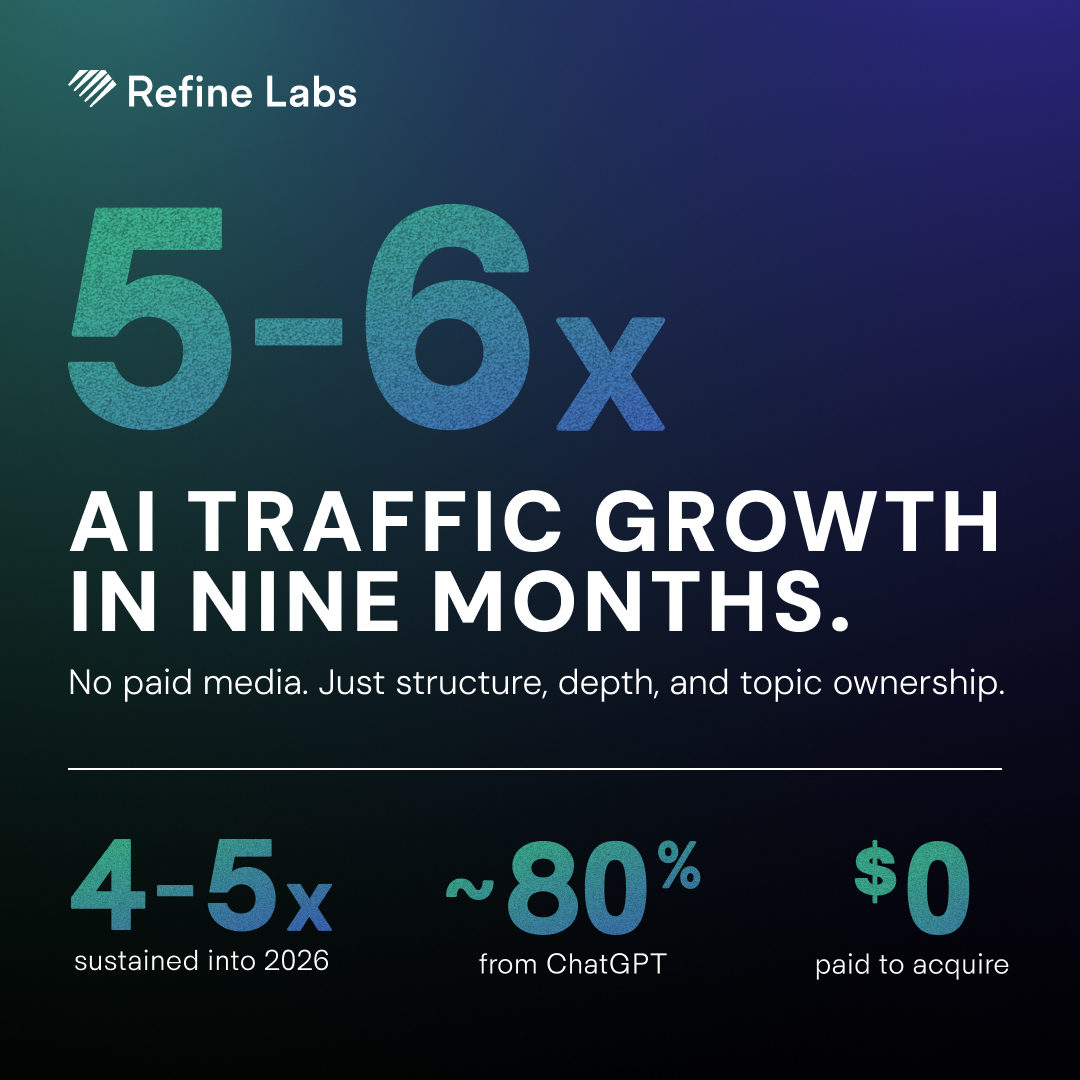
How Refine Labs grew AI-referred website traffic 5–6x in 9 months with zero paid spend—the content structure and technical signals that worked.

Evan Hughes
At the start of 2025, we had what most B2B marketing teams have: a decent content library, reasonable search rankings, and essentially zero traffic from AI tools. ChatGPT, Perplexity, Gemini - they were crawling our site, but not surfacing it. We showed up in neither the citations nor the answers.
That changed in April. Not because of an algorithm update. Not because we got lucky. Because we made a deliberate decision to change how we write - specifically, to write the way language models retrieve, not the way search engines rank.
Nine months later, the chart looks completely different. This post walks through exactly what we did, quarter by quarter, and what the data says about what worked.
Here's what AI-referred sessions looked like across the full period. Every bar is one month. The green is ChatGPT. The rest are Perplexity, Gemini, Claude, Copilot, and OpenAI direct.
The April inflection is not subtle. Before that point - three full months of essentially flat activity. After it, a consistent upward trend that compounds through the rest of the year and peaks in December at approximately 5-6× the January baseline. Importantly, January and February 2026 are still running at 4-5× baseline. This isn't a spike that collapsed. It's a new floor.
January through March weren't failures - they were baseline. The bars in the chart for those months are barely visible. ChatGPT was sending occasional sessions. Perplexity even less. Gemini essentially nothing. Month-over-month, there was no meaningful growth in any direction.
What this told us: we were not a source LLMs were choosing to cite. Our content was crawlable. It existed. It wasn't bad. But it wasn't structured the way language models retrieve information and that gap was the whole problem.
April is where the work started. The first thing we changed wasn't what we wrote - it was how we thought about why we were writing it.
Traditional SEO is about signals: keyword density, backlinks, domain authority, crawl budget. All of those still matter. But LLM discovery works on a different logic. A language model isn't ranking pages - it's deciding what to cite. It's looking for content that is structurally clear, topically authoritative, and easy to extract a precise answer from.
Once you see that distinction, the content changes you need to make become obvious.
Q2 proved the thesis. Q3 was execution at scale. We shifted from rewriting existing pages to publishing new assets built specifically for LLM retrieval. The goal was to become the definitive reference on specific topics within our space - the source an AI would reach for when someone asked a relevant question.
We published a series of long-form deep dives. Not blog posts - reference documents. Each one structured like a comprehensive guide rather than a thought leadership piece.
Q4 is where compounding becomes visible. The cornerstone content from Q2 and Q3 had been indexed, cited, and reinforced. New content published in Q4 picked up traction faster because we already had established authority in these topic clusters. Each new piece benefited from the infrastructure we'd built over the previous six months.
There are a few things we'd flag as genuinely explanatory versus coincidental.
Topic ownership compounds. The biggest driver wasn't any single piece - it was the cluster effect. Once we had three or four deeply structured pages on Brand, Demand, and Expand, new content in those areas picked up traction faster. LLMs have a model of what topics different sources are authoritative on. Once you're established in that model, staying there is easier than getting there.
Structure is a feature. The single highest-leverage change we made was treating H-tags as answer containers rather than navigational labels. Every H2 should be able to stand alone as a question and its section as the answer. This one change likely drove more LLM citations than any other tactical edit we made.
Depth beats volume. We published fewer pieces but made each one comprehensive. A 2,500-word deep dive consistently outperforms five 500-word takes on the same topic for LLM citation purposes. The publishing cadence slowed - the citation rate increased.
Technical structure multiplies content quality. All the content work in the world gets discounted if page structure is messy. Clean URLs, proper H-tag hierarchy, logical internal linking - these determine whether LLMs can correctly attribute content to your domain.
This started as a hypothesis in April 2025: if we write content the way language models want to retrieve it, they'll cite us more. The data confirmed it. But the more useful takeaway is that this playbook is not exotic or out of reach. It doesn't require a massive budget, a specialized team, or technical knowledge most marketing organizations don't have.
It requires clarity of thought, consistency of execution, and patience to let the compounding happen. We built the infrastructure over 9 months. The chart reflects that.
If you're running content for a B2B company and AI referral traffic is still flat, the gap is almost certainly structural - not creative. The question is whether an LLM can find a clear answer in your content and attribute it to you with confidence. Most sites can't pass that test yet.
Refine Labs is the leading B2B demand generation agency that has helped over 300+ B2B companies accelerate revenue growth and improve marketing ROI with innovative marketing strategies.
Learn more at www.refinelabs.com. Connect with us on LinkedIn and YouTube.
Listen to our Podcast with weekly episodes Stacking Growth.
Keep reading